
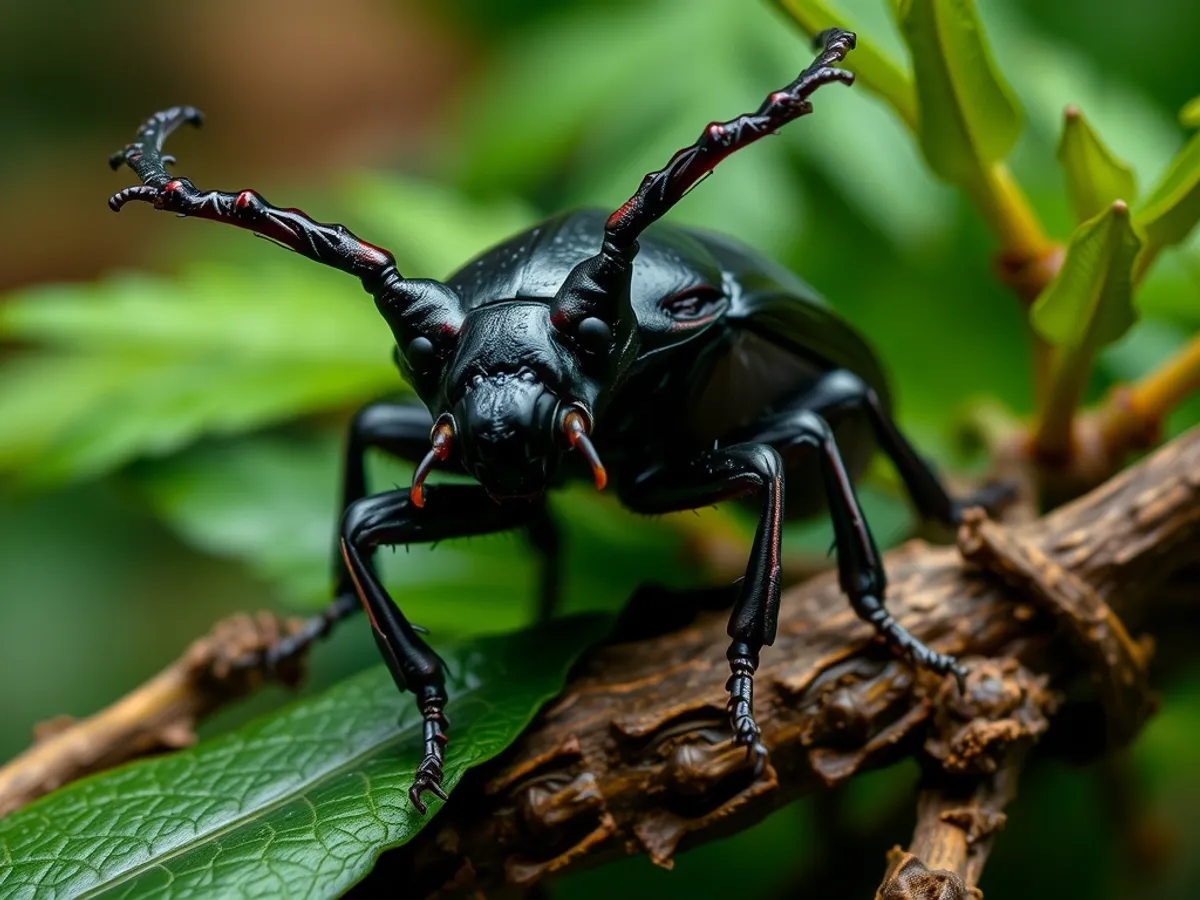
About the Hercules Beetle
Dynastes hercules of Central and South American rainforest is the longest beetle in the world, with exceptional males reaching about 17 cm - but more than half of that is horn. The male carries an enormous forward-projecting thoracic horn opposed by a smaller horn on the head, and the two work as a pair of pincers: rivals wedge each other, lift, and try to slam the opponent off a branch or crush his elytra. Horn length is condition-dependent, driven by how well the larva fed, so it honestly signals nutrition and males vary from hornless "minors" to giants. The larval stage is where most of the animal's life happens: grubs spend a year or two chewing through rotting logs and can reach 100 g, well over the adult's mass, which is why the beetle needs old, undisturbed deadwood. The famous claim that Hercules beetles lift 850 times their own weight is a lab artefact from a single crude experiment and is wildly overstated; careful measurements put the real capacity at a still-impressive but far lower multiple. The elytra of a healthy male are olive-yellow with black spots, and they change colour with humidity: a spongy layer beneath the surface fills with water at high humidity, turning the shell black, and dries back to yellow.
Fascinating facts
Super Strength
The Hercules beetle is considered one of the strongest animals on Earth relative to its size, able to lift up to 850 times its own weight.
Impressive Horns
Only male Hercules beetles have the characteristic long, horn-like structures, which they use in combat with other males over territory and mates.
Color Changing Shell
Their elytra (wing covers) can shift from olive green to black depending on humidity, a result of structural coloration.
Detailed description
The Hercules beetle (Dynastes hercules) is a remarkable member of the Scarabaeidae family, notable for being the longest extant beetle species, with males reaching up to 17 cm (6.7 in) in length, including their characteristic horns. The male's anatomy is dominated by a prominent, forward-projecting thoracic horn and a shorter cephalic horn, which together form a pincer-like structure used in combat with rival males. Females lack these horns and are generally smaller, exhibiting sexual dimorphism. The exoskeleton is exceptionally robust, with coloration ranging from olive-green to yellowish, often overlaid with black mottling; the hue can shift in response to humidity due to the structure of the cuticle. The beetle's elytra (wing covers) are smooth and glossy, protecting the delicate hindwings used for flight. Hercules beetles are primarily nocturnal, spending daylight hours hidden in leaf litter or decaying wood. Their life cycle is dominated by a lengthy larval stage, which can last up to two years, during which the larvae feed voraciously on rotting wood and organic matter. Adults are relatively short-lived, surviving only three to six months, and feed mainly on overripe fruit and sap. The species exhibits solitary behavior, except during mating periods, and is adapted to the humid, dense environments of neotropical rainforests.
Did you know?
The Hercules beetle has the longest body length of any living beetle species, with some males reaching up to 17 centimeters including their horns.
Research & sources
Wikipedia summary
The Hercules beetle is a species of rhinoceros beetle native to the rainforests of southern Mexico, Central America, South America, and the Lesser Antilles. It is the longest extant species of beetle in the world, and is also one of the largest flying insects in the world.
Behaviour & social structure
Hercules beetles are largely solitary and exhibit crepuscular to nocturnal activity patterns, becoming most active during the humid nights of the wet season. Males are known for their aggressive territoriality during the breeding season, engaging in ritualized combat using their horns to dislodge rivals from branches or logs, a behavior that determines access to receptive females. Feeding behavior in adults is opportunistic; they are attracted to fermenting fruit, tree sap, and occasionally nectar, using their strong mandibles to access food sources. Larvae are detritivores, playing a crucial role in nutrient cycling by breaking down decaying wood. Adults are capable of flight, though their large size makes them somewhat clumsy flyers, and they tend to travel short distances. Defensive behaviors include burrowing into substrate or feigning death when threatened. Communication is primarily chemical, with pheromones playing a key role in mate attraction.
Reproduction & life cycle
Reproduction in Dynastes hercules is seasonal, typically coinciding with the onset of the rainy season when humidity is high. Males compete for access to females through horn wrestling, with the victor gaining mating rights. After copulation, females lay clutches of 50–100 eggs in decaying wood or leaf litter. The eggs incubate for 1–2 months before hatching into larvae. The larval stage is the longest, lasting 12–24 months, during which the grubs undergo three instars and can reach lengths of up to 11 cm (4.3 in). Pupation occurs within a self-constructed chamber in the substrate and lasts 1–3 months. There is no parental care post-oviposition; larvae are independent from hatching. Adults emerge synchronously with seasonal rains, maximizing reproductive opportunities.
Adaptations & survival
Hercules beetles possess several notable adaptations. The male's horns are a classic example of sexual selection, evolved for intraspecific combat and mate competition. The exoskeleton's color-changing ability, due to humidity-sensitive microstructures, may provide camouflage or aid in thermoregulation. Their robust mandibles and digestive enzymes are adapted for breaking down tough, lignin-rich decaying wood as larvae. The adult's strong, spiny legs facilitate climbing on slippery, mossy surfaces in rainforest environments. Their large body size and thick cuticle offer protection from many predators, while nocturnal habits reduce exposure to diurnal predators. The ability to fly, despite their size, allows them to disperse and locate mates or new feeding sites.
Cultural significance
The Hercules beetle holds a prominent place in the folklore and culture of Central and South America, often symbolizing strength and endurance due to its size and impressive horns. In some indigenous traditions, the beetle is associated with the spirit world or used as a talisman. In modern times, it is a popular subject in entomological collections and educational exhibits, and features in media, toys, and video games, particularly in Japan where beetle fighting is a hobby. Its unique appearance has inspired art and jewelry, and it is sometimes kept as a pet by insect enthusiasts.
Recent research
Recent research has focused on the biomechanics of the Hercules beetle's horns, revealing that their structure is optimized for strength and leverage during combat. Studies on the cuticle's humidity-dependent color change have implications for biomimetic materials. Genetic analyses have clarified the relationships among Dynastes subspecies, with ongoing debate about the taxonomic status of several island forms. Ecological studies highlight the beetle's role in nutrient cycling and forest decomposition processes. Conservation research is increasingly monitoring the impact of habitat fragmentation and the pet trade on population genetics and viability.
Videos
Habitat
Tropical rainforest


Conservation
The Hercules Beetle is currently classified as Least Concern on the IUCN Red List.
Threats & challenges
Although currently listed as Least Concern by the IUCN, Hercules beetles face several localized threats. Habitat loss due to deforestation and conversion of rainforest to agriculture is the primary challenge, reducing available breeding and feeding sites. Collection for the exotic pet trade and for ornamental purposes (due to their impressive size and horns) can impact local populations. Climate change poses a long-term threat by altering the humidity and temperature regimes critical for their development. Natural predators include birds, mammals, and parasitic wasps that target larvae. Despite these pressures, the species remains widespread, but continued habitat degradation could lead to future declines.
Taxonomy
Scientific name
Dynastes hercules
- Kingdom
- Animalia
- Phylum
- Arthropoda
- Class
- Insecta
- Order
- Coleoptera
- Family
- Scarabaeidae
- Genus
- Dynastes
- Species
- hercules
Community notes
Share your observations about the Hercules Beetle.
No community notes yet. Be the first!
Discover more wildlife
More fascinating animals from the encyclopedia.