
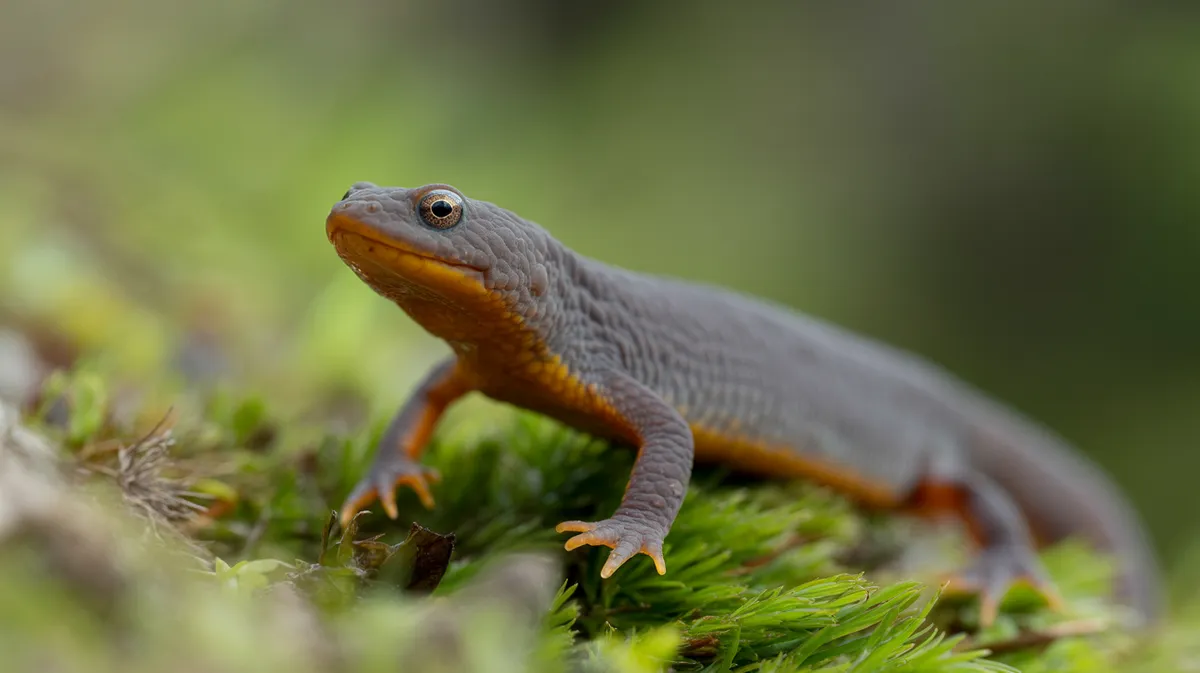
About the Himalayan Newt
The Himalayan Newt, also known as the crocodile newt or warty newt, is a medium-sized amphibian recognized for its rough, warty skin and striking orange markings along its tail and limbs. It inhabits moist forested regions and montane streams in the eastern Himalayas and parts of Southeast Asia. The species is primarily nocturnal and spends much of its life hidden under rocks or leaf litter, emerging during the rainy season to breed in water bodies. Its unique appearance and secretive behavior make it a fascinating yet rarely seen animal in its natural habitat.
Fascinating facts
Warty Skin
The Himalayan Newt's skin is rough and covered in wart-like bumps, which help secrete toxins as a defense mechanism.
Rainy Season Breeder
This newt emerges from hiding to breed only during the monsoon season, laying eggs in shallow, slow-moving streams.
High-Altitude Adaptation
It is well-adapted to life in elevations up to 2,500 meters, surviving cooler temperatures than many other amphibians.
Detailed description
The Himalayan Newt (Tylototriton verrucosus) is a robust, medium-sized salamander reaching lengths of 14–20 cm, with females typically larger than males. Its body is characterized by a rough, granular skin texture, covered in prominent warty tubercles, especially along the dorsolateral ridges, which secrete toxins as a defense mechanism. The coloration is generally dark brown to black, contrasted by vivid orange or reddish markings along the parotoid glands, tail, limbs, and sometimes the ventral surface, serving as aposematic signals to potential predators. The head is broad and flattened, with a blunt snout and small, lidless eyes adapted for nocturnal activity. Limbs are sturdy and well-developed, aiding in terrestrial locomotion, while the laterally compressed tail facilitates swimming during the breeding season. Tylototriton verrucosus is primarily terrestrial outside the breeding season, inhabiting moist leaf litter, under logs, and stones in montane forests at elevations of 1,000–2,500 meters. It is a secretive species, emerging mostly at night or during heavy rainfall. The species exhibits a slow, deliberate gait and is known for its ability to remain motionless when threatened, relying on its cryptic coloration and toxic skin secretions for protection. Its lungs are well-developed, but cutaneous respiration remains important, especially in humid environments.
Did you know?
Despite living in cold, high-altitude regions, Himalayan Newts can survive brief periods of freezing temperatures thanks to their ability to enter a state of dormancy.
Research & sources
Wikipedia summary
Tylototriton verrucosus is a species of newt found in the Indian subcontinent and Southeast Asia. Common names include: Himalayan newt, crocodile newt, crocodile salamander, Himalayan salamander, red knobby newt.
Behaviour & social structure
The Himalayan Newt is predominantly nocturnal, spending daylight hours concealed beneath rocks, logs, or dense vegetation to avoid desiccation and predation. It is a solitary animal outside the breeding season, with individuals maintaining small home ranges. Feeding occurs mostly at night, targeting a variety of invertebrates such as earthworms, insects, mollusks, and occasionally small amphibians. Prey is located using a keen sense of smell and is captured with a rapid strike of the head. During the breeding season, individuals become more aquatic, congregating in temporary pools or slow-moving streams. Agonistic interactions are rare but may occur between males competing for mates. The species exhibits site fidelity, often returning to the same breeding sites annually. When threatened, the newt may arch its body and elevate its tail, displaying its bright warning colors and exuding a milky toxin from its skin glands.
Reproduction & life cycle
Breeding in Tylototriton verrucosus is closely tied to the monsoon season, typically from June to August, when increased rainfall creates suitable aquatic habitats. Males arrive at breeding sites first and engage in courtship displays, including tail undulations and body arching to attract females. Fertilization is internal; the male deposits a spermatophore, which the female picks up with her cloaca. Females lay 30–60 eggs, attaching them singly or in small clusters to submerged vegetation or debris. The eggs are gelatinous and measure about 3–4 mm in diameter. Embryonic development takes 3–4 weeks, depending on water temperature. Larvae are aquatic, possessing external gills and a finned tail, and feed on small aquatic invertebrates. Metamorphosis into terrestrial juveniles occurs after 3–5 months. There is no parental care post-oviposition, and juveniles disperse into surrounding terrestrial habitats upon metamorphosis.
Adaptations & survival
Tylototriton verrucosus exhibits several adaptations for survival in montane environments. Its warty skin is laced with poison glands that secrete tetrodotoxin-like compounds, deterring predators such as birds, snakes, and mammals. The bright orange coloration serves as a warning (aposematism) of its toxicity. The species' ability to absorb water and oxygen through its skin allows it to thrive in humid, oxygen-poor environments. Behavioral adaptations include nocturnality and a preference for microhabitats with stable moisture and temperature, reducing the risk of desiccation. Its reproductive cycle is synchronized with the monsoon, ensuring larval development in temporary pools with reduced predation pressure. The newt's slow metabolism and ability to enter periods of torpor during adverse conditions further enhance its survival in variable montane climates.
Cultural significance
In some regions, the Himalayan Newt is associated with local folklore and is believed to possess medicinal properties, leading to its use in traditional remedies for skin ailments and as a general tonic. Its striking appearance has made it a subject of fascination and superstition, sometimes being regarded as an omen of rain or good fortune. In India, the species is protected under national wildlife laws, and its presence is considered an indicator of healthy montane ecosystems. However, lack of awareness and continued demand in the exotic pet trade pose ongoing challenges to its conservation.
Recent research
Recent studies have focused on the phylogenetic relationships within the genus Tylototriton, revealing significant cryptic diversity and prompting taxonomic revisions. Molecular analyses have distinguished T. verrucosus from closely related species such as T. himalayanus and T. panwaensis, clarifying its distribution and conservation needs. Ongoing research is investigating the chemical composition of its skin toxins and their potential biomedical applications. Ecological studies are examining the impacts of habitat fragmentation and climate change on population connectivity and breeding success. Conservation programs in India and Nepal are piloting habitat restoration and community-based monitoring to better protect this species. There is a recognized need for long-term population monitoring and studies on larval ecology to inform management strategies.
Videos
Habitat
Montane forests and freshwater streams
 Elevated Terrain
Mountain
High-altitude environments with varying climates and specialized wildlife adapted to rugged terrain and thin air.
 Global
Forest
Wooded areas with significant tree cover and diverse plant and animal communities.
 Global
Freshwater
Lakes, rivers, and wetlands with diverse aquatic ecosystems.
Conservation
The Himalayan Newt is currently classified as Near Threatened on the IUCN Red List.
Threats & challenges
The Himalayan Newt faces several threats, including habitat loss due to deforestation, agricultural expansion, and infrastructure development in montane regions. Collection for the pet trade and traditional medicine, particularly in parts of China and Southeast Asia, has contributed to local population declines. Pollution of breeding sites from pesticides and other agrochemicals poses additional risks to eggs and larvae. Climate change, resulting in altered rainfall patterns and increased frequency of droughts, threatens the availability of suitable breeding habitats. Road mortality and fragmentation of populations are emerging concerns as human encroachment increases. The IUCN currently lists the species as Near Threatened, with population trends believed to be decreasing, though comprehensive surveys are lacking in many parts of its range.
Taxonomy
Scientific name
Tylototriton verrucosus
- Kingdom
- Animalia
- Phylum
- Chordata
- Class
- Amphibia
- Order
- Caudata
- Family
- Salamandridae
- Genus
- Tylototriton
- Species
- verrucosus
Community notes
Share your observations about the Himalayan Newt.
No community notes yet. Be the first!
Discover more wildlife
More fascinating animals from the encyclopedia.