
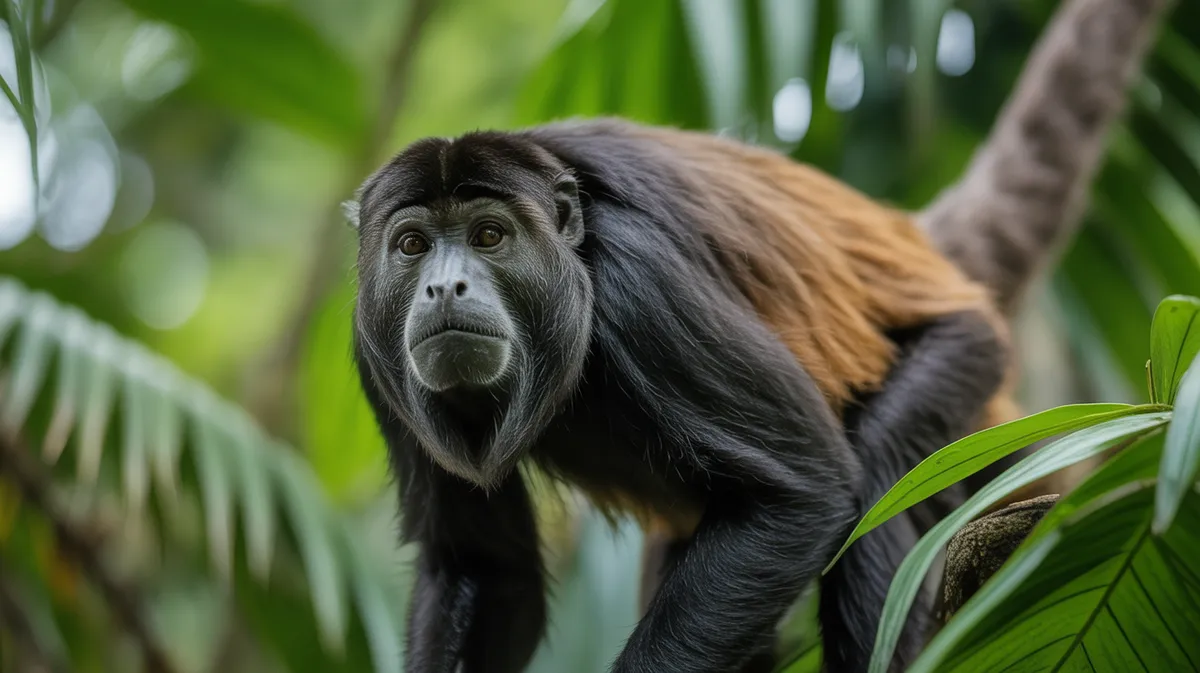
About the Howler Monkey
The howler monkey is the loudest land animal in the Americas and among the loudest anywhere, and its call — a rolling, guttural roar that sounds far too large for the animal producing it — can carry several kilometres through dense forest. The instrument is anatomical: the hyoid bone in the throat, which in most mammals is a modest anchor for the tongue, is enormously enlarged into a hollow shell that works as a resonating chamber. There is a real cost. In howler species the size of the hyoid trades off directly against the size of the testes: males with the biggest resonating chambers and the loudest voices have the smallest testes, and vice versa, which appears to reflect two different reproductive strategies — dominate the acoustic space and hold a group, or invest in sperm competition. It eats mostly leaves, which are hard to digest and provide very little energy, and it spends most of its day doing exactly what you would expect of an animal on that diet: resting.
Fascinating facts
Loudest Primate
Howler monkeys produce vocalizations that are among the loudest of any land animal, thanks to a specialized hyoid bone.
Tree Dwellers
They are strictly arboreal, rarely coming to the ground, and use their prehensile tails as a fifth limb to grasp branches.
Leaf Eaters
Their diet consists mostly of leaves, which are difficult to digest, so they spend much of their time resting to conserve energy.
Detailed description
Howler monkeys (genus Alouatta) are among the largest New World monkeys, with adult males ranging from 40 to 70 cm in body length and weighing 6–10 kg, while females are slightly smaller. Their most distinctive anatomical feature is an enlarged hyoid bone in the throat, which forms a resonating chamber allowing their iconic vocalizations to carry over several kilometers. Their dense, often shaggy fur varies in color from black and brown to reddish, depending on the species. Howler monkeys possess prehensile tails, often as long as their bodies (up to 75 cm), with a tactile pad on the underside of the tip for grasping branches, providing remarkable arboreal agility. They have a robust, stocky build, with strong limbs adapted for climbing and suspending their bodies while feeding or moving through the canopy. Socially, howler monkeys live in cohesive groups typically consisting of 6–15 individuals, structured around multiple adult males and females with their offspring. Their diet is primarily folivorous, focusing on mature and young leaves, but they also consume fruits, flowers, and occasionally nuts, making them important agents of seed dispersal. Howler monkeys are diurnal and spend a significant portion of the day resting to aid digestion of their fibrous diet. Reproduction is characterized by slow rates, with females giving birth to a single infant after a gestation period of about 180 days. Their vocalizations serve both to maintain group cohesion and to defend territory, reducing the need for physical confrontations with neighboring troops.
Did you know?
Howler monkeys are considered the loudest land animals in the Americas and their calls can travel up to 5 km (3 miles) through dense rainforest.
Research & sources
Wikipedia summary
Howler monkeys are the most widespread primate genus in the Neotropics and are among the largest of the platyrrhines along with the muriquis (Brachyteles), the spider monkeys (Ateles) and woolly monkeys (Lagotrix). The monkeys are native to South and Central American forests. They are famous for their loud howls, which can be heard up to three miles away through dense rain forest. Fifteen species are recognized. Previously classified in the family Cebidae, they are now placed in the family Atelidae. They are primarily folivores but also significant frugivores, acting as seed dispersal agents through their digestive system and their locomotion. Threats include human predation, habitat destruction, illegal wildlife trade, and capture for pets or zoo animals.
Behaviour & social structure
Howler monkeys are primarily arboreal and rarely descend to the ground, spending most of their lives in the upper and middle canopy layers. Their daily routine consists of long periods of resting (up to 70% of the day), interspersed with foraging bouts in the early morning and late afternoon. Feeding is a slow process, as they carefully select leaves with lower tannin and fiber content to maximize digestibility. Social interactions within groups are generally peaceful, with grooming and close contact reinforcing bonds, though competition for food or mates can lead to brief aggressive encounters. Vocal communication is highly developed; dawn and dusk are marked by coordinated group howling, which establishes territory boundaries and deters rival groups. Howler monkeys are not hunters; their foraging is methodical, and they may travel several hundred meters daily in search of preferred food sources. Dominance hierarchies exist, particularly among males, but are less rigid than in some other primate species.
Reproduction & life cycle
Howler monkeys are polygynous, with both males and females mating with multiple partners within the group. Breeding can occur year-round, but in some regions, births peak during the rainy season when food is more abundant. The gestation period averages 180–194 days, after which a single infant is born. Newborns cling to their mother's belly for the first few weeks, later riding on her back as they grow. Maternal care is extensive, with mothers nursing and protecting their young for up to 18 months. Other females in the group may assist in caring for infants, a behavior known as alloparenting. Sexual maturity is reached at about 3–4 years for females and 4–5 years for males. Interbirth intervals are typically two years or more, reflecting the species' slow reproductive rate.
Adaptations & survival
Howler monkeys exhibit several specialized adaptations for their arboreal, folivorous lifestyle. The enlarged hyoid bone and associated vocal apparatus enable their far-reaching howls, which are crucial for territory defense and group cohesion. Their prehensile tail acts as a fifth limb, allowing them to grasp branches securely and forage efficiently in the canopy. Dental adaptations include large, shearing molars for processing tough leaves, and a large, multi-chambered stomach with symbiotic gut bacteria to ferment and digest cellulose. Behaviorally, their low-energy lifestyle and extended resting periods are adaptations to a diet low in readily available calories. Their cryptic coloration and cautious movement help avoid predation by raptors and large cats.
Cultural significance
Howler monkeys hold significant roles in the mythology and folklore of indigenous peoples throughout Central and South America. In Maya mythology, they are associated with the arts and are depicted as scribes and musicians. Their haunting calls have inspired local legends, often symbolizing the spirit of the forest or serving as omens. In some regions, howler monkeys are hunted for food or used in traditional medicine, though such practices are declining. Their presence in ecotourism and wildlife documentaries has increased public awareness of their ecological importance and conservation needs.
Recent research
Recent research has focused on the acoustic properties of howler monkey vocalizations, revealing that the frequency and amplitude of their howls are influenced by group size, habitat density, and social context. Genetic studies have clarified the relationships among the 15 recognized species, with evidence of hybridization in areas where ranges overlap. Long-term field studies have documented the effects of habitat fragmentation on group dynamics, reproductive success, and health. Ongoing research is investigating the gut microbiome of howler monkeys to understand their adaptation to a folivorous diet and resilience to dietary changes. Conservation genetics is being used to inform management strategies for isolated populations.
Videos
Habitat
Tropical rainforest


Conservation
The Howler Monkey is currently classified as Vulnerable on the IUCN Red List.
Threats & challenges
Howler monkeys face numerous threats, primarily from habitat loss due to deforestation for agriculture, logging, and urbanization. Fragmentation of forests isolates populations, reducing genetic diversity and increasing vulnerability to local extinction. They are also hunted for bushmeat and captured for the illegal pet trade. Disease transmission from humans and domestic animals poses an additional risk, particularly in fragmented habitats. Some species, such as the Yucatán black howler (Alouatta pigra), are classified as Endangered due to rapid population declines. Climate change, leading to altered rainfall patterns and food availability, further exacerbates these challenges. Conservation efforts focus on habitat protection, reforestation, and the creation of biological corridors to connect isolated populations.
Taxonomy
Scientific name
Alouatta spp.
- Kingdom
- Animalia
- Phylum
- Chordata
- Class
- Mammalia
- Order
- Primates
- Family
- Atelidae
- Genus
- Alouatta
- Species
- spp.
Community notes
Share your observations about the Howler Monkey.
No community notes yet. Be the first!
Discover more wildlife
More fascinating animals from the encyclopedia.