
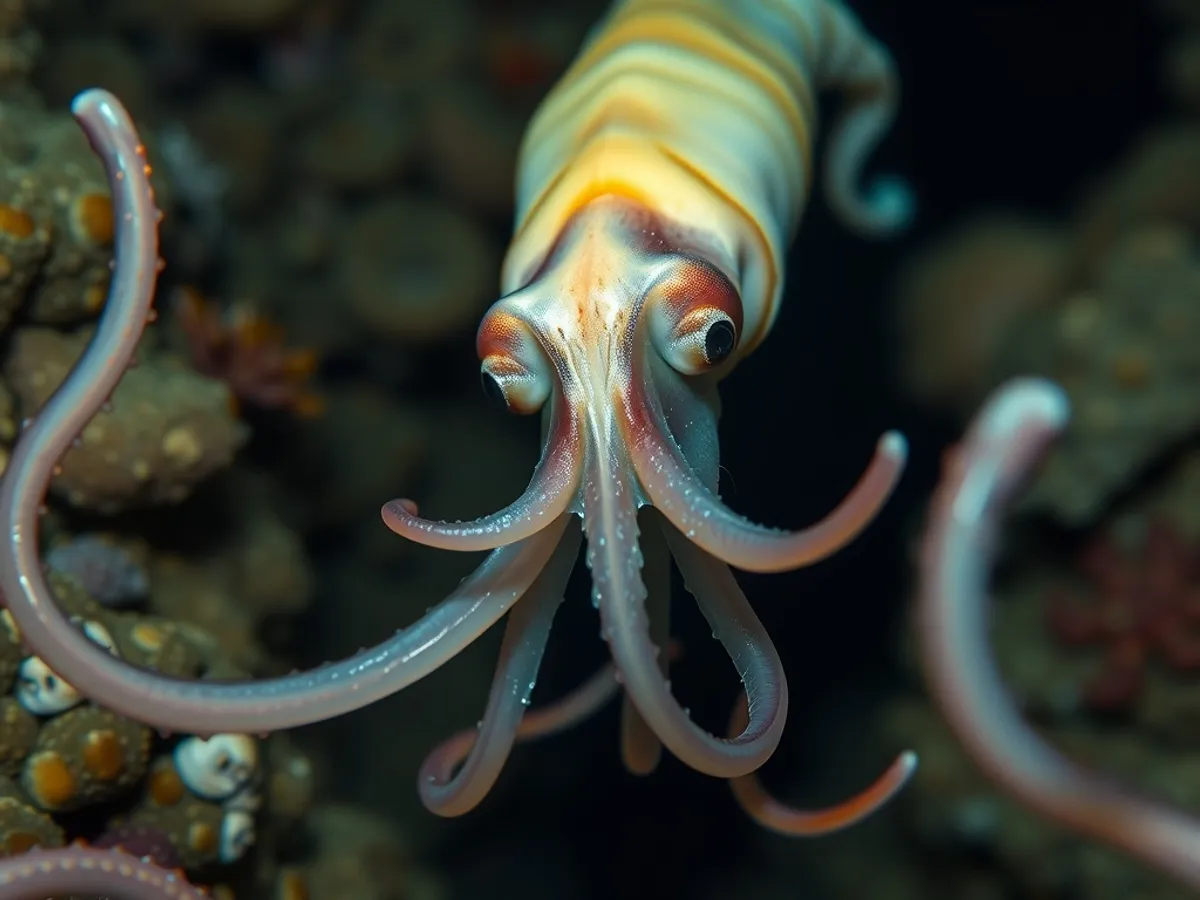
About the Humboldt Squid
Dosidicus gigas grows to about 1.5 m and 50 kg in the eastern Pacific's oxygen-poor Humboldt Current, and it does that in barely a year to eighteen months - a growth rate among the fastest of any animal, sustained by a metabolism that burns hard and a life cycle that ends in death after a single spawning. Chilean and Peruvian fishermen call it diablo rojo, because a hooked squid flushes from white to deep red and back, sometimes flickering rapidly, driven by chromatophores under direct nerve control. The flashing is not merely rage; researchers using bioluminescence-lit deep video have shown the squid produce structured, repeated pigmentation patterns while feeding in groups in near-total darkness, backlit by their own glowing photophores - a plausible visual signalling system used in the dark. They hunt cooperatively in shoals of hundreds, taking lanternfish, krill and each other; cannibalism is routine. Their beak is powerful and their arms carry suckers ringed with rows of sharp chitinous teeth, and they have injured divers, though the reputation as a man-eater is exaggerated. Humboldt squid tolerate the low-oxygen minimum zone by suppressing metabolism, and their range has expanded north as far as Alaska during warm-water events.
Fascinating facts
Master of Disguise
The Humboldt squid can rapidly change its skin color from deep red to white, which helps it communicate and avoid predators.
Fast Swimmer
Thanks to powerful jet propulsion, this squid can reach burst speeds of up to 24 km/h (15 mph) when chasing prey or evading threats.
Pack Hunters
Unlike many squid species, Humboldt squid hunt in coordinated groups, making them highly effective predators in the open ocean.
Detailed description
The Humboldt squid (Dosidicus gigas) is among the largest of all cephalopods, with adults typically measuring 1.0–1.5 meters in mantle length, though rare specimens may exceed 2 meters and weigh over 50 kilograms. Its robust, muscular mantle is torpedo-shaped, aiding in rapid jet propulsion, while its eight arms and two longer tentacles are lined with powerful, toothed suckers for grasping prey. The skin contains chromatophores that enable dramatic color changes, allowing the squid to flash between deep red and white in milliseconds—a behavior used for communication, camouflage, and possibly intimidation. Humboldt squid possess large, complex eyes adapted for low-light conditions in the mesopelagic zone (200–700 meters deep), where they spend much of their time. They are highly social, forming dense shoals of up to several hundred individuals, and exhibit coordinated hunting strategies, often attacking prey in groups. Their diet is diverse, including fish, crustaceans, and other cephalopods, and they are known for cannibalistic tendencies, especially during periods of food scarcity. The species is short-lived, with a lifespan of only 1–2 years, and exhibits rapid growth rates. Reproduction is semelparous: individuals spawn once and then die. Humboldt squid are ecologically significant as both predators and prey, playing a central role in the eastern Pacific marine food web.
Did you know?
The Humboldt squid is sometimes called the 'red devil' due to its aggressive behavior and the deep red color it displays when excited or threatened.
Research & sources
Wikipedia summary
The Humboldt squid, also known as jumbo squid or jumbo flying squid, is a large, predatory squid living in the eastern Pacific Ocean. It is the only known species of the genus Dosidicus of the subfamily Ommastrephinae, family Ommastrephidae.
Behaviour & social structure
Humboldt squid are primarily nocturnal, ascending to shallower waters at night to feed and descending to deeper, colder waters during the day. They are aggressive, opportunistic hunters, using their keen vision and chemosensory abilities to locate prey. Hunting often involves coordinated group attacks, with individuals communicating via rapid color changes and possibly tactile signals. Prey is captured with the tentacles and subdued using the beak and radula. Cannibalism is common, especially in high-density aggregations. Social interactions are complex, with evidence of both cooperation and competition within shoals. When threatened, Humboldt squid may exhibit rapid escape responses, ejecting ink and using jet propulsion to evade predators. Their daily routine is influenced by diel vertical migration, following prey such as lanternfish and other midwater organisms.
Reproduction & life cycle
Reproduction in Dosidicus gigas involves internal fertilization. Males transfer spermatophores to the female's mantle cavity using a specialized arm (hectocotylus). Spawning occurs year-round but peaks seasonally, varying by region—often linked to temperature and food availability. Females produce large gelatinous egg masses containing thousands to millions of eggs, which are released into the water column. Embryonic development is rapid, with hatching occurring within days to weeks, depending on water temperature. There is no parental care; larvae are planktonic and undergo several developmental stages before settling into deeper waters. The species' rapid growth and early maturation are adaptations to their short lifespan and high predation rates.
Adaptations & survival
Humboldt squid exhibit several remarkable adaptations. Their chromatophores allow for instantaneous color changes, facilitating communication, camouflage, and predator deterrence. The large, sensitive eyes are adapted for detecting faint light in deep water. Jet propulsion enables high-speed movement, both for hunting and escape. Bioluminescent organs (photophores) may play a role in counter-illumination camouflage, although their function in this species is still under study. Their beak and radula are exceptionally strong, capable of processing tough prey. Physiologically, they tolerate a wide range of temperatures and oxygen levels, allowing them to exploit hypoxic zones (oxygen minimum layers) that are inaccessible to many predators and competitors.
Cultural significance
Humboldt squid have a mixed reputation among coastal communities. In some regions, they are an important target for artisanal and commercial fisheries, providing food and economic value. Their aggressive behavior and large size have contributed to local legends and media portrayals as 'red devils.' In Peruvian and Mexican cuisine, they are commonly prepared as 'calamar gigante.' The species has also featured in documentaries and scientific outreach, highlighting its ecological importance and remarkable biology.
Recent research
Recent research has focused on the species' rapid range expansion, possibly linked to climate-driven changes in ocean conditions. Studies using electronic tagging and ROVs have revealed complex social behaviors and migration patterns. Genetic analyses indicate significant population structure across their range, with implications for management. Ongoing work is examining their role in biogeochemical cycling, particularly their exploitation of low-oxygen zones. The Humboldt squid is also a model organism for studying cephalopod neurobiology, communication, and rapid adaptive evolution.
Sources
Dosidicus gigas (d'Orbigny, 1835): Taxonomy, Distribution, and Biology
World Register of Marine Species (WoRMS) (2016)
scientificEcology and Behavior of the Humboldt Squid, Dosidicus gigas, in the Gulf of California, Mexico
Mark A. Gilly et al. (2006)
scientificVideos
Habitat
Open ocean (pelagic zone)

Conservation
The Humboldt Squid is currently classified as Least Concern on the IUCN Red List.
Threats & challenges
While currently listed as Data Deficient by the IUCN, Humboldt squid populations are influenced by environmental variability, such as El Niño events, which affect ocean temperature and productivity. Overfishing and bycatch in commercial fisheries pose localized threats, though the species' high reproductive rate and adaptability have allowed populations to expand into new areas, including further north along the Pacific coast. Climate change, particularly ocean deoxygenation and warming, may alter their distribution and prey availability. Additionally, their role as both predator and prey means that changes in their population can have cascading effects on marine ecosystems.
Taxonomy
Scientific name
Dosidicus gigas
- Kingdom
- Animalia
- Phylum
- Mollusca
- Class
- Cephalopoda
- Order
- Oegopsida
- Family
- Ommastrephidae
- Genus
- Dosidicus
- Species
- gigas
Community notes
Share your observations about the Humboldt Squid.
No community notes yet. Be the first!
Discover more wildlife
More fascinating animals from the encyclopedia.