
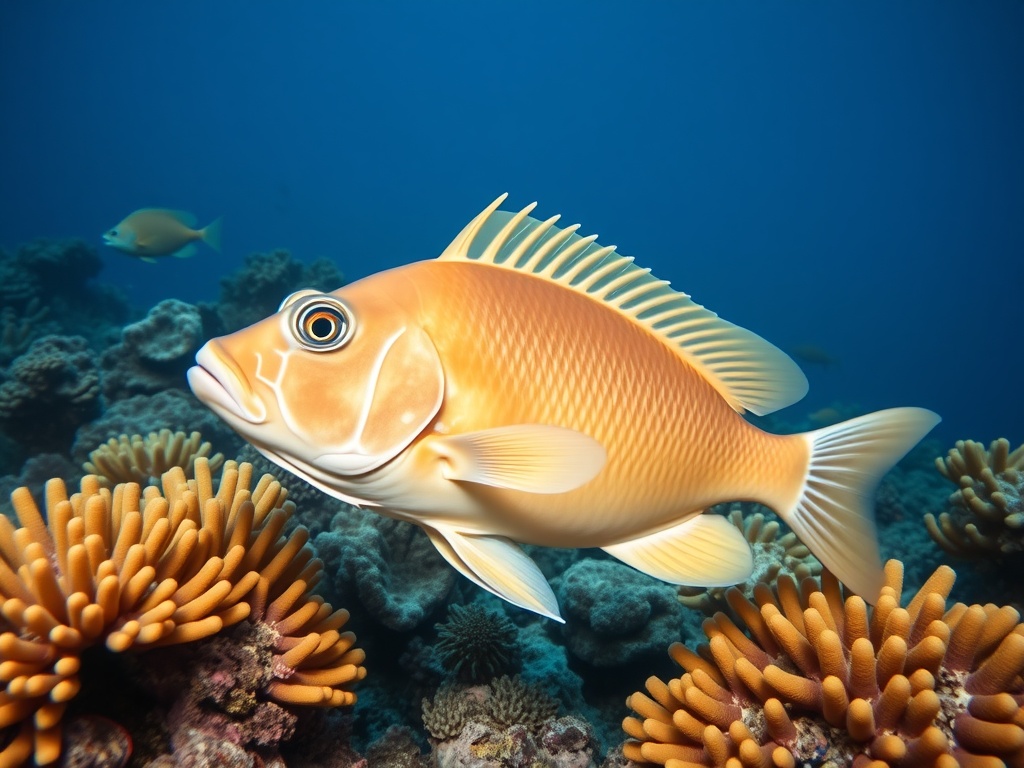
About the Humphead wrasse
Cheilinus undulatus, also called the Napoleon wrasse for the male's bulbous forehead, is the largest wrasse on Earth at up to 2 m and 190 kg, and it lives so slowly that fishing it sustainably is nearly impossible. It takes five to seven years to mature, can live over 30, and is protogynous: individuals start as females and some later change sex to become large males, which means that killing the biggest fish removes the males and can push a population toward reproductive failure. It also occurs at naturally low density - even on a healthy reef, perhaps a handful of adults per hectare - so a modest catch strips a reef bare. Its jaws are built for armour: it crushes and eats sea urchins, molluscs and, crucially, the crown-of-thorns starfish and toxic boxfish that few other reef fish will touch, making it a genuinely important reef guardian. The demand that has driven it to Endangered status is the Hong Kong and mainland Chinese live reef food fish trade, where a live humphead can fetch enormous prices and the lips are a delicacy; the fish are often taken as juveniles with cyanide, which also kills the coral around them. It was listed on CITES Appendix II in 2004.
Fascinating facts
Largest Reef Fish
The Humphead wrasse is one of the largest reef fish species, with some individuals growing over 2 meters in length.
Sex Change Ability
This species can change sex from female to male as they mature, helping maintain population balance.
Coral Protector
By preying on crown-of-thorns starfish, which consume coral, the Humphead wrasse helps protect coral reef ecosystems.
Detailed description
The humphead wrasse (Cheilinus undulatus) is the largest member of the family Labridae, with adult males reaching up to 2.3 meters in length and weighing as much as 190 kilograms, though most individuals are considerably smaller. Its most distinctive feature is the prominent bulbous hump on the forehead, which becomes increasingly pronounced with age, especially in males. The body is robust and elongated, covered in large, thick scales, and displays a striking coloration: adults are typically brilliant blue-green with intricate facial markings and thick, fleshy lips, while juveniles and females are paler with irregular black and white patterns. The species exhibits pronounced sexual dimorphism and is a protogynous hermaphrodite, meaning individuals may change sex from female to male as they mature. Humphead wrasses are generally solitary or found in small, loosely associated groups, often comprising a dominant male and several females. They are diurnal, spending daylight hours foraging across extensive home ranges and seeking shelter in reef crevices at night. Their powerful jaws and pharyngeal teeth enable them to feed on hard-shelled prey, including mollusks, crustaceans, echinoderms, and even toxic species such as crown-of-thorns starfish. The species is long-lived, with lifespans exceeding 30 years, and exhibits slow growth and late sexual maturity, factors that contribute to its vulnerability. Humphead wrasses play a vital ecological role as apex predators within coral reef ecosystems, influencing prey populations and reef health.
Did you know?
Individual Humphead wrasses are known to recognize and approach divers, suggesting a high level of intelligence and curiosity.
Research & sources
Wikipedia summary
The humphead wrasse is a large species of wrasse mainly found on coral reefs in the Indo-Pacific region. It is also known as the Māori wrasse, Napoleon wrasse, Napoleon fish, so mei 蘇眉 (Cantonese), mameng (Filipino), and merer in the Pohnpeian language of the Caroline Islands.
Behaviour & social structure
Humphead wrasses are primarily solitary, with adults patrolling large territories—sometimes exceeding several square kilometers—across outer reef slopes and channels. They are active during the day, foraging methodically for prey by overturning rocks and coral fragments with their strong jaws. Their diet is highly varied, but they are among the few reef fish capable of preying on toxic or armored species, such as boxfish and sea hares, due to their specialized dentition and digestive adaptations. Social interactions are generally limited outside of breeding aggregations, although juveniles and subadults may form small, loose groups. Dominant males maintain harems and defend territories during spawning periods. At night, individuals seek refuge in reef crevices or caves, reducing predation risk. Humphead wrasses are known for their inquisitive nature and can become habituated to divers in protected areas.
Reproduction & life cycle
Cheilinus undulatus is a protogynous hermaphrodite: individuals begin life as females and may transition to males later, typically when reaching a larger size or in response to social cues. Spawning occurs in groups at specific sites, often during the new moon phase, with peak activity varying regionally but generally coinciding with warmer months. Females release pelagic eggs into the water column, which are fertilized externally by males. There is no parental care; eggs and larvae are planktonic, drifting with currents until settling on suitable reef habitats. Sexual maturity is reached at 5–7 years of age, with males generally transitioning at larger sizes (over 1 meter). The species' slow growth, late maturity, and low reproductive output contribute to its susceptibility to overexploitation.
Adaptations & survival
The humphead wrasse possesses several adaptations for its ecological niche: robust, thick lips and powerful jaws equipped with pharyngeal teeth allow it to crush hard-shelled and spiny prey. Its large size and tough scales offer protection from most predators. The species' ability to consume toxic organisms, such as crown-of-thorns starfish and boxfish, is facilitated by specialized digestive enzymes and behavioral strategies that minimize toxin exposure. Protogynous hermaphroditism enables flexible population dynamics, allowing dominant females to become males and maintain breeding groups. Their cryptic nocturnal behavior—hiding in reef crevices—reduces predation risk during vulnerable resting periods.
Cultural significance
The humphead wrasse holds considerable cultural and economic significance in many Indo-Pacific societies. In Chinese cuisine, it is known as 'so mei' and is considered a delicacy, symbolizing wealth and status, especially during festive occasions. In some Pacific Island cultures, the fish features in traditional stories and is regarded as a totemic species. Its striking appearance and size have made it a popular attraction for divers and ecotourism, contributing to local economies. However, high demand in the live reef fish trade has also driven unsustainable exploitation.
Recent research
Recent research has focused on the species' population genetics, revealing significant genetic structuring across its range, which has implications for conservation management. Studies using acoustic telemetry have provided insights into home range size, movement patterns, and habitat use, informing the design of marine protected areas. Ongoing work is investigating the species' role in controlling populations of crown-of-thorns starfish, a major coral predator. Conservation efforts are increasingly incorporating community-based management and enforcement of trade regulations. There is also interest in developing captive breeding techniques, though successful large-scale aquaculture remains elusive due to the species' complex life history.
Videos
Habitat
Coral reefs

Conservation
The Humphead wrasse is currently classified as Endangered on the IUCN Red List.
Threats & challenges
The primary threats to the humphead wrasse are overfishing, particularly for the live reef fish trade, and habitat loss due to coral reef degradation. The species is highly prized in luxury seafood markets, especially in Southeast Asia, where large individuals fetch high prices. Its slow growth, late maturity, and low reproductive rate make populations especially vulnerable to exploitation. Illegal, unreported, and unregulated (IUU) fishing remains a significant problem, even in areas with legal protections. Habitat destruction from destructive fishing practices (e.g., cyanide and blast fishing), coastal development, and climate change-induced coral bleaching further threaten its survival. Population declines of 50% or more have been reported in many regions, prompting its listing as Endangered on the IUCN Red List and inclusion in CITES Appendix II.
Taxonomy
Scientific name
Cheilinus undulatus
- Kingdom
- Animalia
- Phylum
- Chordata
- Class
- Actinopterygii
- Order
- Labriformes
- Family
- Labridae
- Genus
- Cheilinus
- Species
- undulatus
Where to see a humphead wrasse
2 zoos and aquariums in 2 countries are recorded as keeping this species.


Community notes
Share your observations about the Humphead wrasse.
No community notes yet. Be the first!
Discover more wildlife
More fascinating animals from the encyclopedia.