
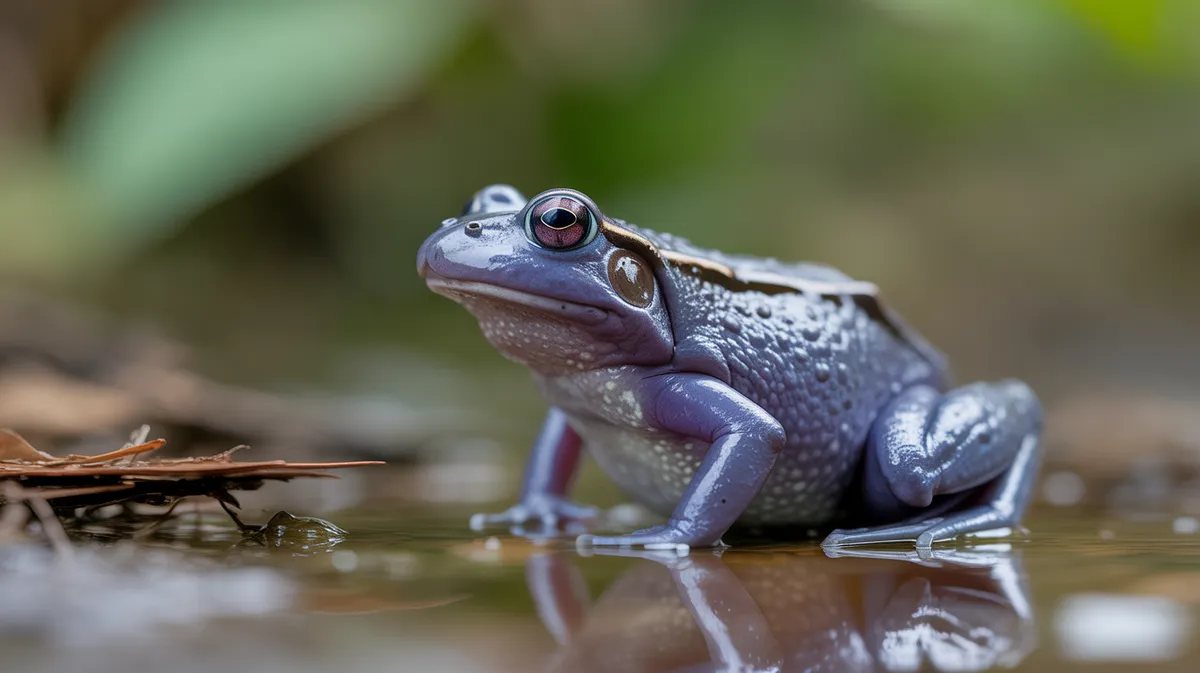
About the Indian Purple Frog
Nasikabatrachus sahyadrensis was described only in 2003, from India's Western Ghats, and it caused a stir out of all proportion to its size, because it is not merely a new species but the sole surviving representative of a lineage whose closest relatives are the Sooglossidae of the Seychelles - a split dating to roughly 100 million years ago, when India and the Seychelles were part of the same fragment of Gondwana. The frog is, in effect, a living relic of continental drift. It looks the part: a bloated purple body, a tiny head, small eyes and a pointed, protrusible snout ending in a hard white tip, and its body is built entirely for burrowing. It spends essentially its whole life underground, digging to depths of several metres and feeding on termites, which it hoovers up in tunnels with a specialised groove-tongue and fluted snout - it does not surface to hunt. It emerges above ground for perhaps two weeks a year, at the onset of the monsoon, to breed in fast-flowing streams. The tadpoles are equally odd: they have a large sucker mouth and cling to the surface of wet rock in torrents and waterfalls, grazing algae, and they take around 100 days to develop.
Fascinating facts
Monsoon Breeder
The Purple Frog emerges from underground only for a few days each year during the monsoon to breed in temporary streams.
Subterranean Lifestyle
It spends up to 11 months of the year underground, feeding on termites and ants with its specially adapted tongue.
Ancient Lineage
Genetic studies indicate that the Indian Purple Frog represents a lineage that split from other frogs over 100 million years ago.
Detailed description
The Indian Purple Frog (Nasikabatrachus sahyadrensis) is a highly specialized, fossorial amphibian endemic to the southern Western Ghats of India, primarily in Kerala and parts of Tamil Nadu. Adults typically measure 6–9 cm in length, with females generally larger than males. Its body is globular and robust, with a small, narrow head and a distinctive pointed snout adapted for burrowing. The skin is smooth, thick, and dark purplish-grey, providing camouflage in the moist, loamy soils it inhabits. Eyes are small and positioned dorsally, reflecting its subterranean lifestyle. Limbs are short and muscular, with spade-like metatarsal tubercles on the hind feet to aid in digging. The species spends nearly its entire life underground, emerging only briefly during the early monsoon for explosive breeding. Its vocalizations, described as a chicken-like clucking, are unique among amphibians and are used by males to attract mates. The Indian Purple Frog is the sole member of its family, Nasikabatrachidae, and represents an ancient lineage that diverged from its closest relatives over 120 million years ago, making it a 'living fossil' of significant evolutionary interest.
Did you know?
The Indian Purple Frog was only formally described by scientists in 2003, despite being evolutionarily ancient and existing for millions of years.
Research & sources
Behaviour & social structure
Nasikabatrachus sahyadrensis is predominantly fossorial, spending up to 11 months of the year underground in moist, loose soils. It is a solitary species, with individuals rarely interacting outside the breeding season. The frog is primarily active during the monsoon, when it emerges to breed. Feeding occurs mostly underground, where it uses its specialized tongue to feed on ants, termites, and other small invertebrates. It employs a sit-and-wait strategy, remaining motionless until prey passes by. Surface activity is extremely limited, and the frog is highly sensitive to desiccation and disturbance. There is no evidence of territoriality or complex social structures; interactions are mostly limited to brief breeding aggregations.
Reproduction & life cycle
Breeding is highly synchronized with the onset of the southwest monsoon (typically May–June). Males congregate near ephemeral streams and waterlogged areas, calling to attract females with their distinctive vocalizations. Amplexus is axillary, and females lay large clutches of eggs (up to 3,000) in shallow, temporary streams. Eggs are deposited in strings attached to submerged vegetation or rocks. The larval (tadpole) stage is aquatic and highly specialized: tadpoles possess oral suckers that allow them to cling to rocks in fast-flowing streams, feeding on algae and detritus. Metamorphosis occurs within 100–130 days, after which juveniles disperse into the surrounding soil. There is no parental care beyond egg deposition.
Adaptations & survival
The Indian Purple Frog exhibits several remarkable adaptations for its fossorial lifestyle. Its compact, rounded body reduces water loss and facilitates movement through soil. The pointed snout and strong, spade-like hind limbs are specialized for digging. Reduced eyes and a reliance on tactile and chemical cues reflect its subterranean existence. The tongue is protrusible and highly sticky, adapted for capturing ants and termites underground. Tadpoles are uniquely adapted to torrential streams, with ventral suckers and flattened bodies to resist being swept away. The species' explosive breeding strategy ensures rapid reproduction during the brief window of suitable surface conditions.
Cultural significance
The Indian Purple Frog is largely unknown in local folklore due to its secretive nature and limited visibility. However, its unusual appearance has attracted attention in the scientific and conservation communities, where it is celebrated as a symbol of the Western Ghats' unique evolutionary heritage. Occasionally, local communities refer to it as 'Maveli Kaappa' (Maveli's Frog), linking it to the mythological king Mahabali, though this is not widespread. There are no known traditional uses or significant roles in indigenous medicine or rituals.
Recent research
Since its formal description in 2003, Nasikabatrachus sahyadrensis has been the focus of phylogenetic and evolutionary studies, revealing its close relationship to Seychelles frogs and supporting the theory of ancient Gondwanan dispersal. Recent research has investigated its reproductive biology, larval adaptations, and genetic diversity. Studies using environmental DNA (eDNA) are being developed to improve detection and monitoring. Conservation research is focused on habitat requirements, population genetics, and the impacts of land-use change. The species is also used as a model for studying amphibian adaptation to subterranean and torrent habitats.
Sources
A new family of frogs from India shows ancient links to Africa
Biju, S.D., Bossuyt, F. (2003)
scientificNasikabatrachus sahyadrensis: The IUCN Red List of Threatened Species 2021
IUCN SSC Amphibian Specialist Group
conservationA new family of frogs from India shows ancient links to Africa
S.D. Biju & F. Bossuyt (2003)
scientificNasikabatrachus sahyadrensis: The IUCN Red List of Threatened Species 2022
IUCN SSC Amphibian Specialist Group
conservationVideos
Habitat
Moist forest floors in the Western Ghats


Conservation
The Indian Purple Frog is currently classified as Endangered on the IUCN Red List.
Threats & challenges
Nasikabatrachus sahyadrensis is classified as Endangered by the IUCN due to its highly restricted range and ongoing habitat loss. Major threats include deforestation, conversion of forest to agricultural land (especially cardamom and tea plantations), infrastructure development, and pollution of breeding streams. Fragmentation of habitat isolates populations, reducing genetic diversity and increasing vulnerability. Climate change poses additional risks by altering monsoon patterns and stream flow. The species' secretive habits and brief surface activity make population monitoring difficult, complicating conservation efforts. Current population trends are declining, and urgent habitat protection is needed.
Taxonomy
Scientific name
Nasikabatrachus sahyadrensis
- Kingdom
- Animalia
- Phylum
- Chordata
- Class
- Amphibia
- Order
- Anura
- Family
- Nasikabatrachidae
- Genus
- Nasikabatrachus
- Species
- sahyadrensis
Community notes
Share your observations about the Indian Purple Frog.
No community notes yet. Be the first!
Discover more wildlife
More fascinating animals from the encyclopedia.