
About the Indian Star Tortoise
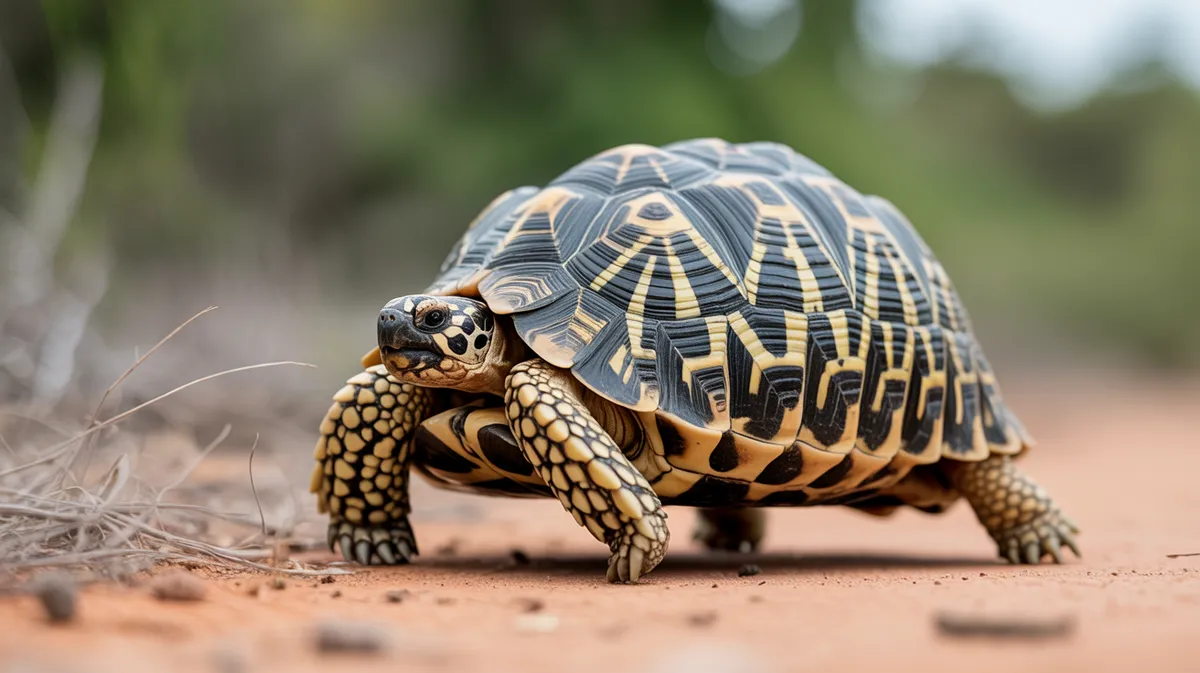
The Indian Star Tortoise is a small to medium-sized tortoise known for its strikingly beautiful, star-patterned shell. Native to India, Sri Lanka, and parts of Pakistan, this species prefers dry areas such as scrub forests, grasslands, and semi-deserts. Their distinctive radiating yellow and black markings help them blend into the dappled sunlight of their habitat, providing camouflage from predators. Indian Star Tortoises are popular in the pet trade, but wild populations are threatened by habitat loss and illegal collection.
Fascinating facts
Unique Shell Pattern
Each Indian Star Tortoise has a distinct star-like pattern on its shell, which provides excellent camouflage in its native habitat.
Strict Herbivore
Their diet consists mainly of grasses, fallen fruit, succulent plants, and flowers.
Protected Species
International trade of the Indian Star Tortoise is strictly regulated due to its Vulnerable status and high demand in the pet market.
Detailed description
The Indian Star Tortoise (Geochelone elegans) is a small to medium-sized terrestrial tortoise, with adults typically reaching a carapace length of 20–28 cm (8–11 in), though females are generally larger than males. Its most distinctive feature is the highly domed, star-patterned carapace, marked by yellow radiating lines from the center of each dark scute, which provides effective camouflage in its native habitats. The plastron is pale yellow with dark markings, and the limbs are covered in prominent, rounded scales. The head is relatively small, with a blunt snout and a beak-like mouth adapted for grazing. Indian Star Tortoises are primarily crepuscular, being most active during the cooler parts of the day. They are slow-moving and rely on their cryptic coloration to avoid predation. Unlike some tortoises, they are not strong burrowers but may seek shelter under vegetation or in shallow scrapes during the hottest hours. The species exhibits sexual dimorphism: females are larger, with more rounded and broader shells, while males have longer tails and a slightly concave plastron. Longevity in the wild is estimated at 35–80 years, with captive individuals sometimes exceeding these ages under optimal care. The tortoise's shell shape and star pattern are believed to disrupt its outline, making it harder for predators to detect in dappled light environments.
Did you know?
Despite being terrestrial, Indian Star Tortoises can survive long periods without water by absorbing moisture from their food and dew.
Research & sources
Wikipedia summary
The Indian star tortoise is a threatened tortoise species native to India, Pakistan and Sri Lanka where it inhabits dry areas and scrub forest. It has been listed as Vulnerable on the IUCN Red List since 2016, as the population is thought to comprise more than 10,000 individuals, but with a declining trend. It is threatened by habitat loss and poaching for the illegal wildlife trade. It was upgraded to CITES Appendix I in 2019 by full consensus among all member states, giving it the highest level of international protection from commercial trade. Conservation group TRAFFIC found 6,040 were seized globally that were intended to be sold in the pet trade. Currently they are commonly bred in many countries to be sold as pets.
Behaviour & social structure
Indian Star Tortoises are primarily solitary, coming together only during the breeding season or at shared feeding sites. They are herbivorous grazers, feeding on a wide variety of grasses, succulent plants, flowers, and fallen fruits; in the wild, their diet is highly seasonal, reflecting the availability of vegetation. They are known to consume calcium-rich substrates such as soil or snail shells to supplement their mineral intake. Activity peaks during the early morning and late afternoon, with individuals seeking shade or shelter during midday heat. They are not territorial but may show mild aggression during courtship or competition for food. Defensive behaviors include retracting into the shell and using the highly domed carapace to wedge themselves under obstacles, making extraction by predators difficult. Hydration is obtained from dew, succulent plants, and infrequent drinking at water sources. In arid regions, they may remain inactive during prolonged dry spells, entering a state of aestivation.
Reproduction & life cycle
Breeding in Indian Star Tortoises generally coincides with the onset of the monsoon (June–September), although timing can vary regionally. Males court females by circling them, biting at their limbs, and ramming their shells. Copulation is accompanied by vocalizations and can last several minutes. Females lay 2–10 eggs per clutch, with 1–5 clutches per season, depending on environmental conditions and individual health. Eggs are deposited in shallow nests dug by the female, typically in sandy or loose soil. Incubation lasts 47–180 days, with temperature playing a critical role in determining the duration and, potentially, the sex of the hatchlings (temperature-dependent sex determination is suspected but not conclusively proven in this species). There is no parental care post-oviposition; hatchlings are independent from birth and rely on their cryptic coloration for protection. Juvenile mortality is high due to predation and environmental hazards.
Adaptations & survival
The Indian Star Tortoise exhibits several key adaptations for survival in arid and semi-arid environments. Its highly domed, star-patterned shell not only provides camouflage but also may help the animal right itself if overturned. The shell's shape is thought to reduce the risk of predation by making it difficult for predators to grip or crush. The tortoise's slow metabolism and ability to aestivate during droughts help it survive periods of food and water scarcity. Its herbivorous diet is highly flexible, allowing it to exploit a range of plant resources, including tough, fibrous grasses and drought-resistant succulents. The beak is strong and sharp, adapted to cropping low vegetation. Behavioral adaptations include crepuscular activity patterns to avoid thermal stress and the use of microhabitats (such as under bushes or rocks) for thermoregulation.
Cultural significance
In South Asian cultures, the Indian Star Tortoise is often associated with longevity, stability, and good fortune. In Hindu mythology, the tortoise (Kurma) is an avatar of the god Vishnu, symbolizing support and cosmic balance. The species is sometimes kept as a status symbol or for religious purposes, despite legal restrictions. Traditional uses include the belief that keeping a tortoise in the home brings prosperity, though such practices contribute to illegal trade. The tortoise's striking appearance has made it a subject of art and folklore across its range.
Recent research
Recent research has focused on the genetic diversity of Indian Star Tortoise populations, revealing significant genetic structuring across its range, which has implications for conservation management and reintroduction programs. Studies on the species' reproductive biology have highlighted the importance of temperature in incubation and hatchling sex ratios. Conservation organizations are developing protocols for the rehabilitation and release of confiscated tortoises, including health screening and genetic assessment. There is ongoing research into the impacts of the illegal pet trade on wild populations and the effectiveness of international trade bans. Ecological studies are examining the species' role in seed dispersal and its interactions with native plant communities.
Videos
Habitat
Dry scrub forests, grasslands, and semi-deserts
 Arid Regions
Desert
Arid lands with minimal rainfall, extreme temperatures, and specialized wildlife adapted to harsh conditions.
 Various Continental Regions
Grassland
Open areas dominated by grasses rather than trees, supporting numerous herbivores and their predators.
 Global
Forest
Wooded areas with significant tree cover and diverse plant and animal communities.
Conservation
The Indian Star Tortoise is currently classified as Vulnerable on the IUCN Red List.
Threats & challenges
The Indian Star Tortoise faces significant threats from habitat loss due to agricultural expansion, urbanization, and deforestation. Illegal collection for the international pet trade is a major driver of population decline; despite CITES Appendix I protection, thousands are trafficked annually. Overgrazing by livestock and the use of pesticides further degrade their habitats. Wild populations are highly fragmented, with some local extinctions reported. The species is also vulnerable to predation by feral dogs and native predators, particularly at the egg and hatchling stages. Conservation challenges include weak law enforcement, lack of public awareness, and difficulties in repatriating confiscated individuals due to disease risks and genetic concerns. Population trends are declining, and the IUCN estimates the total wild population at over 10,000 but decreasing.
Taxonomy
Scientific name
Geochelone elegans
- Kingdom
- Animalia
- Phylum
- Chordata
- Class
- Reptilia
- Order
- Testudines
- Family
- Testudinidae
- Genus
- Geochelone
- Species
- elegans
Community notes
Share your observations about the Indian Star Tortoise.
No community notes yet. Be the first!
Discover more wildlife
More fascinating animals from the encyclopedia.