
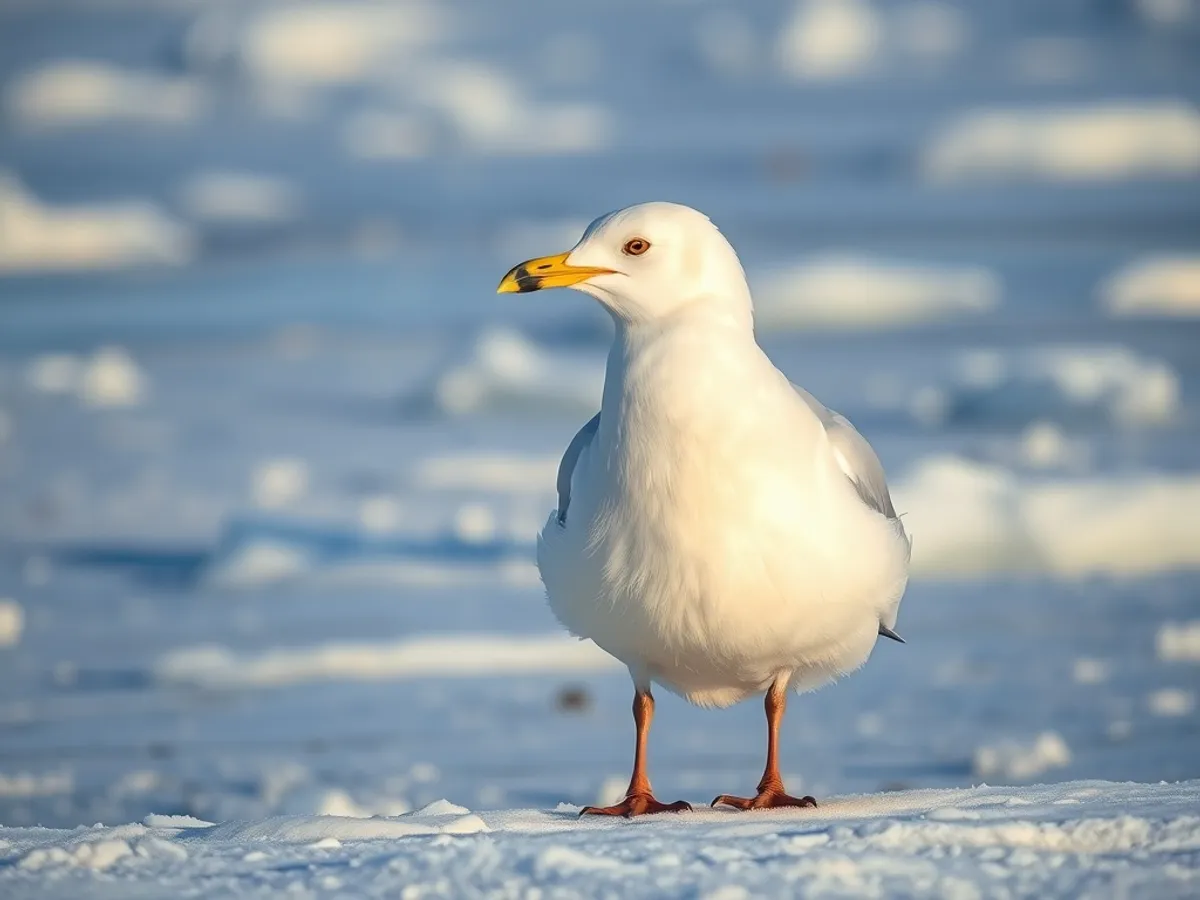
About the Ivory Gull
The Ivory Gull is a medium-sized, entirely white seabird native to the high Arctic. It is specially adapted to life in some of the coldest and harshest environments on Earth, often seen following polar bears and scavenging on the remains of their kills. With its thick plumage, short legs, and strong bill, the Ivory Gull is well-suited for life on sea ice, where it breeds and forages. Its population is declining due to climate change and contamination, making it one of the rarest gulls in the world.
Fascinating facts
Arctic Specialist
The Ivory Gull is one of the few bird species that spend their entire lives in the high Arctic, even during the harsh winter months.
Scavenger
Ivory Gulls frequently follow polar bears and other predators to scavenge remains from their kills, playing a key role in the Arctic food web.
Unique Nester
Unlike many gulls, Ivory Gulls often nest on rocky outcrops or remote islands surrounded by ice, making their colonies difficult to access.
Detailed description
The Ivory Gull (Pagophila eburnea) is a small, robust gull measuring 40–43 cm (16–17 in) in length, with a wingspan of 108–120 cm (43–47 in) and weighing between 400–700 g (14–25 oz). Its plumage is entirely white, providing effective camouflage against the Arctic ice and snow, while the legs are black and the bill is bluish with a yellow tip. The eyes are dark, and juveniles are distinguished by dusky markings on the wings and face, which they lose after their second year. The Ivory Gull has a compact body, short neck, and rounded head, with relatively short, thick legs and webbed feet adapted for walking on ice. Its strong, slightly hooked bill is well-suited for scavenging and tearing flesh. The species is highly pelagic outside the breeding season, often seen far from land, and is known for its remarkable endurance in extreme cold. Ivory Gulls are agile fliers, capable of hovering and making quick turns to snatch food from the ice or water surface. Their vocalizations are high-pitched and squeaky, used in both social interactions and territorial displays. The species is monotypic, being the sole member of its genus, and is uniquely specialized for life in the high Arctic.
Did you know?
Unlike most gulls, the Ivory Gull's diet can include the droppings of seals and whales, which provide vital nutrients in the nutrient-sparse Arctic.
Research & sources
Wikipedia summary
The ivory gull is a small gull, the only species in the genus Pagophila. It is a resident breeding bird in the high Arctic and has a circumpolar distribution through Greenland, northernmost North America, and Eurasia.
Behaviour & social structure
Ivory Gulls are opportunistic feeders, exhibiting both scavenging and predatory behaviors. They are frequently observed following polar bears, walruses, and other large predators to feed on the remains of marine mammal carcasses, particularly seals. Their diet also includes fish, invertebrates, and occasionally eggs and chicks of other seabirds. Foraging often occurs in small flocks, especially outside the breeding season, and they are known to congregate at sites of abundant food, such as whale or seal carcasses. Ivory Gulls are diurnal, with activity patterns closely tied to the availability of food and daylight, which is continuous during the Arctic summer. They display strong site fidelity to breeding colonies but are otherwise highly nomadic, tracking shifting sea ice. Socially, they are relatively tolerant of conspecifics at feeding sites but can be aggressive in defending nesting territories. Their flight is buoyant and graceful, and they are adept at landing and taking off from slippery ice surfaces.
Reproduction & life cycle
Ivory Gulls breed in small, loose colonies on remote, rocky outcrops, cliffs, or flat ground near sea ice, typically from late June to August. They are monogamous, with pairs forming long-term bonds. Courtship involves aerial displays and mutual preening. Nests are shallow scrapes lined with moss, lichens, and feathers. The typical clutch consists of 1–3 olive-brown eggs with dark blotches. Both parents share incubation duties, which last 24–25 days. Chicks are semi-precocial, covered in down, and remain in the nest for 3–4 weeks. Both adults feed the chicks by regurgitation. Fledging occurs at about 30–35 days, after which juveniles remain dependent on parents for several weeks. Breeding success is highly variable and influenced by food availability and predation.
Adaptations & survival
Ivory Gulls possess several adaptations for Arctic survival. Their dense, layered plumage provides exceptional insulation against subzero temperatures, while a high metabolic rate helps maintain body heat. The white coloration offers camouflage against snow and ice, reducing predation risk. Their nasal glands efficiently excrete excess salt, allowing them to consume marine prey and seawater. Webbed feet and strong claws enable stable movement on ice. Behaviorally, they exploit the kills of apex predators, minimizing energy expenditure on hunting. Their ability to travel vast distances over pack ice and open water allows them to exploit ephemeral food resources. Physiologically, they exhibit resistance to cold-induced stress and can fast for extended periods during food scarcity.
Cultural significance
The Ivory Gull holds symbolic significance for Arctic indigenous peoples, often regarded as a harbinger of sea ice and seasonal change. In Inuit culture, its presence is associated with the availability of marine mammals and the health of the ice ecosystem. The species is occasionally depicted in Arctic folklore and traditional art, though it is not commonly hunted or used for subsistence. Its rarity and striking appearance have made it an emblematic species in Arctic conservation campaigns and ecotourism.
Recent research
Recent research has focused on the Ivory Gull's contaminant loads, revealing some of the highest mercury concentrations recorded in any Arctic seabird, likely due to its scavenging habits. Satellite tracking studies have elucidated their extensive movements across the Arctic basin, highlighting their reliance on sea ice and vulnerability to climate-driven habitat loss. Genetic analyses confirm low genetic diversity, raising concerns about resilience to environmental change. Ongoing studies are monitoring breeding success, population trends, and the impacts of pollutants and climate change. Conservation efforts include international cooperation under the Agreement on the Conservation of African-Eurasian Migratory Waterbirds (AEWA) and targeted protection of key breeding sites.
Videos
Habitat
Arctic sea ice and coastal tundra


Conservation
The Ivory Gull is currently classified as Near Threatened on the IUCN Red List.
Threats & challenges
The Ivory Gull faces significant threats, primarily from climate change, which is rapidly reducing the extent and stability of Arctic sea ice, crucial for breeding and foraging. Contaminant exposure, especially to mercury and persistent organic pollutants (POPs), is alarmingly high in this species due to biomagnification through scavenging. Oil spills and increased shipping in the Arctic pose additional risks. Human disturbance at breeding sites, egg collection, and predation by introduced mammals (e.g., Arctic foxes) further impact populations. Recent surveys indicate a steep population decline, with some estimates suggesting a reduction of over 80% in parts of Canada since the 1980s. The global population is estimated at 6,000–11,500 mature individuals, leading to its Near Threatened status on the IUCN Red List.
Taxonomy
Scientific name
Pagophila eburnea
- Kingdom
- Animalia
- Phylum
- Chordata
- Class
- Aves
- Order
- Charadriiformes
- Family
- Laridae
- Genus
- Pagophila
- Species
- eburnea
Community notes
Share your observations about the Ivory Gull.
No community notes yet. Be the first!
Discover more wildlife
More fascinating animals from the encyclopedia.