
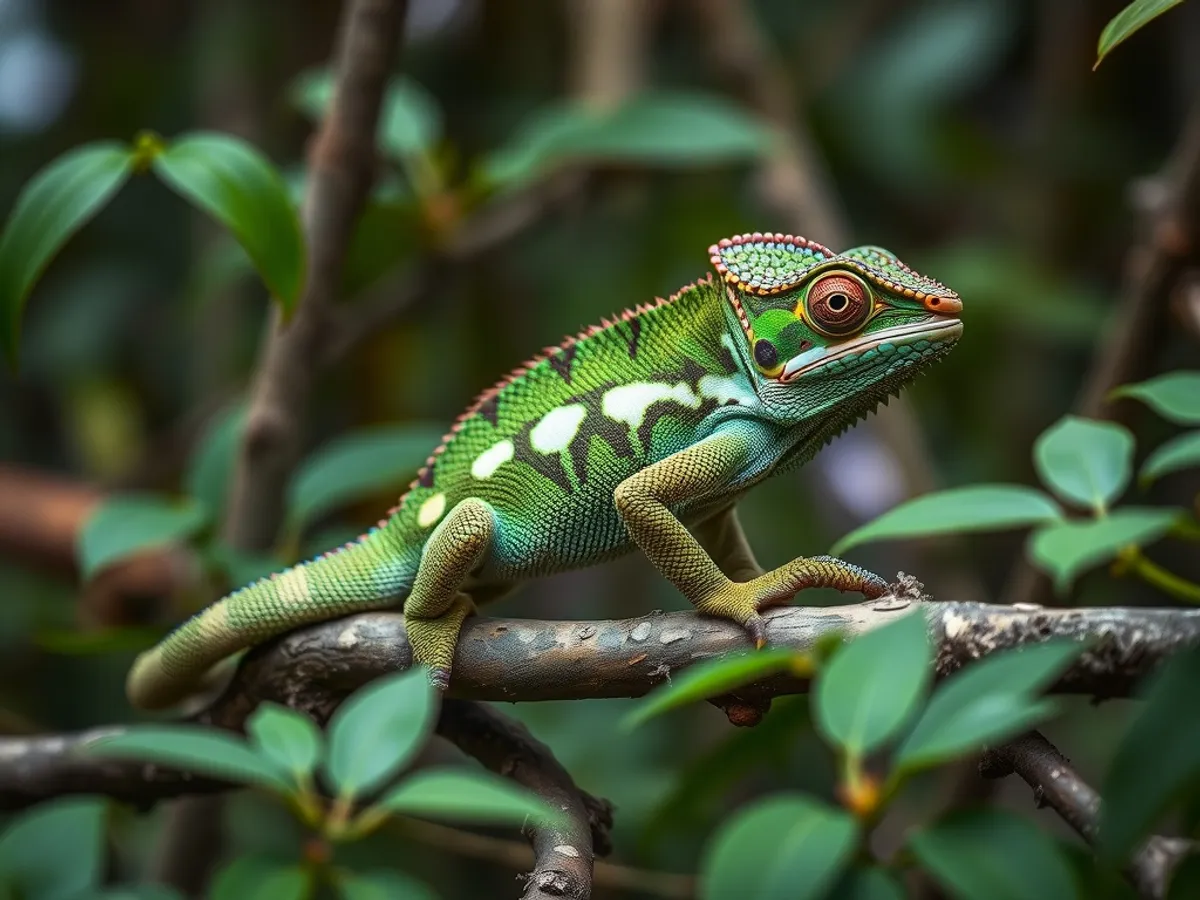
About the Jackson's Chameleon
Trioceros jacksonii of the montane forests of Kenya and Tanzania is the "three-horned chameleon", and the horns are true bony structures covered in keratin, borne only by the males, who fight with them - two rivals lock horns and try to lever each other off a branch, a mode of combat far closer to a deer or a rhinoceros beetle than to anything else in the lizard world. Females of the common subspecies have no horns at all. Unlike most chameleons, Jackson's does not lay eggs: females retain the eggs internally and give birth to 8 to 30 live young after a gestation of five to six months, an adaptation to cold, high-altitude forests where eggs in the ground would not develop reliably. Its colour change, like all chameleons', is not about matching a background - it is driven by temperature, mood, social signalling and hormonal state, and works by adjusting the spacing of guanine nanocrystals in the skin's iridophore layer, tuning which wavelengths are reflected. A population introduced to Oahu in 1972 from a pet shipment released to recover after a stressful journey has since spread across the Hawaiian islands, where it eats native tree snails and insects and is now a recognised invasive.
Fascinating facts
Three Horns
Male Jackson's Chameleons have three distinct horns on their heads, used for display and combat with rivals.
Incredible Vision
Their eyes can move independently, giving them a full 360-degree field of view to spot both prey and predators.
Live Birth
Unlike many reptiles, Jackson's Chameleons are ovoviviparous, meaning they give birth to live young rather than laying eggs.
Detailed description
Jackson's Chameleon (Trioceros jacksonii) is a medium-sized arboreal lizard, with adult males typically reaching 30–33 cm (12–13 in) in total length, including the tail, while females are generally smaller, averaging 25–28 cm (10–11 in). Males are instantly recognizable by their three prominent, brownish horns—one rostral (on the nose) and two preocular (above the eyes)—used in ritualized combat and display, whereas females usually lack horns or have only small bumps. Their laterally compressed bodies are covered in granular scales, and coloration ranges from vibrant emerald green to yellowish or bluish hues, with the ability to change shade for communication or camouflage. Eyes are large, turreted, and move independently, providing a wide field of vision. The prehensile tail and zygodactylous feet (two toes forward, two back) are highly adapted for grasping branches in their montane forest habitat. Jackson's Chameleons are diurnal, relying on their acute vision to hunt insects and other small invertebrates. They exhibit a slow, deliberate gait, often swaying to mimic foliage movement. Unlike most chameleons, this species is ovoviviparous, giving birth to live young rather than laying eggs. Their lifespan in the wild is estimated at 5–10 years, with males generally living longer than females.
Did you know?
Jackson's Chameleons can project their tongues up to twice their body length to snatch insects with incredible accuracy.
Research & sources
Wikipedia summary
Jackson's chameleon, also known commonly as Jackson's horned chameleon, the three-horned chameleon, and the Kikuyu three-horned chameleon, is a species of chameleon, a lizard in the family Chamaeleonidae. The species is native to East Africa, and introduced to Hawaii, Florida, and California. There are three recognized subspecies.
Behaviour & social structure
Jackson's Chameleons are primarily solitary and territorial, with males defending overlapping but distinct home ranges. Aggressive encounters between males involve head-bobbing, lateral displays, and horn-to-horn jousting, but rarely result in serious injury. They are sit-and-wait predators, using their independently mobile eyes to scan for prey before rapidly projecting their sticky, muscular tongue—sometimes exceeding their own body length—to capture insects, spiders, and occasionally small vertebrates. Recent studies have documented chemical prey luring, where individuals may secrete substances to attract prey. Feeding is typically most active in the morning and late afternoon. Chameleons spend much of their day basking to regulate body temperature, retreating to dense foliage at night to sleep. Social interactions are limited outside of the breeding season, and both sexes use subtle color changes to signal stress, aggression, or receptivity.
Reproduction & life cycle
Breeding in Jackson's Chameleons is seasonal in their native range, often coinciding with the onset of the rainy season (March–June). Courtship involves males displaying vibrant colors and engaging in ritualized combat for access to receptive females. Copulation is brief, and females are ovoviviparous, with a gestation period of 5–6 months. Females give birth to 8–30 live young, each measuring about 5–6 cm (2–2.5 in) at birth. Neonates are fully independent and receive no parental care. Females may breed up to twice per year under optimal conditions. Sexual maturity is reached at 5–9 months, with rapid growth during the juvenile stage.
Adaptations & survival
Jackson's Chameleons possess several key adaptations for arboreal life: their prehensile tails and zygodactylous feet provide exceptional grip on branches, while their laterally compressed bodies aid in navigating dense foliage. The independently mobile eyes allow for 360-degree vision and precise depth perception, critical for both hunting and predator avoidance. Their projectile tongue is a highly specialized feeding adaptation, capable of extending up to twice the body length in less than a second. Cryptic coloration and the ability to change color serve both as camouflage and as a means of social communication. Horns in males are used for intraspecific competition and display, rather than defense against predators.
Cultural significance
In East African cultures, chameleons are sometimes regarded with superstition, viewed as omens or mystical creatures due to their color-changing abilities and unusual appearance. However, Jackson's Chameleon itself has limited direct cultural significance. Globally, it has become a symbol of adaptability and transformation, frequently featured in educational materials and the exotic pet trade. In Hawaii, its introduction has led to public awareness campaigns about invasive species and ecosystem balance.
Recent research
Recent research has focused on the biomechanics of tongue projection, revealing that Jackson's Chameleon can accelerate its tongue at over 2,500 m/s², one of the fastest movements in the animal kingdom. Studies on chemical prey luring have suggested the use of pheromones or other attractants in hunting behavior. Genetic analyses have clarified the relationships among the three recognized subspecies: T. j. jacksonii (Kenya highlands), T. j. xantholophus (Mount Kenya), and T. j. merumontanus (Mount Meru, Tanzania), each with subtle morphological and ecological differences. Ongoing research in Hawaii examines the ecological impact of introduced populations on native fauna and the potential for biological control.
Videos
Habitat
Montane forest


Conservation
The Jackson's Chameleon is currently classified as Least Concern on the IUCN Red List.
Threats & challenges
While classified as Least Concern by the IUCN, Jackson's Chameleon faces localized threats in its native range, including habitat loss due to deforestation, agricultural expansion, and urbanization. Collection for the international pet trade has historically impacted some populations, though export restrictions have reduced this pressure. Introduced populations, particularly in Hawaii, have become invasive, threatening native invertebrates and small vertebrates. Climate change poses a long-term risk by altering the montane forest ecosystems they depend on. Disease transmission, particularly from introduced pathogens, is an emerging concern in both native and introduced populations.
Taxonomy
Scientific name
Trioceros jacksonii
- Kingdom
- Animalia
- Phylum
- Chordata
- Class
- Reptilia
- Order
- Squamata
- Family
- Chamaeleonidae
- Genus
- Trioceros
- Species
- jacksonii
Community notes
Share your observations about the Jackson's Chameleon.
No community notes yet. Be the first!
Discover more wildlife
More fascinating animals from the encyclopedia.