
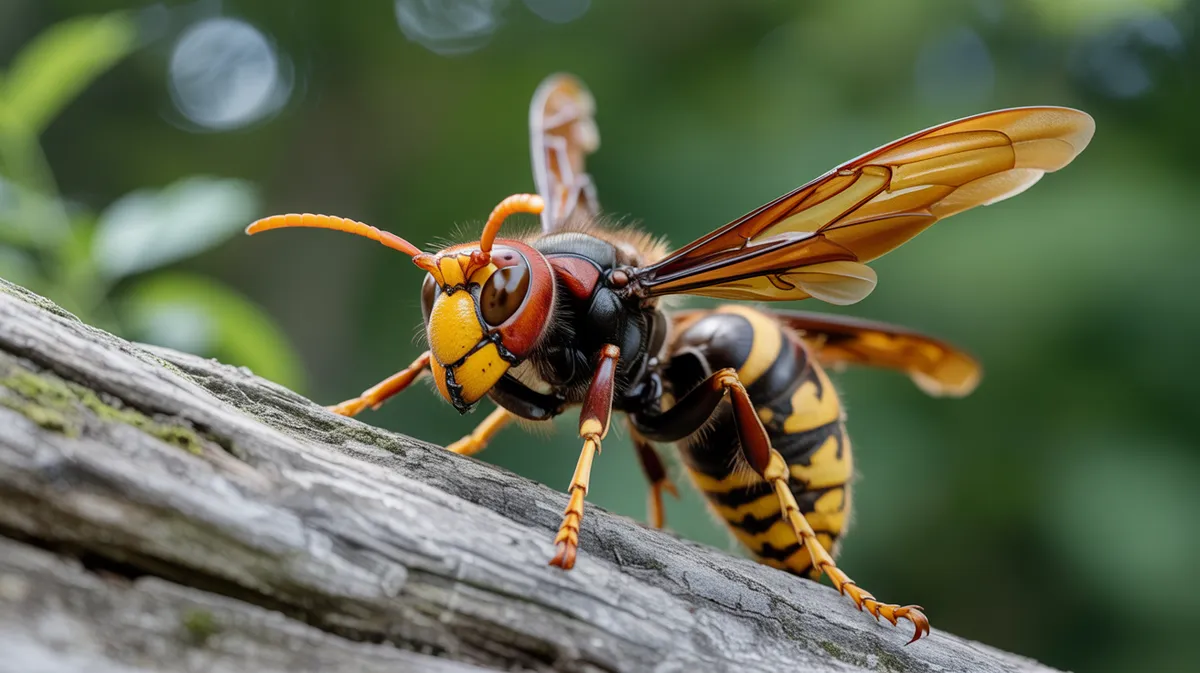
About the Japanese giant hornet
Vespa mandarinia japonica is the largest hornet in the world, with queens up to 5 cm and a wingspan around 7 cm, and its impact on honeybees is the reason it is famous. A single scout that finds a hive marks it with a pheromone, and then a raiding party of a few dozen hornets arrives and systematically decapitates the bees with their mandibles - thirty hornets can kill 30,000 European honeybees in a few hours, then carry the brood back to feed their own larvae. European honeybees, Apis mellifera, have no defence at all, which is why the hornet is catastrophic to imported hives in Japan. The native Japanese honeybee, Apis cerana japonica, does have one, and it is remarkable: several hundred bees mob the scout hornet before it can call for help, form a ball around it, and vibrate their flight muscles, driving the temperature at the centre of the ball to around 46 C. That is just above the hornet's lethal limit and just below the bees' own - a two-degree window - and elevated carbon dioxide inside the ball lowers the hornet's heat tolerance further. The hornet cooks. Its sting is dangerous to people mainly through allergy and venom volume, and it kills dozens in Japan each year.
Fascinating facts
Honeybee Predator
Japanese giant hornets are notorious for attacking and decimating honeybee colonies, often killing thousands of bees in a single raid.
Powerful Venom
Their venom is not only extremely painful but can also cause severe allergic reactions and, in rare cases, be fatal to humans.
Underground Nests
These hornets typically nest underground or in hollow tree trunks, making their colonies difficult to spot and approach.
Detailed description
The Japanese giant hornet (Vespa mandarinia japonica) is a subspecies of the Asian giant hornet and is the largest hornet native to Japan, with queens reaching lengths of 45–50 mm and workers averaging 38–40 mm. Its robust body is marked by a striking orange-yellow head, prominent dark eyes, and a black-banded, yellow-orange abdomen. The mandibles are large and powerful, adapted for both hunting and nest excavation. The species possesses a potent stinger, measuring up to 6 mm, capable of delivering a complex venom that can cause severe pain and, in rare cases, allergic reactions in humans. Colonies are eusocial, typically comprising a single queen, several hundred workers, and males during the reproductive season. Nests are constructed underground or in tree hollows, often reaching depths of 30–60 cm and containing up to 1,000 cells. Japanese giant hornets are apex insect predators, preying on a variety of arthropods, particularly honeybees, mantises, and other wasps. Their foraging and hunting are highly coordinated, with scouts marking prey colonies using pheromones to recruit nestmates for mass attacks. The species exhibits complex communication behaviors, including vibrational signals and pheromone trails. Seasonal colony cycles begin in spring, with new queens founding nests, and culminate in late autumn when reproductive individuals disperse.
Did you know?
A small group of Japanese giant hornets can destroy an entire honeybee hive in just a few hours, decapitating the bees and carrying larvae back to their nest.
Research & sources
Wikipedia summary
The Asian giant hornet, also known as the northern giant hornet, and the Japanese giant hornet, is the world's largest hornet. It is native to temperate and tropical East Asia, South Asia, mainland Southeast Asia, and parts of the Russian Far East. It was also found in the Pacific Northwest of North America in late 2019, with a few more additional sightings in 2020, and nests found in 2021, prompting concern that it could become an invasive species, but in December 2024, the hornets were announced to have been eradicated from the region, as well as from the rest of the United States.
Behaviour & social structure
Japanese giant hornets exhibit highly organized social behavior, with clear division of labor among castes. Workers are responsible for foraging, nest defense, and brood care, while the queen focuses exclusively on egg-laying. Foraging typically occurs during daylight hours, with peak activity in the morning and late afternoon. Hunting strategies are sophisticated: individual hornets may scout for prey, especially honeybee hives, and mark them with pheromones to recruit others for coordinated attacks. During such raids, hornets decapitate adult bees and transport the thoraxes back to their nest to feed larvae. Communication within the colony involves both chemical signals and substrate-borne vibrations. Defensive behavior is pronounced near the nest, with workers responding aggressively to intruders. Hornets also exhibit thermoregulatory behavior, fanning their wings to ventilate the nest and clustering to maintain optimal brood temperatures.
Reproduction & life cycle
The reproductive cycle begins in early spring when overwintered queens emerge from hibernation to establish new nests. After selecting a suitable underground cavity or tree hollow, the queen constructs initial brood cells and lays eggs. Larvae hatch after 5–8 days and are fed masticated insects by the queen. Pupation occurs after 14–18 days, and the first generation of workers emerges in about 3–4 weeks. As the colony grows, the queen transitions exclusively to egg-laying, while workers assume all other tasks. In late summer to early autumn, the colony produces reproductive individuals: new queens and males. Mating occurs outside the nest, often in flight. After mating, males die, and fertilized queens seek sheltered sites to overwinter, while the original colony declines and dies with the onset of cold weather. There is no parental care beyond provisioning the larvae within the nest.
Adaptations & survival
Japanese giant hornets possess several notable adaptations. Their large, robust mandibles are specialized for cutting and dismembering prey, particularly effective in bee raids. The venom contains a unique mixture of cytolytic peptides and neurotoxins, which serve both as a defense mechanism and to subdue prey. Their exoskeleton is thick and resilient, providing protection during aggressive encounters. Hornets have acute vision, with compound eyes adapted for detecting movement and polarized light, aiding navigation and prey detection. Socially, the species has evolved complex pheromonal communication systems for recruitment and alarm signaling. Thermoregulatory behaviors, such as wing fanning and clustering, allow colonies to maintain optimal temperatures for brood development. Additionally, Japanese honeybees (Apis cerana japonica) have co-evolved a defense mechanism called 'bee balling,' where they swarm invading hornets and raise the temperature to lethal levels for the hornet but not for themselves.
Cultural significance
In Japanese culture, the giant hornet is both feared and respected. Its image appears in folklore and traditional stories, often symbolizing strength and danger. The larvae and pupae are considered a delicacy in some rural regions, where they are harvested and consumed roasted or as part of local dishes. The hornet's venom is sometimes used in traditional medicine, believed to have tonic properties, though scientific evidence is limited. The species is also featured in contemporary media and is a subject of fascination due to its size and formidable reputation. In recent years, its potential as an invasive species has heightened public awareness and concern.
Recent research
Recent research has focused on the hornet's venom composition, revealing novel peptides with potential biomedical applications, such as mastoparan and mandaratoxin. Studies on hornet-honeybee interactions have provided insights into co-evolutionary arms races, particularly the development of 'bee balling' as a defense mechanism. Genetic analyses have clarified the phylogenetic relationships within the Vespa genus, supporting the subspecific status of V. m. japonica. Ongoing research is investigating the hornet's navigation abilities, including the use of polarized light and visual landmarks. Ecological studies are monitoring the impact of climate change on phenology and distribution. In the context of invasive species management, recent eradication efforts in North America have provided valuable data on detection, tracking, and control methods.
Videos
Habitat
Temperate forests and woodlands


Conservation
The Japanese giant hornet is currently classified as Least Concern on the IUCN Red List.
Threats & challenges
Currently, the Japanese giant hornet is classified as Least Concern, with stable populations across its native range. However, habitat loss due to urbanization and deforestation poses localized threats. Pesticide use can negatively impact hornet populations, particularly in agricultural areas. Human-wildlife conflict arises due to the hornet's painful sting and potential danger to people, leading to nest destruction. Climate change may alter the distribution and phenology of the species, potentially affecting colony success. Invasive spread outside its native range, as seen in North America, raises ecological concerns, but eradication efforts have so far been successful. Natural predators are few, but some birds and mammals may prey on hornet larvae or pupae.
Taxonomy
Scientific name
Vespa mandarinia japonica
- Kingdom
- Animalia
- Phylum
- Arthropoda
- Class
- Insecta
- Order
- Hymenoptera
- Family
- Vespidae
- Genus
- Vespa
- Species
- mandarinia japonica
Community notes
Share your observations about the Japanese giant hornet.
No community notes yet. Be the first!
Discover more wildlife
More fascinating animals from the encyclopedia.