
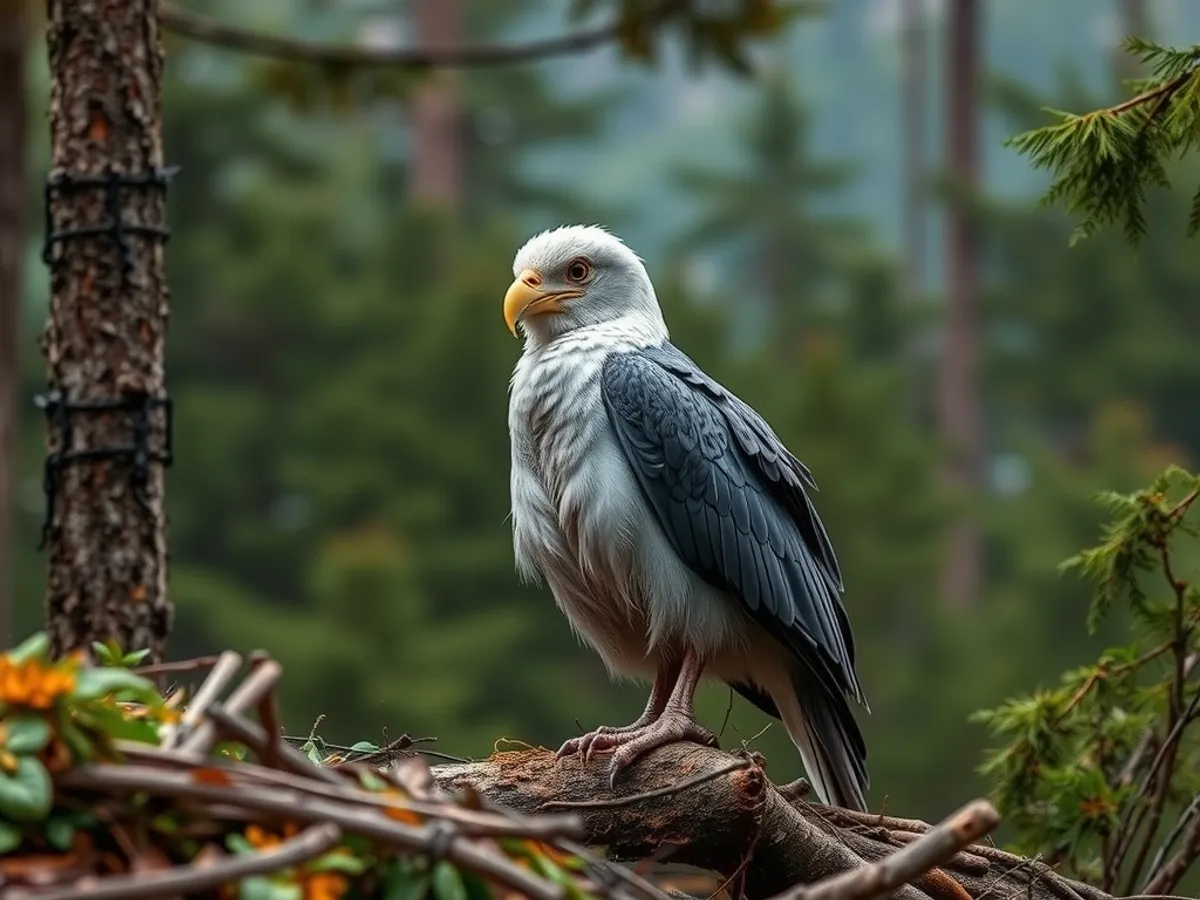
About the Kagu
Rhynochetos jubatus of New Caledonia is a ghost-gray, crested, almost flightless bird with a lineage so isolated that it sits in a family of its own, its nearest living relative the sunbittern of South America - a Gondwanan split. It has a set of features found in almost no other bird: prominent nasal corns, flaps of tissue covering the nostrils to keep soil out while it probes the ground, and an exceptionally high ratio of powder-down feathers, giving it its dusty, ashen look and helping it shed New Caledonia's rain. Its blood cells are unusual, and it has one of the lowest metabolic rates of any bird. It cannot really fly - the wings are full-sized but the flight muscles are weak - and it uses them as a display, spreading them to show bold black-and-white banding that is otherwise completely hidden. It hunts by standing motionless, sometimes with one foot raised, for long periods, listening for movement underground, then striking. Kagu pairs duet at dawn with a barking call that carries 2 km. Reduced to about a thousand birds, its main enemy is dogs, feral and pet, which alone kill a substantial share of the population every year.
Fascinating facts
Flightless Wonder
The Kagu is unable to fly, but it can run swiftly and uses its wings for balance and display.
Endemic to New Caledonia
The Kagu is found only on the main island of New Caledonia, making its survival highly dependent on local conservation.
Strange Nostrils
Its nostrils are covered by unique flaps, a rare feature among birds, to prevent debris from entering as it probes the soil.
Detailed description
The Kagu (Rhynochetos jubatus) is a medium-sized, flightless bird measuring approximately 55 cm (22 in) in length and weighing around 900–1100 grams. Its plumage is a soft, bluish-grey with lighter underparts, providing effective camouflage among the misty forest floor. The bird is instantly recognizable by its prominent, wispy crest, which it can raise or lower depending on mood or social interactions. Its long, sturdy legs and toes are bright red, as is its straight, pointed bill, both adaptations for terrestrial foraging. A unique anatomical feature is the presence of nasal corns—fleshy coverings over the nostrils—believed to protect against dirt while probing the soil. The wings are relatively short and rounded, rendering the Kagu nearly flightless, though it can glide short distances or flutter to low branches if threatened. The eyes are large and dark, aiding vision in the dim understory. The Kagu's vocalizations are complex and loud, used for territory defense and pair bonding, and can carry over long distances through dense vegetation. Its overall morphology and behavior reflect a highly specialized adaptation to the cool, humid montane forests of New Caledonia, where it is the top terrestrial predator among birds.
Did you know?
The Kagu has the largest nostrils of any bird relative to its size, protected by unique flaps to keep out dirt while it forages on the forest floor.
Research & sources
Wikipedia summary
The kagu or cagou is a crested, long-legged, and bluish-grey bird endemic to the dense mountain forests of New Caledonia. It is the only surviving member of the genus Rhynochetos and the family Rhynochetidae, although a second species has been described from the fossil record.
Behaviour & social structure
Kagus are primarily crepuscular, being most active during dawn and dusk, though they may forage throughout the day in overcast or rainy conditions. They are solitary or found in monogamous pairs, fiercely territorial and defending their home ranges with loud, barking calls and visual displays. Foraging is done on the ground, where they walk slowly and methodically, probing leaf litter and soil with their bills to extract invertebrates such as earthworms, snails, insects, and occasionally small vertebrates. When threatened, they freeze and rely on their cryptic coloration, but will raise their crest and spread their wings in a threat display if cornered. Kagus are known for their elaborate courtship rituals, which include synchronized dancing, mutual preening, and duet calling. Daily routines involve preening, sunbathing, and maintaining their territory boundaries through vocalizations.
Reproduction & life cycle
Kagus are monogamous and form long-term pair bonds, with both sexes participating in territory defense and chick rearing. The breeding season typically coincides with the Southern Hemisphere’s cooler months, from June to December. The female lays a single, large, pale-grey egg on a simple ground nest made of leaves and twigs. Both parents share incubation duties over a period of 33–37 days. After hatching, the chick is covered in cryptic down and remains in the nest for several days before becoming mobile. Parental care is extensive; both adults feed and guard the chick for several months, with fledging occurring at around 30–40 days. Juveniles may remain with their parents for up to a year, learning foraging skills and territory boundaries.
Adaptations & survival
The Kagu’s flightlessness is a result of evolutionary isolation in a predator-poor environment, though this has made it vulnerable to introduced mammals. Its strong legs and feet are adapted for terrestrial locomotion and digging. The nasal corns are a unique adaptation among birds, protecting the nostrils from debris during foraging. Its cryptic coloration and secretive behavior help avoid detection by predators. The loud, far-carrying calls are essential for maintaining contact in dense forests and for territory defense. Kagus also have a highly developed sense of hearing, aiding in the detection of prey beneath the leaf litter.
Cultural significance
The Kagu is a national symbol of New Caledonia, featured on the territory’s emblem, stamps, and currency. It holds significant cultural value for the indigenous Kanak people, who regard it as a symbol of the island’s unique natural heritage. The bird’s ghostly appearance and haunting calls have inspired local folklore, often referred to as the 'ghost of the forest.' Historically, the Kagu was occasionally hunted for food or captured as a pet, but such practices have largely ceased due to its protected status and cultural reverence.
Recent research
Recent genetic studies have clarified the Kagu’s phylogenetic position, placing it as the sole extant member of the family Rhynochetidae and order Eurypygiformes, with its closest living relative being the Sunbittern (Eurypyga helias) of Central and South America. Ongoing research focuses on population monitoring, habitat use, and the effectiveness of predator control programs. Notably, a second, extinct species (Rhynochetos orarius) has been described from Holocene subfossil remains, indicating a more diverse past for the genus. Advances in bioacoustics are being used to monitor Kagu populations and understand their complex vocal repertoire. Conservation genetics is also being applied to inform management of the small, fragmented populations.
Videos
Habitat
Mountain forest


Conservation
The Kagu is currently classified as Endangered on the IUCN Red List.
Threats & challenges
The primary threats to the Kagu are predation by introduced mammals, especially dogs, cats, and rats, which prey on eggs, chicks, and adults. Habitat loss due to logging, mining, and forest fragmentation further exacerbates their decline. The species is highly sensitive to disturbance and has a low reproductive rate, making population recovery slow. Current estimates suggest fewer than 1,000 mature individuals remain in the wild, with populations fragmented and declining. Conservation efforts include predator control, habitat protection, and captive breeding, but challenges persist due to ongoing human encroachment and insufficient enforcement of protective measures.
Taxonomy
Scientific name
Rhynochetos jubatus
- Kingdom
- Animalia
- Phylum
- Chordata
- Class
- Aves
- Order
- Eurypygiformes
- Family
- Rhynochetidae
- Genus
- Rhynochetos
- Species
- jubatus
Where to see a kagu
1 zoo and aquarium in 1 country are recorded as keeping this species.

Community notes
Share your observations about the Kagu.
No community notes yet. Be the first!
Discover more wildlife
More fascinating animals from the encyclopedia.