
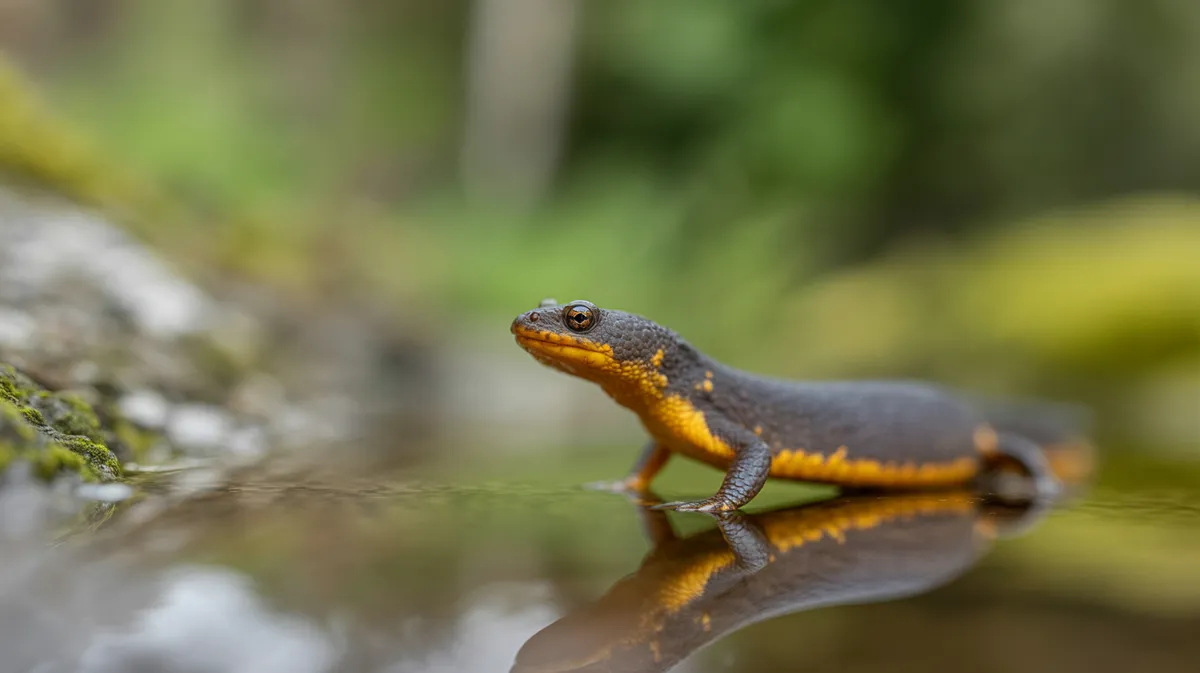
About the Kaiser’s Newt
Kaiser’s Newt, also known as the Luristan Newt or Emperor Newt, is a strikingly colored amphibian native to the Zagros Mountains of Iran. It exhibits vibrant black and white banding along its body, complemented by orange accents on its limbs and tail. This small newt inhabits rocky streams and pools in oak and pistachio woodlands, where it spends much of its life in and around clear, cool freshwater. Kaiser’s Newt is highly threatened due to habitat loss, illegal collection for the pet trade, and its naturally restricted range. As a result, it is considered one of the most endangered amphibians in the world.
Fascinating facts
Striking Coloration
Kaiser’s Newt features bold black-and-white bands and bright orange markings, making it one of the most visually distinctive newts in the world.
Critical Endangerment
The wild population is estimated at fewer than 1,000 mature individuals and continues to decline due to habitat destruction and illegal collection.
Specialized Habitat
This species is restricted to clear, cool, rocky streams in the Zagros Mountains, relying on pristine freshwater for survival and breeding.
Detailed description
Kaiser’s Newt (Neurergus kaiseri) is a small, visually striking salamander, with adults typically reaching 10–14 cm in total length. Its dorsal surface is characterized by a bold pattern of irregular black and white bands, while the ventral side and limbs are marked with vivid orange or red-orange coloration, a likely aposematic signal to potential predators. The skin is smooth and moist, typical of aquatic and semi-aquatic salamanders, and the tail is laterally compressed, aiding in swimming. This species exhibits sexual dimorphism, with males developing a more prominent tail fin and slightly swollen cloacal region during the breeding season. Kaiser’s Newt is primarily nocturnal and crepuscular, spending daylight hours concealed under rocks or submerged debris. It is a relatively solitary animal outside the breeding season, with limited social interaction. The species is highly aquatic during the reproductive period but may become more terrestrial in the drier months, retreating into moist crevices or under logs. Its specialized habitat requirements include clear, cool, flowing streams with abundant cover and minimal siltation, found within the oak and pistachio woodlands of the Zagros Mountains. The newt’s diet consists mainly of aquatic invertebrates, such as insect larvae, small crustaceans, and worms, which it captures using a rapid, protrusible tongue. Its life span in the wild is not precisely known but is estimated to be 8–12 years, with some individuals in captivity living up to 14 years.
Did you know?
Kaiser’s Newt is found naturally in just four small streams, making its wild population exceptionally vulnerable to environmental changes.
Research & sources
Behaviour & social structure
Kaiser’s Newt is generally secretive, spending much of its time hidden beneath rocks or submerged logs to avoid predation and desiccation. It emerges primarily at dusk and during the night to forage, using chemosensory cues to locate prey. The species is an opportunistic feeder, employing a sit-and-wait strategy or slow, deliberate movements to approach prey before striking with its sticky tongue. Social interactions are minimal outside the breeding season, with individuals maintaining small, overlapping home ranges. During the breeding period, males may display courtship behaviors, such as tail-fanning and body undulations, to attract females. Aggressive encounters are rare, but males may compete for access to optimal breeding sites. Daily routines are closely tied to humidity and temperature, with increased activity during wet or humid conditions.
Reproduction & life cycle
Breeding occurs in late winter to early spring (February to April), coinciding with increased water flow in streams. Males arrive at breeding sites first and establish territories. Courtship involves elaborate displays, including tail-fanning and body arching, to entice females. Fertilization is internal: the male deposits a spermatophore, which the female picks up with her cloaca. Females lay between 40–100 eggs, attaching them singly or in small clusters to submerged vegetation or rocks. The eggs hatch after 18–30 days, depending on water temperature. Larvae are fully aquatic, possessing external gills and a finned tail, and undergo metamorphosis after 3–4 months. There is no parental care beyond egg-laying; larvae are independent from hatching.
Adaptations & survival
Kaiser’s Newt exhibits several adaptations for its specialized habitat. Its aposematic coloration warns predators of potential toxicity, as its skin secretes mild toxins. The laterally compressed tail and webbed toes facilitate efficient swimming in fast-flowing streams. Moist, permeable skin allows for cutaneous respiration, which is vital in oxygen-rich, cool water. Behavioral adaptations include nocturnality and the use of refuges to minimize water loss and predation risk. Its reproductive timing is synchronized with seasonal water availability, ensuring optimal conditions for larval development. The species’ ability to aestivate in terrestrial refuges during dry periods is another key survival strategy.
Cultural significance
Kaiser’s Newt holds symbolic value as a flagship species for the conservation of Iran’s unique amphibian fauna. While it does not have a prominent role in local folklore or mythology, its striking appearance has made it a subject of interest among naturalists and conservationists. The species is sometimes featured in environmental education campaigns to raise awareness about habitat preservation and biodiversity in the Zagros region.
Recent research
Recent research has focused on the population genetics and phylogeography of Neurergus kaiseri, revealing low genetic diversity due to its restricted range. Studies on its reproductive biology have informed captive breeding programs, which are now established in several European and North American institutions to support ex situ conservation. Ongoing field surveys aim to identify new populations and monitor habitat quality. There is also research into the species’ skin toxins and their ecological function. Conservation genetics and habitat modeling are current priorities to inform reintroduction and habitat management strategies.
Sources
Taxonomy, distribution and conservation status of Neurergus kaiseri (Caudata: Salamandridae)
Sharifi, M., Vaissi, S., & Papenfuss, T. J. (2012)
scientificNeurergus kaiseri: The IUCN Red List of Threatened Species 2023
IUCN SSC Amphibian Specialist Group
conservationTaxonomy, Distribution and Conservation of Neurergus kaiseri
Rastegar-Pouyani, N. et al. (2006)
scientificNeurergus kaiseri: IUCN Red List of Threatened Species 2023
IUCN SSC Amphibian Specialist Group
conservationVideos
Habitat
Rocky streams and pools in temperate forests (oak and pistachio woodlands)
 Elevated Terrain
Mountain
High-altitude environments with varying climates and specialized wildlife adapted to rugged terrain and thin air.
 Global
Forest
Wooded areas with significant tree cover and diverse plant and animal communities.
 Global
Freshwater
Lakes, rivers, and wetlands with diverse aquatic ecosystems.
Conservation
The Kaiser’s Newt is currently classified as Critically Endangered on the IUCN Red List.
Threats & challenges
The primary threats to Kaiser’s Newt are habitat loss and degradation, driven by deforestation, water extraction, dam construction, and overgrazing by livestock. Its extremely limited range (less than 10 known localities) makes it highly vulnerable to stochastic events. Illegal collection for the international pet trade has historically been a significant threat, although international trade is now regulated under CITES Appendix I. Pollution, especially from agricultural runoff, further degrades aquatic habitats. The population is estimated to be fewer than 1,000 mature individuals and is declining. Conservation challenges include enforcing habitat protection, preventing illegal collection, and mitigating the impacts of climate change, which may alter stream hydrology.
Taxonomy
Scientific name
Neurergus kaiseri
- Kingdom
- Animalia
- Phylum
- Chordata
- Class
- Amphibia
- Order
- Caudata
- Family
- Salamandridae
- Genus
- Neurergus
- Species
- kaiseri
Community notes
Share your observations about the Kaiser’s Newt.
No community notes yet. Be the first!
Discover more wildlife
More fascinating animals from the encyclopedia.