
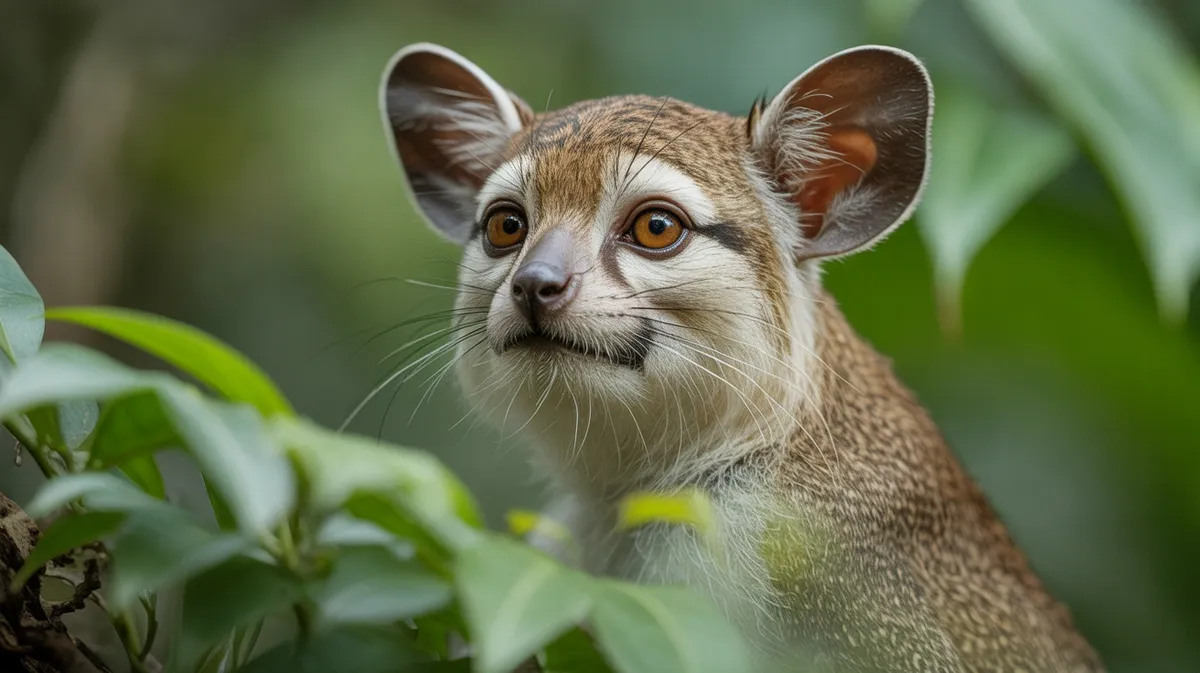
About the Kipunji
Rungwecebus kipunji was discovered in 2003 - independently, and almost simultaneously, by two separate research teams working in different Tanzanian forests - and described in 2005, making it the first new African monkey genus identified in 83 years. It was initially placed in the mangabey genus Lophocebus on appearance, but genetic work in 2006 on a specimen showed it was something else entirely: closer to baboons than to mangabeys, and warranting its own genus, named for Mount Rungwe. Later analysis suggested its origin may involve ancient hybridisation between baboon and mangabey lineages. The kipunji is a long-haired, tan-brown monkey with an upright crest of hair and a distinctive vocalisation that gave it its name - a low, honking bark quite unlike any mangabey's whoop, and used for group cohesion. It survives in two isolated populations in the Southern Highlands and in the Udzungwa Mountains, totalling perhaps a thousand animals across a few dozen square kilometres, which makes it Critically Endangered and one of Africa's rarest primates. Local Nyakyusa people had long known the animal and called it kipunji; scientists heard about it from hunters before ever seeing one.
Fascinating facts
Recently Discovered
The Kipunji was only scientifically described in 2005, making it one of the most recently discovered species of monkey.
Tiny Range
It is found in just two isolated montane forest areas: the Rungwe-Livingstone Forest and Ndundulu Forest in Tanzania.
Unique Calls
The Kipunji communicates with a distinctive loud 'honk-bark' call, unlike the calls of any other African monkey.
Detailed description
The kipunji (Rungwecebus kipunji) is a medium-sized Old World monkey distinguished by its long, upright crest of hair on the crown, a unique feature among African primates. Adults typically measure 85–90 cm in total length, with a tail nearly as long as the body, and weigh between 10–16 kg, with males being slightly larger than females. The fur is a light to medium brown, with paler underparts and a darker face framed by the prominent crest and side-whiskers. The face is expressive, with a relatively short muzzle and forward-facing eyes adapted for arboreal life. Kipunji possess robust limbs and long, dexterous fingers, enabling agile movement through the upper canopy of their montane forest habitat. Socially, they form cohesive groups of 20–39 individuals, typically comprising multiple adult males and females with their offspring, exhibiting a multi-male, multi-female social structure. Vocal communication is highly developed, with a repertoire that includes a distinctive 'honk-bark' call, used for group cohesion and predator warnings. Their diet is primarily folivorous, but they also consume fruits, seeds, flowers, and occasionally invertebrates. Kipunji are diurnal and strictly arboreal, rarely descending to the ground, and are known for their cautious and elusive behavior, which has contributed to their late scientific discovery.
Did you know?
For years, the Kipunji was misidentified and only recognized as a new species after both local reports and camera trap evidence confirmed its existence.
Research & sources
Wikipedia summary
The kipunji, also known as the highland mangabey, is a species of Old World monkey that lives in the highland forests of Tanzania. It was independently described by researchers from the Wildlife Conservation Society, the University of Georgia, and Conservation International, in December 2003 and July 2004, making it the first new African monkey species discovered since 1984. Originally assigned to the genus Lophocebus, genetic and morphological data showed that it is more closely related to the baboons than to the other mangabeys in the genus Lophocebus. Scientists subsequently assigned it to a new genus, Rungwecebus, named after Mount Rungwe. The kipunji is the first new monkey genus discovered since Allen's swamp monkey in 1923.
Behaviour & social structure
Kipunji are highly social primates, spending most of their time in the forest canopy at elevations between 1,300 and 2,450 meters. They travel in loosely coordinated groups, foraging for leaves, fruits, and young shoots, with feeding bouts interspersed with periods of rest and social grooming. Group cohesion is maintained through a complex system of vocalizations, including the unique 'honk-bark' and various grunts and alarm calls. Aggressive encounters are rare but may occur between neighboring groups, particularly during times of resource scarcity. Kipunji exhibit a fission-fusion dynamic, with subgroups splitting and rejoining throughout the day. They are wary of humans and predators, often freezing or fleeing silently into dense foliage when disturbed. Grooming is an important social activity, reinforcing bonds and reducing tension within the group.
Reproduction & life cycle
Kipunji are believed to have a polygynandrous mating system, with both males and females mating with multiple partners. Breeding appears to occur year-round, though some seasonality may be present, with peaks corresponding to periods of increased food availability. The gestation period is estimated at around 5–6 months, after which a single infant is born. Newborns are dependent on their mothers for the first several months, clinging to the belly and later riding on the back. Alloparental care, where other group members assist in caring for infants, has been observed. Weaning occurs at approximately 12–18 months, and sexual maturity is reached at 4–5 years. Interbirth intervals are likely to be 2–3 years, reflecting the slow reproductive rate typical of large-bodied primates.
Adaptations & survival
The kipunji exhibits several adaptations for life in the montane forest canopy. Its long, prehensile tail aids in balance during arboreal locomotion, while strong, flexible limbs and grasping hands facilitate climbing and leaping between branches. The dense, insulating fur provides protection against the cool, moist conditions of high-elevation forests. Their folivorous diet is supported by a robust digestive system capable of processing fibrous plant material, including a large, sacculated stomach. The species' cryptic coloration and cautious behavior reduce predation risk. Social adaptations include complex vocalizations and coordinated group movements, enhancing survival in a fragmented and competitive environment.
Cultural significance
Due to its recent scientific discovery and elusive nature, the kipunji has little direct presence in local folklore or traditional practices. However, its habitat overlaps with areas of cultural importance to local communities, and its conservation has become a symbol of Tanzania's unique biodiversity. The kipunji's discovery has raised awareness of the need to protect montane forests and has become a flagship species for regional conservation initiatives. There are ongoing efforts to engage local communities in habitat protection and sustainable land use.
Recent research
Since its discovery in 2003–2004, the kipunji has been the subject of intensive taxonomic, genetic, and ecological research. Molecular studies revealed that it is more closely related to baboons (genus Papio) than to other mangabeys, leading to its placement in the new genus Rungwecebus. Ongoing research focuses on its population genetics, habitat requirements, and the effects of forest fragmentation. Conservation studies have highlighted the importance of habitat corridors and community-based management. Recent camera trap and acoustic monitoring projects aim to improve population estimates and understand movement patterns. The kipunji's unique evolutionary position provides valuable insights into primate diversification in Africa.
Sources
Videos
Habitat
Montane forest


Conservation
The Kipunji is currently classified as Critically Endangered on the IUCN Red List.
Threats & challenges
The kipunji faces severe threats from habitat loss and fragmentation due to agricultural expansion, logging, and human settlement, particularly in the Southern Highlands and Udzungwa Mountains of Tanzania. Its total population is estimated at fewer than 1,100 individuals, with subpopulations isolated in small forest patches. Illegal hunting for bushmeat and accidental capture in snares further exacerbate population declines. The species' restricted range and low reproductive rate make it highly vulnerable to stochastic events and genetic bottlenecks. Conservation efforts are hindered by limited resources, lack of local awareness, and ongoing habitat encroachment. Climate change poses an additional long-term threat by altering the structure and distribution of montane forests.
Taxonomy
Scientific name
Rungwecebus kipunji
- Kingdom
- Animalia
- Phylum
- Chordata
- Class
- Mammalia
- Order
- Primates
- Family
- Cercopithecidae
- Genus
- Rungwecebus
- Species
- kipunji
Community notes
Share your observations about the Kipunji.
No community notes yet. Be the first!
Discover more wildlife
More fascinating animals from the encyclopedia.