
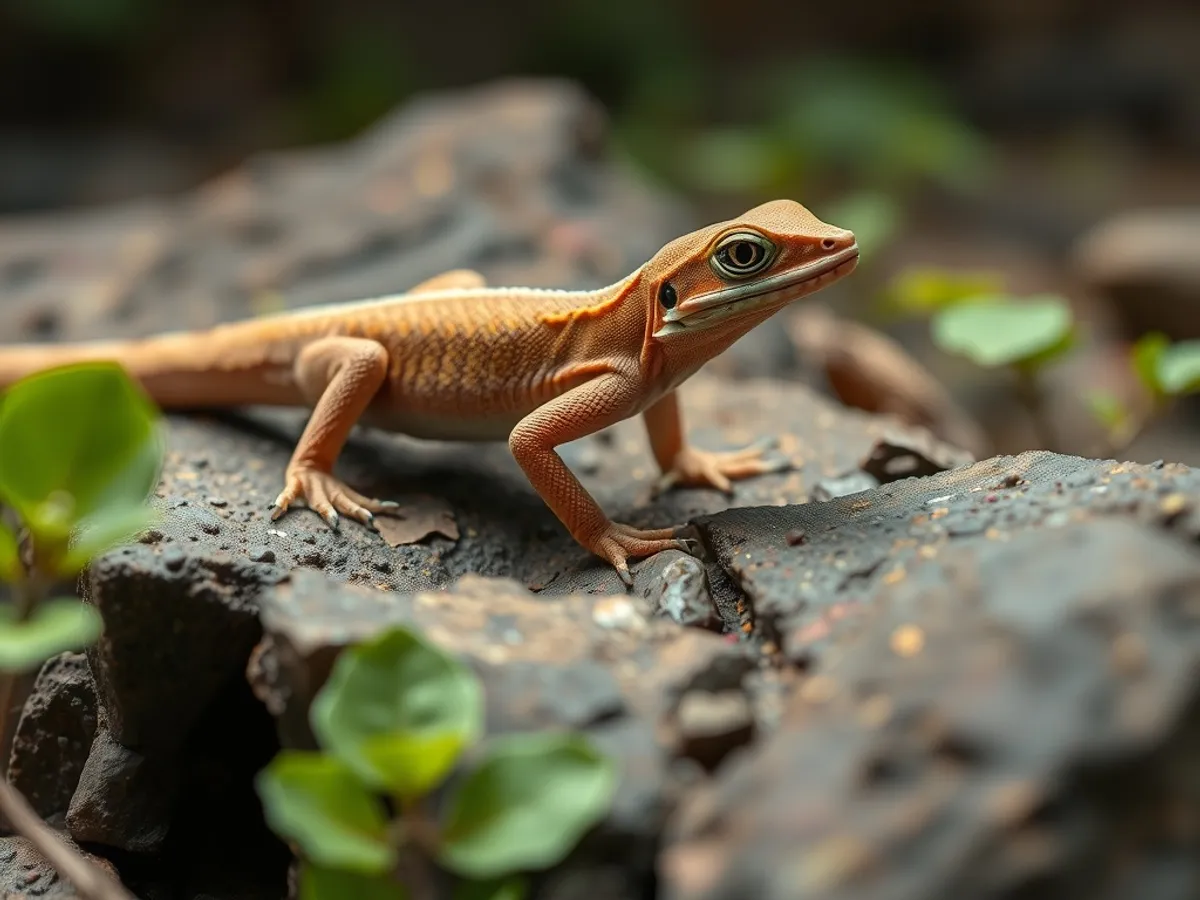
About the Kwangsi gecko
The Kwangsi gecko is a small, nocturnal lizard endemic to the Guangxi (Kwangsi) region of southern China. It is recognized for its striking coloration, often featuring bands of dark and light markings across a robust body and tail. This terrestrial gecko prefers moist, rocky forest habitats, where it shelters under stones and among leaf litter. The species is secretive and rarely seen in the wild, making observations and studies challenging. Its unique appearance and limited range contribute to its appeal among reptile enthusiasts.
Fascinating facts
Nocturnal Hunter
The Kwangsi gecko is most active at night, using its enhanced vision to hunt small invertebrates in the dark.
Tail Autotomy
When threatened, this gecko can detach its tail to distract predators, later regenerating a new one.
Endemic Range
This species is found exclusively in the Guangxi region of southern China, making its conservation especially important.
Detailed description
The Kwangsi gecko (Goniurosaurus kwangsiensis) is a medium-sized, terrestrial gecko distinguished by its robust build and vivid coloration. Adults typically reach a snout-vent length (SVL) of 90–110 mm, with a proportionally thick tail that may serve as a fat reserve. The dorsal surface is marked by alternating dark brown to black and pale yellow or orange bands, which provide effective camouflage among leaf litter and rocky substrates. The skin is covered in fine granular scales interspersed with larger tubercles, giving it a slightly rough texture. The eyes are large, lidless, and possess vertical pupils, an adaptation for nocturnal activity. Limbs are strong and relatively short, aiding in maneuverability across uneven terrain. The species is primarily nocturnal and crepuscular, emerging at dusk to forage. It is highly secretive, spending daylight hours hidden beneath rocks, logs, or within crevices. Kwangsi geckos are solitary outside of the breeding season, exhibiting territorial behavior. Their coloration and cryptic habits, combined with their restricted range, make them difficult to observe in the wild.
Did you know?
Unlike many geckos, the Kwangsi gecko cannot climb smooth vertical surfaces because it lacks adhesive toe pads.
Research & sources
Wikipedia summary
The Kwangsi gecko is a species of gecko. It is endemic to Guangxi Province in China.
Behaviour & social structure
Goniurosaurus kwangsiensis is a nocturnal predator, emerging at night to hunt for small invertebrates such as crickets, beetles, spiders, and other arthropods. It relies on stealth and slow, deliberate movements to approach prey, followed by a rapid strike. The gecko uses its acute sense of smell and vision to locate food. During the day, it remains hidden in moist microhabitats to avoid desiccation and predation. Social interactions are minimal, with individuals maintaining exclusive territories; aggressive displays and tail waving may occur if conspecifics intrude. When threatened, the gecko may autotomize (shed) its tail as a defense mechanism, distracting predators while it escapes. The tail regenerates over time, though it is often shorter and less vividly colored than the original.
Reproduction & life cycle
Breeding in the Kwangsi gecko typically occurs during the warm, humid months from late spring to early summer (May–July). Males engage in courtship displays that include body undulations and gentle biting of the female’s neck. After successful copulation, females lay clutches of 2 eggs in moist, concealed locations such as under rocks or within leaf litter. The eggs are elliptical, measuring approximately 18–22 mm in length. Incubation lasts 60–75 days, depending on ambient temperature and humidity. Hatchlings are independent upon emergence, measuring about 45–50 mm SVL, and exhibit similar coloration to adults. There is no parental care post-oviposition, and juveniles must fend for themselves from birth.
Adaptations & survival
Goniurosaurus kwangsiensis exhibits several adaptations for survival in its subtropical, rocky forest habitat. Its cryptic coloration and banding pattern provide camouflage against predators. The granular and tuberculate skin texture helps reduce water loss and offers some protection from abrasive substrates. The gecko’s large eyes and vertical pupils enhance night vision, crucial for nocturnal foraging. The ability to autotomize the tail is a key anti-predator adaptation, while the regenerated tail serves as a fat storage organ, supporting survival during periods of food scarcity. Behavioral adaptations include strict nocturnality and preference for high-humidity microhabitats, reducing the risk of dehydration.
Cultural significance
There is limited documented cultural significance of Goniurosaurus kwangsiensis within local Guangxi communities. Unlike some other gecko species in East Asia, it does not appear prominently in folklore, traditional medicine, or symbolism. However, its unique appearance and rarity have made it a sought-after species among reptile enthusiasts and collectors, contributing to its vulnerability in the wild.
Recent research
Recent taxonomic studies have clarified the distinction between Goniurosaurus kwangsiensis and closely related species within the Goniurosaurus genus, using both morphological and molecular analyses (Yang & Chan, 2015). Ongoing research focuses on its ecology, population genetics, and the impact of habitat fragmentation. Conservation biologists are investigating the effectiveness of protected areas and captive breeding programs as potential strategies for population recovery. Studies on its reproductive biology and embryonic development are limited, highlighting the need for further field research. The species’ sensitivity to environmental changes makes it a potential indicator for ecosystem health in subtropical karst landscapes.
Sources
Videos
Habitat
Forest and rocky outcrops in subtropical regions


Conservation
The Kwangsi gecko is currently classified as Near Threatened on the IUCN Red List.
Threats & challenges
The Kwangsi gecko faces several conservation challenges. Habitat loss and fragmentation due to agricultural expansion, logging, and infrastructure development in Guangxi Province are primary threats. Illegal collection for the international pet trade also poses significant pressure, given the species’ limited distribution and attractive appearance. Climate change, leading to altered rainfall patterns and increased temperatures, may further impact suitable habitat availability. Population trends are difficult to assess due to the species’ secretive nature, but localized declines have been reported. The species is currently listed as Near Threatened, and effective conservation measures are needed to prevent further decline.
Taxonomy
Scientific name
Goniurosaurus kwangsiensis
- Kingdom
- Animalia
- Phylum
- Chordata
- Class
- Reptilia
- Order
- Squamata
- Family
- Eublepharidae
- Genus
- Goniurosaurus
- Species
- kwangsiensis
Community notes
Share your observations about the Kwangsi gecko.
No community notes yet. Be the first!
Discover more wildlife
More fascinating animals from the encyclopedia.