
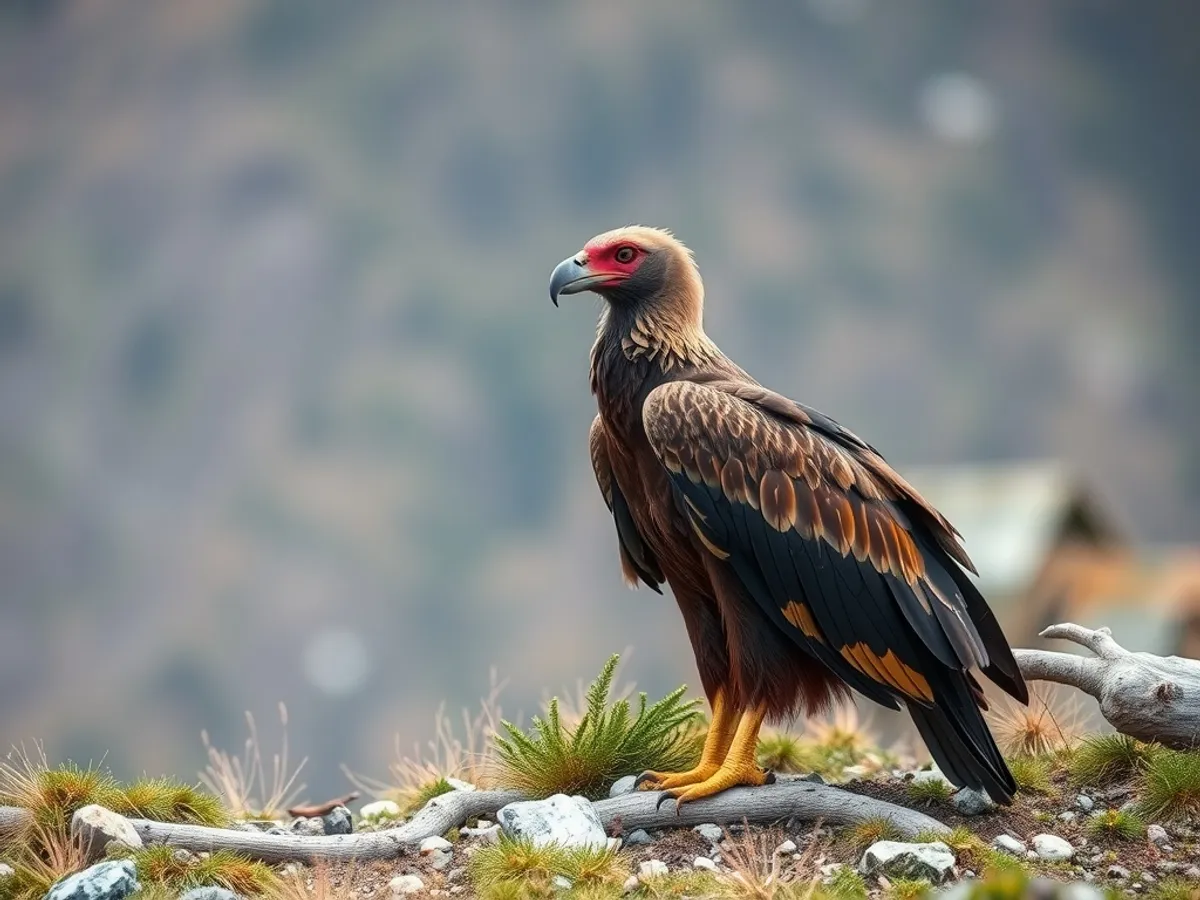
About the Lammergeier
Gypaetus barbatus, the bearded vulture, is the only vertebrate on Earth whose diet is essentially bone - marrow and bone make up 70 to 90 percent of what it eats. It waits until other scavengers have stripped a carcass, then takes the skeleton. Small bones are swallowed whole, and the bird's stomach acid, at around pH 1, is corrosive enough to dissolve compact bone within a day. Bones too large to swallow are carried aloft and dropped onto a favoured slab of rock - an ossuary or "bone-breaking site", used repeatedly for years - from heights of 50 to 150 m, and the bird will make many attempts, adjusting the drop, until the bone shatters and the marrow is accessible. Young birds take years to master the technique. The lammergeier also does something no other bird is known to do deliberately: it bathes in iron-oxide-rich mud and springs, staining its naturally white head and breast a vivid rust-orange. Since the pigment is entirely cosmetic and larger, more dominant birds are more heavily stained, it appears to be a status signal - the only known case of a bird deliberately applying makeup. The Greek playwright Aeschylus is said to have died when one dropped a tortoise on his bald head, mistaking it for a rock.
Fascinating facts
Bone Specialist
Up to 90% of the Lammergeier's diet consists of bone, which it digests with extremely acidic stomach juices.
Bone Dropper
Lammergeiers are known for dropping bones from great heights onto rocks to break them and access the marrow inside.
Colorful Bathers
They acquire their distinctive orange hue by bathing in ferric oxide-rich mud, which stains their feathers.
Detailed description
The Lammergeier, or Bearded Vulture (Gypaetus barbatus), is a striking Old World vulture distinguished by its elongated, narrow wings (wingspan 2.3–2.8 m) and wedge-shaped tail, which is unique among vultures. Adults typically measure 94–125 cm in length and weigh between 4.5 and 7.8 kg, with females generally larger than males. Their plumage is predominantly pale orange to rusty on the underparts, a coloration derived from iron oxide-rich soils in which they bathe, while the head is white with a characteristic black 'beard' and facial mask. The Lammergeier's robust bill and powerful neck muscles are adapted for consuming bones, which comprise up to 90% of its diet. This species is highly adapted to high-altitude environments, commonly found at elevations of 500–4,000 meters, and even up to 7,500 meters in the Himalayas. Lammergeiers are solitary or occur in pairs, rarely forming larger groups except at abundant food sources. Their flight is agile and buoyant, allowing them to soar for hours on thermals while searching for carrion. They play a crucial ecological role as the only vertebrate specialized in bone consumption, thus facilitating nutrient cycling in mountain ecosystems. The species is long-lived, with a lifespan exceeding 20 years in the wild and up to 45 years in captivity.
Did you know?
Lammergeiers have been observed using tools, such as stones, to break open tough bones and even tortoise shells, making them one of the rare tool-using birds.
Research & sources
Wikipedia summary
The bearded vulture, also known as the lammergeier and ossifrage, is a very large bird of prey in the monotypic genus Gypaetus. The bearded vulture is the only known vertebrate whose diet consists of 70–90% bone.
Behaviour & social structure
Lammergeiers are primarily diurnal and spend much of the day soaring over rugged terrain in search of bones and carrion. They exhibit a unique feeding behavior: carrying large bones aloft and dropping them from heights of 50–150 meters onto rocky surfaces to shatter them and access the marrow. This behavior, known as 'ossifrage,' is learned and refined over several years. Lammergeiers are generally solitary outside the breeding season, but pairs maintain large territories (up to 400 km²) and communicate with a range of vocalizations and displays. They are not aggressive at carcasses, often waiting until other scavengers have left before feeding on remaining bones. Daily activity peaks in the morning and late afternoon, with midday spent resting or preening. Juveniles may form loose associations, but adults are territorial and monogamous.
Reproduction & life cycle
Bearded Vultures are monogamous and form long-term pair bonds. Breeding occurs once yearly, typically from December to February, depending on region. Nests are constructed on inaccessible cliff ledges using sticks, wool, and bones, and are reused and enlarged over years, sometimes reaching 2–3 meters in diameter. Females lay 1–2 eggs, which are incubated for 53–60 days by both parents. Usually, only one chick survives due to siblicide or resource limitation. Chicks fledge at 100–130 days but remain dependent on parents for several months. Sexual maturity is reached at 5–7 years, and breeding pairs exhibit strong site fidelity.
Adaptations & survival
The Lammergeier's digestive system is highly specialized, with extremely acidic gastric juices (pH ~1), enabling rapid digestion of bone (within 24 hours). Its powerful bill and neck muscles facilitate bone handling and consumption. The species' wedge-shaped tail and long wings provide exceptional maneuverability and lift in thin mountain air. The orange coloration of the underparts is thought to play a role in social signaling and may provide antibacterial benefits. Behavioral adaptations include delayed breeding and extended parental care, which are suited to the unpredictable food supply in alpine environments. Their keen eyesight allows detection of food sources from great distances.
Cultural significance
The Lammergeier features prominently in the folklore and mythology of many mountain cultures. In the Himalayas, it is revered as a sacred bird and associated with sky burials, where it plays a role in the ritual disposal of human remains. In European folklore, it was once (incorrectly) believed to carry off lambs or even children, leading to persecution. The bird's dramatic appearance and bone-dropping behavior have inspired myths and artistic depictions across its range. Today, it is a symbol of wilderness and conservation in several countries.
Recent research
Recent research has focused on the Lammergeier's unique bone-eating adaptations, including the microbiome of its digestive tract and the biomechanics of bone-dropping. Genetic studies have clarified the species' phylogenetic placement, revealing it is only distantly related to other Old World vultures. Ongoing reintroduction and monitoring programs in the Alps and Pyrenees have provided valuable data on dispersal, survival, and habitat use. Studies have also examined the impact of environmental contaminants and the effectiveness of supplementary feeding stations in supporting population recovery.
Sources
Videos
Habitat
Mountainous regions


Conservation
The Lammergeier is currently classified as Near Threatened on the IUCN Red List.
Threats & challenges
Major threats to Lammergeiers include poisoning (both intentional and accidental), collision with power lines, habitat disturbance, reduced food availability due to changes in traditional livestock practices, and illegal persecution. Lead poisoning from ingesting ammunition fragments is an emerging concern. The population is fragmented and declining in parts of its range, particularly in Europe, where it is classified as Near Threatened by the IUCN. Conservation challenges include maintaining suitable habitat, mitigating human-wildlife conflict, and supporting reintroduction projects. Climate change may further impact alpine ecosystems and prey availability.
Taxonomy
Scientific name
Gypaetus barbatus
- Kingdom
- Animalia
- Phylum
- Chordata
- Class
- Aves
- Order
- Accipitriformes
- Family
- Accipitridae
- Genus
- Gypaetus
- Species
- barbatus
Community notes
Share your observations about the Lammergeier.
No community notes yet. Be the first!
Discover more wildlife
More fascinating animals from the encyclopedia.