
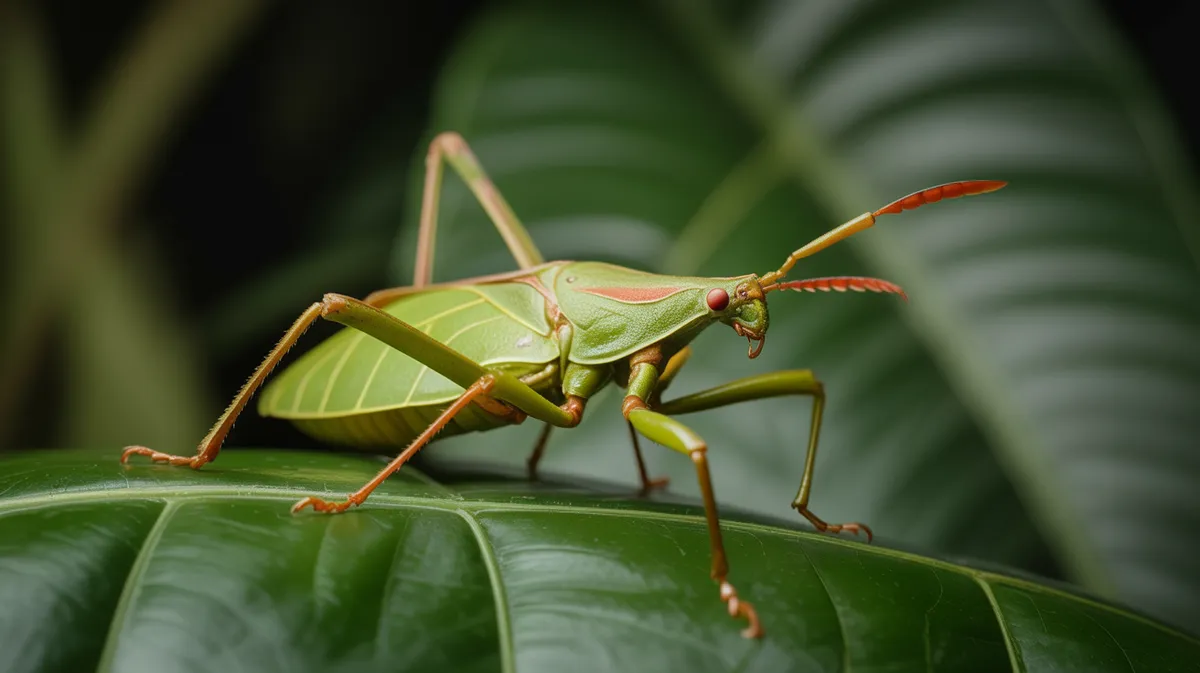
About the Leaf Insect
Leaf insects (family Phylliidae) of South and Southeast Asia are the most complete plant mimics among animals: the body is flattened into a leaf blade with a false midrib and lateral veins, the legs bear flanges that look like smaller leaflets, and the edges of the body carry irregular brown patches and notches that convincingly imitate fungal blotches and insect-chewed damage. The illusion is completed by behaviour - a disturbed leaf insect rocks gently back and forth, mimicking a leaf moving in a breeze, and it will hold that rocking for minutes. The eggs are the second act of the deception. They are hard, sculpted, and closely resemble plant seeds, complete in many species with a fatty knob called a capitulum, which is exactly the structure that seeds use to bribe ants into carrying them. Ants pick up the eggs, take them into the nest, eat the capitulum, and discard the egg intact in the colony's waste chamber, where it sits safe from parasitoid wasps and desiccation until it hatches - a mimicry system called myrmecochory borrowed wholesale from plants. Newly hatched nymphs are red or brown and run quickly to a host plant, where they turn green after their first feed. Many species reproduce by parthenogenesis, and males are rare or unknown in some.
Fascinating facts
Master of Disguise
Leaf insects mimic leaves so convincingly that even their legs have veins and their bodies have irregular, 'nibbled' edges.
Ancient Lineage
Leaf insects belong to the order Phasmatodea, sharing ancestry with stick insects, and have existed for millions of years.
Seed-Like Eggs
Their eggs closely resemble plant seeds, making them difficult for predators to find and eat.
Detailed description
Phyllium philippinicum, a member of the family Phylliidae, is a medium-sized leaf insect renowned for its extraordinary mimicry of living foliage. Adults typically measure 60–90 mm in length, with females being larger and broader than males. Their dorsoventrally flattened bodies are bright green, often with brown or yellowish markings that mimic leaf veins, fungal spots, or decaying edges, enhancing their camouflage. The legs are lobed and flattened, further resembling leaf petioles and margins. Antennae are relatively short in females but longer and more filiform in males, who are also equipped with fully functional wings for flight, unlike the mostly flightless females. The exoskeleton is soft and flexible, aiding in their ability to sway and mimic leaves moved by wind. Leaf insects are primarily nocturnal, remaining motionless and hidden during daylight hours. Their cryptic coloration and behavior make them nearly invisible to predators such as birds and reptiles. When threatened, they may drop to the forest floor and remain still, or gently sway to enhance their disguise. Their life cycle includes egg, nymph, and adult stages, with nymphs already displaying leaf-like features upon hatching.
Did you know?
Despite their leaf-like appearance, leaf insects can sometimes change their shade of green or brown depending on their environment and age.
Research & sources
Wikipedia summary
The family Phylliidae contains the extant true leaf insects or walking leaves, which include some of the most remarkably camouflaged leaf mimics (mimesis) in the entire animal kingdom. They occur from South Asia through Southeast Asia to Australia. Earlier sources treat Phylliidae as a much larger taxon, containing genera in what are presently considered to be several different families.
Behaviour & social structure
Phyllium philippinicum is a solitary and predominantly nocturnal species, emerging at dusk to feed on the leaves of host plants such as guava (Psidium spp.), mango (Mangifera indica), and other native trees. They use their powerful mandibles to chew leaf tissue, often feeding from the edges inward, which can create feeding marks that resemble natural leaf damage. During the day, they remain motionless on the undersides of leaves, relying on their camouflage for protection. Social interactions are minimal, limited mainly to mating encounters. When disturbed, they may perform a rocking or swaying motion to mimic a leaf in the breeze. Males are more active and mobile, especially during the mating season, while females tend to be more sedentary. Both sexes are capable of autotomy, shedding a limb to escape predation if necessary.
Reproduction & life cycle
Reproduction in Phyllium philippinicum is primarily sexual, though parthenogenesis (asexual reproduction) has been observed in captivity. Mating typically occurs at night, with males using their well-developed wings to locate females via pheromonal cues. After copulation, females lay eggs singly, often dropping them to the forest floor or attaching them to leaves. The eggs are oval, brown, and covered with small spines or ridges, measuring about 4–6 mm in length. Incubation lasts 3–6 months, depending on temperature and humidity. Upon hatching, nymphs resemble small, dark brown or reddish ants, which may provide initial protection through Batesian mimicry. As they molt and grow, they gradually acquire their characteristic leaf-like appearance. There is no parental care; nymphs are independent from birth.
Adaptations & survival
Phyllium philippinicum exhibits a suite of remarkable adaptations for survival. Its primary defense is morphological mimicry: the body, legs, and even wing venation closely resemble leaves, complete with simulated veins, irregular edges, and color variations. Behavioral adaptations include remaining motionless during the day and swaying when disturbed. The ability to autotomize limbs provides an escape mechanism from predators. Nymphs display ant mimicry, which deters some predators during their vulnerable early life stages. Their nocturnal habits reduce exposure to diurnal predators. The flattened body allows them to press closely against leaves, minimizing shadows and further enhancing concealment.
Cultural significance
Leaf insects have fascinated humans for centuries, often featured in local folklore as symbols of invisibility, transformation, or natural harmony. In the Philippines and other parts of Southeast Asia, they are sometimes kept as pets or displayed in insect collections, admired for their beauty and camouflage. Their remarkable mimicry has inspired art, literature, and educational programs focused on biodiversity and adaptation. However, they have limited direct use in traditional medicine or cuisine.
Recent research
Recent research has focused on the genetic basis of leaf mimicry in Phylliidae, revealing complex developmental pathways that regulate body shape and coloration. Studies using molecular phylogenetics have clarified relationships within the family, leading to the description of new species and genera. Behavioral ecology investigations have documented the effectiveness of their camouflage against avian and reptilian predators. Conservation studies are ongoing to assess the impact of habitat fragmentation and to develop captive breeding protocols for threatened populations. Notably, a 2021 study used high-resolution imaging to analyze the microstructure of their cuticle, providing insights into the evolution of plant mimicry in insects.
Videos
Habitat
Tropical forest


Conservation
The Leaf Insect is currently classified as Least Concern on the IUCN Red List.
Threats & challenges
Currently, Phyllium philippinicum is classified as Least Concern, but localized threats exist. Habitat loss due to deforestation and agricultural expansion in Southeast Asia poses the greatest risk, as these insects are dependent on intact forest canopies. Pesticide use and collection for the pet trade also contribute to population pressures in some areas. Climate change may alter the distribution of suitable host plants, indirectly affecting their survival. Despite these challenges, the species remains relatively stable in protected and undisturbed habitats.
Taxonomy
Scientific name
Phyllium philippinicum
- Kingdom
- Animalia
- Phylum
- Arthropoda
- Class
- Insecta
- Order
- Phasmatodea
- Family
- Phylliidae
- Genus
- Phyllium
- Species
- philippinicum
Community notes
Share your observations about the Leaf Insect.
No community notes yet. Be the first!
Discover more wildlife
More fascinating animals from the encyclopedia.