
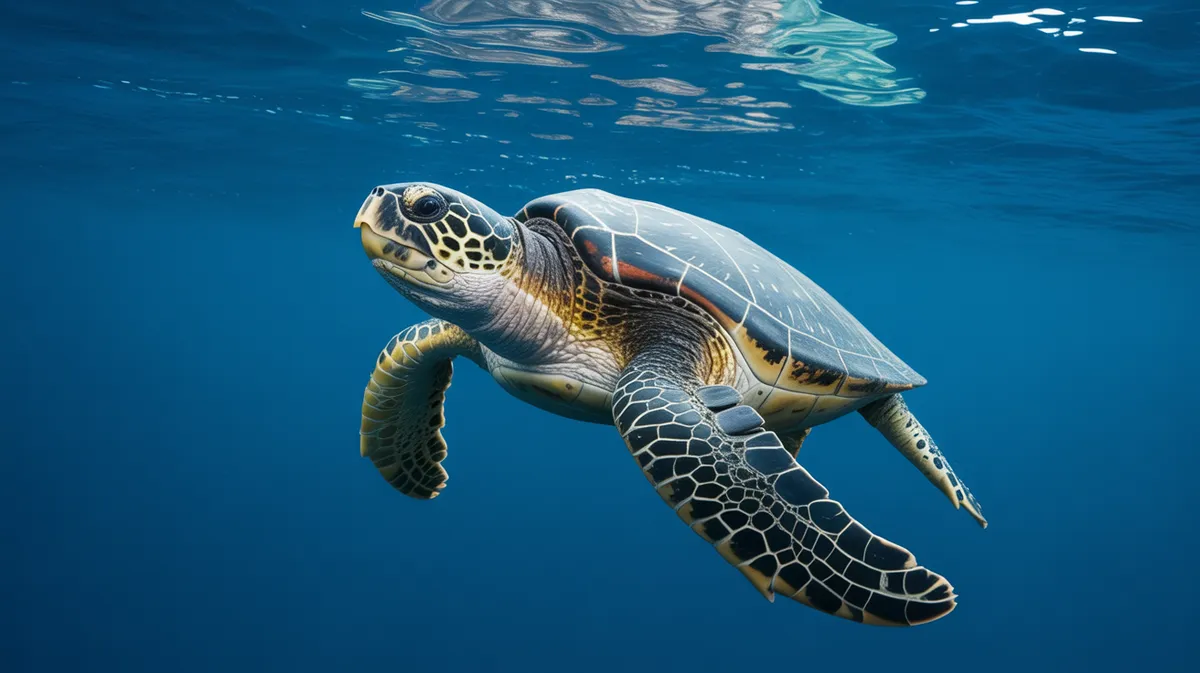
About the Leatherback Sea Turtle
The leatherback is the largest turtle alive and the only one without a hard shell — instead it carries a leathery, oil-saturated skin over a mosaic of small bones, which lets its body deform under pressure rather than resist it. That is what allows it to dive beyond a thousand metres, deeper than any other reptile. It is also, functionally, a warm-blooded reptile: sheer bulk, a thick insulating fat layer, counter-current heat exchangers in the flippers and near-continuous swimming let it hold its body well above the temperature of the water around it, so it can forage in seas off Canada and Norway that would immobilise any other turtle. Its entire diet is essentially jellyfish, which are around ninety-five per cent water, so it must eat an enormous volume every day, and its throat and oesophagus are lined with backward-pointing keratin spines that stop the slippery prey from escaping back out. Those same spines mean that a swallowed plastic bag — which looks exactly like a jellyfish — cannot be brought back up.
Fascinating facts
Giant Size
Leatherback sea turtles are the largest turtles on Earth and can reach lengths over 2 meters (6.5 feet).
Extreme Divers
They are capable of diving deeper than most other reptiles, reaching depths exceeding 1,200 meters (4,000 feet) in search of prey.
Long-Distance Travelers
Leatherbacks undertake some of the longest migrations of any marine animal, crossing entire ocean basins between feeding and nesting grounds.
Detailed description
The Leatherback Sea Turtle (Dermochelys coriacea) is a unique marine reptile and the sole extant member of the family Dermochelyidae. Adults typically measure 1.5–2.0 meters in carapace length, with some individuals reaching up to 2.7 meters, and can weigh between 250 and 700 kilograms, making them the largest living turtles and the heaviest non-crocodilian reptiles. Unlike other sea turtles, leatherbacks lack a hard, bony shell; instead, their carapace is composed of a mosaic of small bones embedded in a thick, leathery skin with seven prominent longitudinal ridges. Their streamlined, hydrodynamic body and large, paddle-like forelimbs—proportionally the longest of any sea turtle—enable them to undertake transoceanic migrations of over 15,000 kilometers annually. Leatherbacks are deep divers, regularly reaching depths of 300–1,200 meters and occasionally descending beyond 1,200 meters in search of prey. Their body temperature can remain several degrees above ambient water due to a combination of large body size, counter-current heat exchangers, and a thick layer of subdermal fat, allowing them to forage in cold temperate and even subpolar waters. The species is solitary for most of its life, coming ashore only to nest. Leatherbacks possess specialized backward-pointing spines (papillae) in their esophagus, which help them consume and retain gelatinous prey such as jellyfish. Their global distribution spans the Atlantic, Pacific, and Indian Oceans, with distinct subpopulations exhibiting unique migratory and nesting behaviors.
Did you know?
Leatherback sea turtles can migrate more than 10,000 miles (16,000 kilometers) each year, making them one of the most widely traveled marine creatures.
Research & sources
Wikipedia summary
The leatherback sea turtle, sometimes called the lute turtle, leathery turtle or simply the luth, is the largest of all living turtles and the heaviest non-crocodilian reptile, reaching lengths of up to 2.7 metres and weights of 500 kilograms (1,100 lb). It is the only living species in the genus Dermochelys and family Dermochelyidae. It can easily be differentiated from other modern sea turtles by its lack of a bony shell; instead, its carapace is covered by oily flesh and flexible, leather-like skin, for which it is named. Leatherback turtles have a global range, although there are multiple distinct subpopulations. The species as a whole is considered vulnerable, and some of its subpopulations are critically endangered.
Behaviour & social structure
Leatherback sea turtles are primarily solitary and spend the majority of their lives in pelagic (open ocean) environments. They are highly migratory, with individuals traveling across entire ocean basins between nesting and foraging grounds. Feeding occurs mainly at the surface or at depth, where they actively hunt gelatinous zooplankton, especially jellyfish, using visual cues. Leatherbacks are crepuscular and nocturnal feeders, often foraging at night when jellyfish are more abundant near the surface. They are capable of deep, prolonged dives lasting up to 85 minutes, facilitated by their collapsible lungs and high oxygen storage capacity. Social interactions are minimal outside of the breeding season, and there is little evidence of coordinated group behavior. On nesting beaches, females exhibit strong natal homing, returning to the same region where they were born to lay eggs. Males rarely return to land after reaching maturity.
Reproduction & life cycle
Leatherback reproduction is characterized by internal fertilization, with mating occurring in offshore waters near nesting beaches. Females nest every 2–3 years, laying 4–7 clutches per season at intervals of 8–12 days. Each clutch contains approximately 50–110 eggs, of which a portion are infertile 'yolkless' eggs, possibly serving as a buffer against predation or desiccation. Incubation lasts 60–70 days, with temperature-dependent sex determination: warmer sand produces females, cooler sand produces males. Females exhibit no parental care beyond egg-laying, and hatchlings emerge en masse at night to reduce predation risk. Breeding seasons vary by region but typically coincide with warmer months. Sexual maturity is reached at 9–20 years, though precise age estimates remain uncertain due to the species' long pelagic juvenile phase.
Adaptations & survival
Leatherbacks possess several remarkable adaptations. Their lack of a rigid shell and presence of a flexible, streamlined carapace reduce drag and enable deep diving. The thick, oily skin and underlying fat layer provide insulation against cold waters, while counter-current heat exchange in their flippers minimizes heat loss. Their large size confers thermal inertia, further aiding endothermy. The esophageal papillae allow them to consume large volumes of soft-bodied prey without injury from stinging cells. Their powerful forelimbs facilitate long-distance swimming and rapid movement. Sensory adaptations include acute vision adapted for low-light conditions and possible detection of Earth's magnetic field for navigation. Their reproductive strategy of producing many eggs per season compensates for high hatchling mortality.
Cultural significance
Leatherback turtles hold cultural importance in many coastal communities. In some regions, they are revered in local mythology and folklore, symbolizing endurance, navigation, and the mysteries of the sea. Historically, their eggs and meat have been harvested for food, and their oil used for medicinal or ritual purposes, though such practices are now illegal or discouraged in most countries. Leatherbacks also serve as flagship species for marine conservation, raising public awareness about ocean health and the impacts of plastic pollution.
Recent research
Recent research has focused on satellite telemetry to track migratory routes, revealing transoceanic movements and critical foraging areas. Studies on thermal biology have elucidated their capacity for regional endothermy, a rare trait among reptiles. Genetic analyses are clarifying population structure and connectivity, informing conservation management. Ongoing research addresses the impacts of climate change on nesting success, particularly skewed sex ratios due to rising sand temperatures. Innovative bycatch reduction technologies and community-based nest protection programs are being developed and assessed for effectiveness.
Sources
Turtles of the World, 2010 Update: Annotated Checklist of Taxonomy, Synonymy, Distribution and Conservation Status
Rhodin, A.G.J., van Dijk, P.P., Inverson, J.B., Shaffer, H.B. (2010)
scientificVideos
Habitat
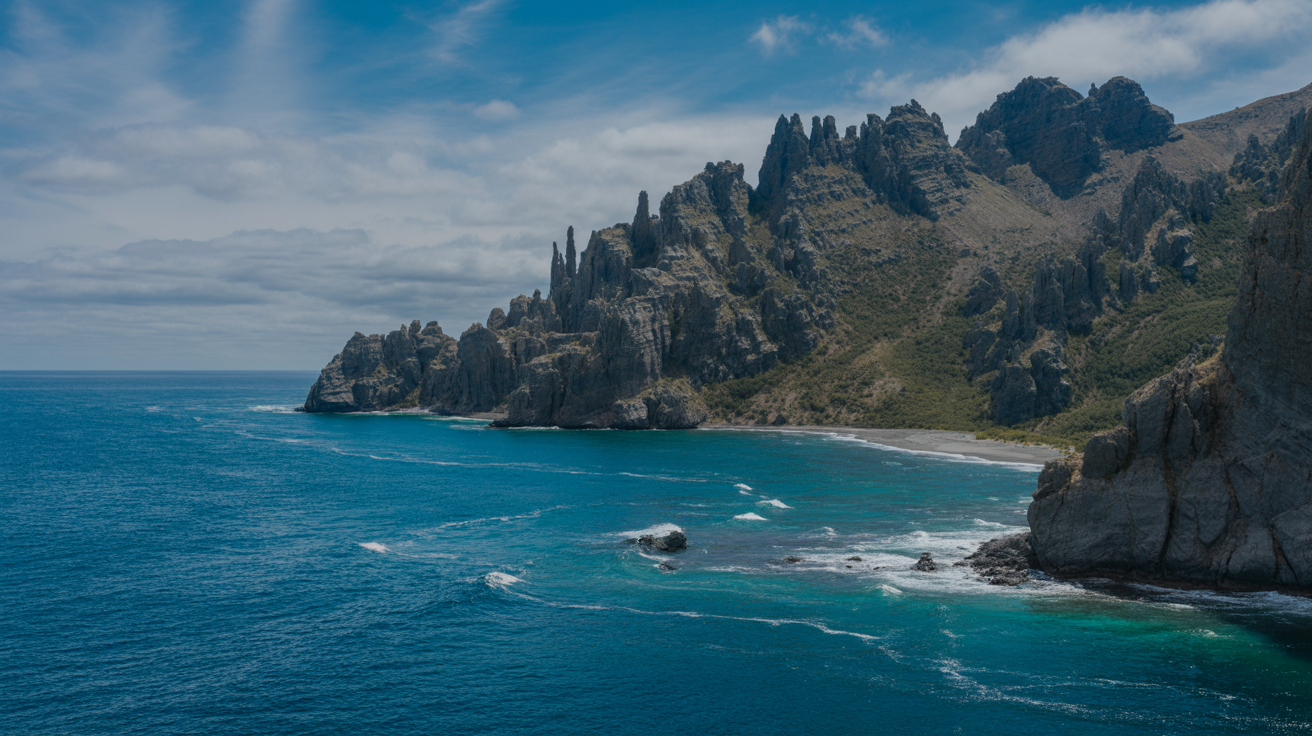
Open ocean
Conservation
The Leatherback Sea Turtle is currently classified as Vulnerable on the IUCN Red List.
Threats & challenges
Leatherback populations face numerous threats, including bycatch in fisheries (especially longline and gillnet operations), ingestion of marine debris (notably plastic bags mistaken for jellyfish), direct harvest of eggs and adults, coastal development reducing nesting habitat, climate change affecting sex ratios and nesting success, and predation on eggs and hatchlings by mammals, birds, and crabs. Some subpopulations, such as those in the Pacific, have experienced dramatic declines of over 90% in recent decades. Global population trends are variable, with some Atlantic populations stable or increasing due to conservation efforts, while Pacific populations remain critically endangered. Conservation challenges include enforcing international protections, reducing bycatch, protecting nesting beaches, and mitigating climate impacts.
Taxonomy
Scientific name
Dermochelys coriacea
- Kingdom
- Animalia
- Phylum
- Chordata
- Class
- Reptilia
- Order
- Testudines
- Family
- Dermochelyidae
- Genus
- Dermochelys
- Species
- coriacea
Community notes
Share your observations about the Leatherback Sea Turtle.
No community notes yet. Be the first!
Discover more wildlife
More fascinating animals from the encyclopedia.