
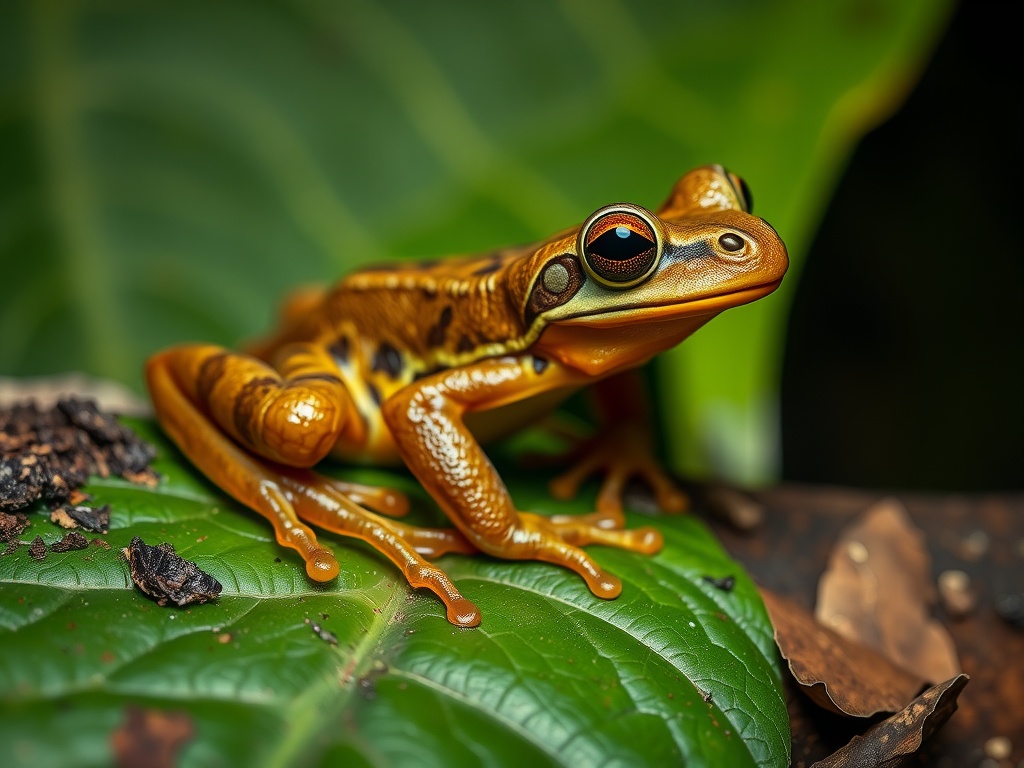
About the Lemur Leaf Frog
The Lemur Leaf Frog is a small, slender amphibian known for its bright green coloration and large, expressive eyes. Native to Central America, this nocturnal frog is arboreal, spending most of its life in the rainforest canopy. Its skin can change color from green during the day to brown at night, providing camouflage from predators. The species is highly sensitive to environmental changes and is a flagship for amphibian conservation efforts. Its population has declined drastically due to habitat loss, disease, and climate change.
Fascinating facts
Arboreal Lifestyle
The Lemur Leaf Frog spends the majority of its life high in the trees of tropical rainforests, only descending to breed.
Striking Eyes
This frog has unusually large, golden eyes with vertical pupils, helping it see in low light conditions.
Color Change
By day, its skin is bright green to blend with leaves, but at night, it turns brown to match tree bark and avoid predators.
Detailed description
The Lemur Leaf Frog (Agalychnis lemur) is a small, slender tree frog, with adults typically measuring 30–45 mm in snout-vent length. Its most striking feature is its large, protruding, golden-brown eyes with vertical pupils, which are well-adapted for nocturnal vision. The dorsal skin is smooth and bright green during the day, shifting to a brown or reddish hue at night—a remarkable example of diurnal color change for camouflage. The ventral surface is pale, and the limbs are long and delicate, equipped with adhesive toe pads that facilitate an arboreal lifestyle. Unlike many other tree frogs, the Lemur Leaf Frog lacks webbing between its fingers and toes, reflecting its adaptation to climbing rather than swimming. Its body is laterally compressed, allowing it to blend seamlessly with leaves. This species is primarily nocturnal, emerging at dusk to forage and mate. During the day, it rests on the undersides of leaves, minimizing water loss and predation risk. The Lemur Leaf Frog is highly sensitive to environmental changes, making it an important indicator species for rainforest health.
Did you know?
Despite being called the Lemur Leaf Frog, it is not related to lemurs; the name refers to its eye and face shape.
Research & sources
Wikipedia summary
Agalychnis lemur, the lemur leaf frog or lemur frog, is a species of frog in the subfamily Phyllomedusinae. It is found in Costa Rica, Panama, and adjacent northwestern Colombia. It is classed as Critically Endangered and threatened by the fungal disease chytridiomycosis.
Behaviour & social structure
Agalychnis lemur is a solitary and secretive species, spending most of its life in the rainforest canopy, typically 1–5 meters above ground. It is strictly nocturnal, becoming active at night to hunt for small arthropods such as insects and spiders. The frog uses its excellent vision and stealth to ambush prey, relying on a sit-and-wait strategy. During the day, it remains motionless on the undersides of leaves, adopting a cryptic posture with limbs tucked in to reduce visibility. Social interactions are limited outside of the breeding season, with males establishing small territories around suitable egg-laying sites. Vocalizations are infrequent and generally limited to soft, low-pitched calls during courtship or territorial disputes. The species exhibits minimal aggression, with encounters between adults rarely escalating beyond vocal displays.
Reproduction & life cycle
Breeding occurs during the rainy season, typically from May to November, when humidity is high and temporary pools form. Males call softly from vegetation overhanging water bodies to attract females. Amplexus is axillary, with the male grasping the female just behind her forelimbs. Females lay clutches of 15–30 eggs on the upper surfaces of leaves above water. The eggs are encased in a gelatinous mass to prevent desiccation. Embryonic development lasts 6–10 days, after which the tadpoles drop into the water below upon hatching. There is no direct parental care post-oviposition, but the choice of oviposition site is critical for offspring survival. Tadpoles are free-swimming and metamorphose into froglets after 6–8 weeks, depending on environmental conditions.
Adaptations & survival
The Lemur Leaf Frog exhibits several adaptations for arboreal life, including expanded toe pads with specialized mucous glands for adhesion to smooth leaves. Its diurnal color change is a sophisticated form of camouflage, reducing predation risk by matching the background at different times of day. The skin contains peptides with antimicrobial properties, offering some defense against pathogens. The species’ laterally compressed body and long limbs enable efficient movement through dense foliage. Its large eyes enhance night vision, crucial for nocturnal foraging and predator avoidance. The gelatinous egg mass protects developing embryos from desiccation and some predators. Behavioral adaptations, such as resting on leaf undersides and minimizing movement during daylight, further reduce water loss and detection by predators.
Cultural significance
While the Lemur Leaf Frog does not have a prominent role in indigenous folklore or traditional medicine, it has become a symbol of amphibian conservation in Central America. Its striking appearance and vulnerability have made it a flagship species for rainforest preservation campaigns and environmental education programs. The frog is featured in ecotourism materials and conservation literature, raising awareness about the plight of amphibians globally. Captive breeding programs, such as those at the Manchester Museum and other institutions, have further highlighted its importance as an ambassador for amphibian conservation.
Recent research
Recent research has focused on the Lemur Leaf Frog’s susceptibility to chytridiomycosis, with studies examining the efficacy of skin peptides in resisting fungal infection. Genetic analyses have revealed low genetic diversity in remnant populations, underscoring the urgency of conservation interventions. Behavioral studies have documented the species’ unique diurnal color change and its role in predator avoidance. Captive breeding and reintroduction trials are ongoing, with promising results in maintaining healthy populations ex situ. Ecological studies are investigating the frog’s microhabitat preferences and the impact of climate variability on breeding success. The species is also used as a model organism for studying amphibian responses to environmental stressors.
Sources
Agalychnis lemur (Lemur Leaf Frog): Natural History and Conservation
IUCN SSC Amphibian Specialist Group (2020)
scientificThe Lemur Leaf Frog: Conservation, Captive Breeding, and Reintroduction
Tapley, B., Rowley, J.J.L., et al. (2015)
scientificVideos
Habitat
Humid lowland and montane rainforests
 Elevated Terrain
Mountain
High-altitude environments with varying climates and specialized wildlife adapted to rugged terrain and thin air.
 Tropical Regions
Rainforest
Dense, wet forests with the highest biodiversity on Earth, containing more than half of the world's plant and animal species.
 Global
Forest
Wooded areas with significant tree cover and diverse plant and animal communities.
Conservation
The Lemur Leaf Frog is currently classified as Critically Endangered on the IUCN Red List.
Threats & challenges
Agalychnis lemur faces severe threats from habitat loss due to deforestation, agricultural expansion, and infrastructure development in Central America. The species is highly susceptible to chytridiomycosis, a fungal disease caused by Batrachochytrium dendrobatidis, which has decimated populations throughout its range. Climate change exacerbates these threats by altering rainfall patterns and increasing the frequency of extreme weather events, impacting breeding success. Pesticide use and pollution further degrade habitat quality. The population has declined by over 80% in some areas since the 1990s, and the species is now classified as Critically Endangered by the IUCN. Fragmented populations are at increased risk of inbreeding and local extinction. Conservation efforts are hampered by the frog’s secretive habits and the inaccessibility of its preferred habitats.
Taxonomy
Scientific name
Agalychnis lemur
- Kingdom
- Animalia
- Phylum
- Chordata
- Class
- Amphibia
- Order
- Anura
- Family
- Phyllomedusidae
- Genus
- Agalychnis
- Species
- lemur
Where to see a lemur leaf frog
1 zoo and aquarium in 1 country are recorded as keeping this species.

Community notes
Share your observations about the Lemur Leaf Frog.
No community notes yet. Be the first!
Discover more wildlife
More fascinating animals from the encyclopedia.