
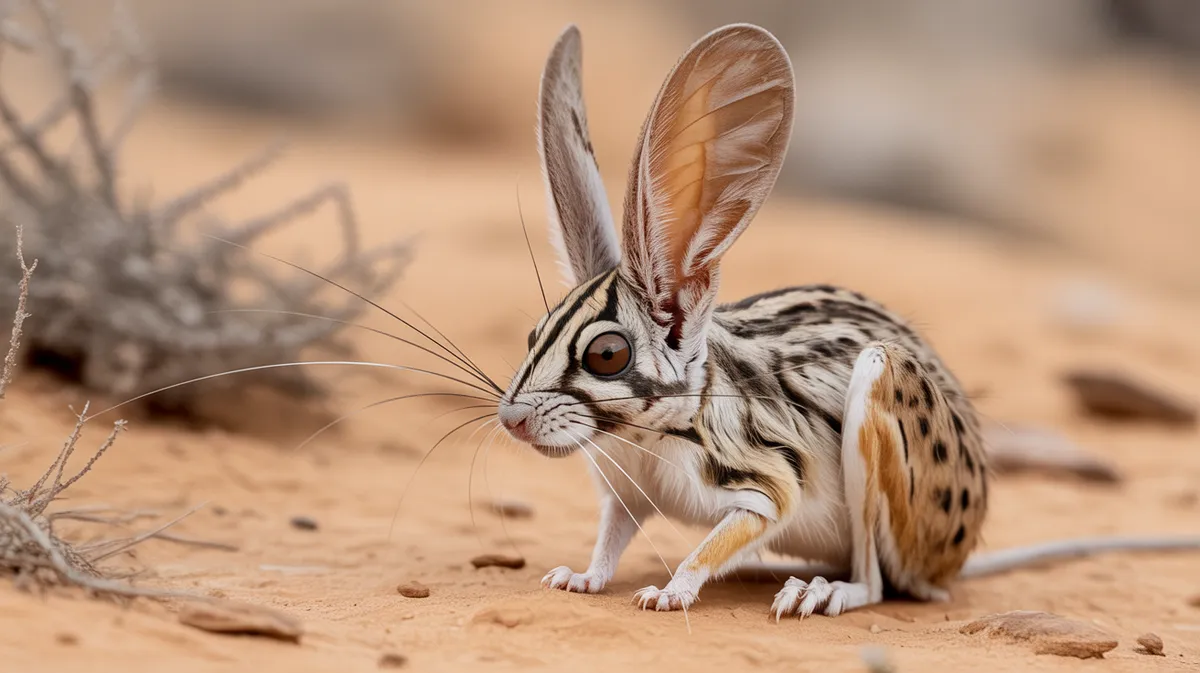
About the Long-eared Jerboa
Euchoreutes naso of the deserts of Mongolia and northwestern China has ears that are roughly a third longer than its head - the largest ear-to-body ratio of any mammal - mounted on a body the size of a golf ball with a tail nearly twice the body's length and hind legs like a miniature kangaroo. It is a hopping bipedal rodent that can leap several times its own body length, and the tail, tipped with a black-and-white tuft, works as a counterbalance and rudder in mid-air. The ears are not simply for hearing prey; they are large radiators, dumping heat in a desert that is brutally hot by day, and they also give it exceptional acuity for detecting the insects it hunts at night and the owls and foxes that hunt it. Its feet carry brushes of stiff hairs that give traction on loose sand and let it kick sand backwards while burrowing. It shelters in burrows by day, plugging the entrance, and it hibernates through the Gobi winter. The species is nocturnal, rare, poorly known, and was virtually never filmed until a Zoological Society of London expedition captured footage in 2007 as part of the EDGE programme, giving the world its first real look at a living one.
Fascinating facts
Record-Breaking Ears
The long-eared jerboa's ears are longer than its entire head, helping it detect insects and dissipate heat.
Desert Acrobat
This rodent's powerful hind legs allow it to leap many times its own body length to avoid predators and navigate sandy deserts.
Nocturnal Hunter
Long-eared jerboas are active only at night, emerging under the cover of darkness to hunt insects and other small invertebrates.
Detailed description
The long-eared jerboa (Euchoreutes naso) is a diminutive desert rodent, measuring 7–9 cm in head-body length, with a tail that can reach up to 15–16 cm—often twice the length of its body. Its most striking features are its disproportionately large, membranous ears, which can be up to 5 cm long, and its elongated hind limbs, adapted for saltatorial (jumping) locomotion. The fur is silky and dense, colored pale sandy-brown dorsally and white ventrally, providing camouflage against desert substrates. The snout is long and flexible, aiding in foraging for insects and other small invertebrates. The jerboa's hind feet are three-toed and highly specialized for leaping, while the forelimbs are much shorter and used primarily for handling food. Its large, dark eyes are adapted for nocturnal vision, and the long, tufted tail provides balance during rapid, erratic jumps. The species is solitary and elusive, spending daylight hours in burrows to avoid extreme temperatures and emerging at night to forage. Its overall morphology is an example of convergent evolution, sharing similarities with other desert-adapted rodents despite distant relationships.
Did you know?
Despite looking mouse-like, the long-eared jerboa is more closely related to gerbils than to mice or rats.
Research & sources
Wikipedia summary
The long-eared jerboa is a nocturnal mouse-like rodent with a long tail, long hind legs for jumping, and exceptionally large ears. It is distinct enough that authorities consider it to be the only member of both its genus, Euchoreutes, and subfamily, Euchoreutinae.
Behaviour & social structure
Long-eared jerboas are strictly nocturnal, emerging from their burrows shortly after sunset. Their movement is characterized by powerful, bipedal leaps, often covering distances of up to 1 meter in a single bound. Foraging is primarily insectivorous, with a diet consisting mainly of moths, beetles, and other arthropods, supplemented occasionally by seeds and plant material. They use their acute hearing to detect prey and predators in the dark. Social interactions are minimal; individuals are largely solitary outside of the breeding season, with overlapping home ranges but little direct contact. They communicate through ultrasonic vocalizations and scent marking. During the day, jerboas remain in self-excavated burrows, which can be up to 1 meter deep and are sealed from the inside to maintain humidity and temperature. Activity levels are highly influenced by moonlight and temperature, with reduced activity during bright or cold nights to avoid predation and conserve energy.
Reproduction & life cycle
Breeding in the long-eared jerboa is seasonal, typically occurring from late spring to early summer, coinciding with increased insect abundance. Males and females come together briefly for mating, after which females gestate for approximately 25–30 days. Litters usually consist of 2–6 altricial young, born blind and hairless in the safety of the maternal burrow. The mother provides sole parental care, nursing the young until they are weaned at around 4–5 weeks of age. Juveniles reach sexual maturity within their first year, allowing for rapid population recovery in favorable conditions. There is little evidence of paternal involvement, and breeding frequency may be limited by environmental conditions and food availability.
Adaptations & survival
The long-eared jerboa exhibits a suite of adaptations for desert survival. Its large ears serve a dual function: enhancing auditory acuity for detecting prey and predators, and facilitating thermoregulation by dissipating excess body heat. The elongated hind limbs and reduced forelimbs are specialized for saltation, enabling rapid escape from predators and efficient travel across loose sand. The fur's coloration provides camouflage, while the dense underfur insulates against temperature extremes. Burrowing behavior protects against daytime heat and desiccation. Its kidneys are highly efficient, minimizing water loss, and it obtains most of its moisture from food. Nocturnality reduces exposure to predators and extreme temperatures. The long, sensitive vibrissae (whiskers) aid in navigation and foraging in darkness.
Cultural significance
The long-eared jerboa has little direct significance in traditional human culture, likely due to its secretive, nocturnal habits and sparse distribution. However, it has gained attention in modern times as a symbol of desert biodiversity and adaptation, featuring in conservation campaigns and educational materials. Its unusual appearance has made it a subject of fascination in popular media and wildlife documentaries, helping to raise awareness of lesser-known desert fauna.
Recent research
Recent research has focused on the long-eared jerboa's unique locomotion and auditory adaptations, with high-speed video analyses revealing the biomechanics of its saltatory movement. Genetic studies have confirmed its distinct evolutionary lineage within Dipodidae, supporting its placement in a monotypic genus and subfamily. Ongoing fieldwork in Mongolia and China aims to clarify its distribution, population trends, and responses to environmental change. Notably, a 2007 expedition by the Zoological Society of London captured the first video footage of the species in the wild, sparking renewed interest in its conservation. Studies on its thermoregulatory physiology and water economy are ongoing, given its extreme desert environment.
Videos
Habitat
Desert


Conservation
The Long-eared Jerboa is currently classified as Endangered on the IUCN Red List.
Threats & challenges
Despite being classified as Least Concern by the IUCN, the long-eared jerboa faces several threats. Habitat degradation from overgrazing, mining, and infrastructure development in Central Asian deserts (notably in Mongolia and northwestern China) poses significant risks. Climate change may further exacerbate habitat loss and alter prey availability. The species' elusive nature and low population densities make monitoring difficult, leading to potential underestimation of threats. Predation by owls, foxes, and snakes is natural, but increased human activity may elevate mortality rates. Conservation challenges include a lack of comprehensive population data and limited awareness of the species' ecological role.
Taxonomy
Scientific name
Euchoreutes naso
- Kingdom
- Animalia
- Phylum
- Chordata
- Class
- Mammalia
- Order
- Rodentia
- Family
- Dipodidae
- Genus
- Euchoreutes
- Species
- naso
Community notes
Share your observations about the Long-eared Jerboa.
No community notes yet. Be the first!
Discover more wildlife
More fascinating animals from the encyclopedia.