
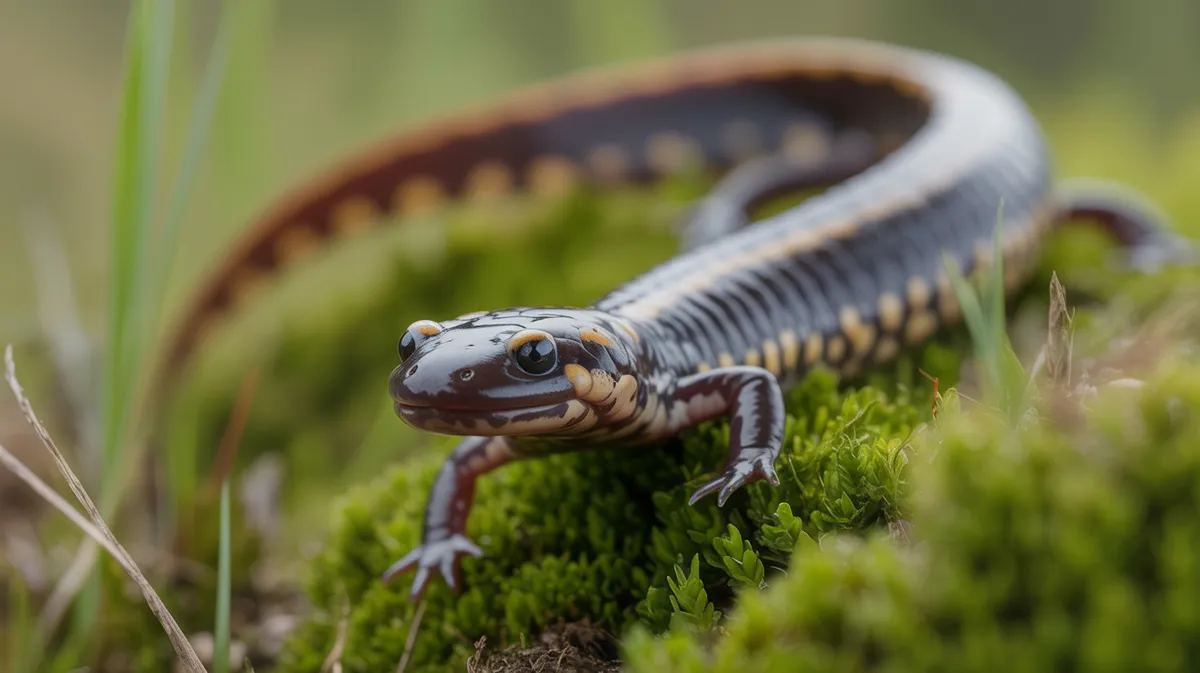
About the Long-toed Salamander
The Long-toed Salamander is a slender amphibian distinguished by its elongated fourth toe on each hind foot, which gives the species its name. This salamander displays a dark body with a striking yellow or greenish dorsal stripe that can be continuous or broken. It is primarily found in moist forests, grasslands, and meadows near freshwater sources in western North America. The species is secretive and nocturnal, spending much of its life hidden under logs, rocks, or leaf litter, and emerging mainly during breeding season. Adaptable and resilient, the Long-toed Salamander can tolerate a range of habitats at various elevations.
Fascinating facts
Special Toes
The species is named for its notably long fourth toe on each hind foot, which aids in climbing and navigating soft or muddy terrain.
Wide Range
Long-toed Salamanders inhabit a broad swath of western North America, from Alaska and British Columbia south to California and Idaho.
Unique Breeding Habits
They breed in temporary ponds, and their eggs are often attached to submerged vegetation or debris, providing protection from predators.
Detailed description
The Long-toed Salamander (Ambystoma macrodactylum) is a medium-sized mole salamander, typically measuring 4.1–8.9 cm (1.6–3.5 in) in snout-to-vent length as adults, with some individuals reaching up to 13 cm (5.1 in) total length including the tail. Its most distinctive feature is the elongated fourth toe on each hind foot, which is significantly longer than the others and aids in movement through loose substrates. The dorsal coloration varies from black to dark brown, often adorned with a yellow, olive, or greenish stripe that runs from the head to the tail, sometimes broken into spots or blotches. The ventral side is usually pale gray or white with scattered dark spots. The skin is smooth and moist, facilitating cutaneous respiration, and contains granular glands that secrete mild toxins as a defense against predators. The head is broad with prominent eyes, and the tail is laterally compressed, aiding in swimming. Long-toed Salamanders are primarily nocturnal and secretive, spending daylight hours concealed under logs, rocks, or within burrows. They exhibit seasonal migrations to breeding sites, often traveling considerable distances from terrestrial habitats to ephemeral ponds or slow-moving streams. This species displays remarkable ecological plasticity, occupying a range of habitats from lowland forests to subalpine meadows, and can be found at elevations from sea level up to 2,800 meters (9,200 ft). Five recognized subspecies exhibit subtle morphological and genetic differences, reflecting adaptation to local environments.
Did you know?
Despite being amphibians, Long-toed Salamanders are capable of surviving in relatively dry environments by retreating underground or into moist microhabitats.
Research & sources
Wikipedia summary
The long-toed salamander is a mole salamander in the family Ambystomatidae. This species, typically 4.1–8.9 cm (1.6–3.5 in) long when mature, is characterized by its mottled black, brown, and yellow pigmentation, and its long outer fourth toe on the hind limbs. Analysis of fossil records, genetics, and biogeography suggest A. macrodactylum and A. laterale are descended from a common ancestor that gained access to the western Cordillera with the loss of the mid-continental seaway toward the Paleocene.
Behaviour & social structure
Long-toed Salamanders are solitary outside the breeding season and exhibit strong site fidelity to both terrestrial refuges and breeding ponds. They are primarily nocturnal, emerging at night or during periods of high humidity to forage. Their diet consists mainly of small invertebrates such as insects, spiders, worms, and crustaceans, which they capture using a rapid tongue projection. Juveniles and larvae are opportunistic feeders, preying on aquatic invertebrates and sometimes conspecific eggs or larvae. During the non-breeding season, adults remain largely inactive, entering a state of torpor during cold or dry periods. Social interactions are minimal except during breeding, when temporary aggregations form at aquatic sites. Anti-predator behaviors include rapid escape movements, tail autotomy, and the secretion of noxious skin toxins. Homing behavior has been documented, with individuals able to navigate back to their home territory after displacement.
Reproduction & life cycle
Breeding occurs in late winter to early spring, typically from February to May depending on elevation and latitude. Adults migrate en masse to breeding ponds, often triggered by rainfall or snowmelt. Males arrive first and engage in courtship displays, including tail undulations and pheromone release to attract females. Fertilization is internal; males deposit spermatophores on submerged substrates, which females pick up with their cloaca. Females lay 100–400 eggs in small clusters attached to submerged vegetation or debris. Embryonic development lasts 2–6 weeks, depending on water temperature. Larvae are aquatic, possessing external gills and a finned tail, and undergo metamorphosis after 2–4 months. In high-elevation or cold habitats, larval development may be prolonged, with some individuals overwintering as larvae. Parental care is absent after egg deposition. Sexual maturity is typically reached at 2–4 years of age.
Adaptations & survival
Ambystoma macrodactylum exhibits several adaptations for survival in variable environments. The elongated fourth toe enhances locomotion in soft, muddy substrates and may assist in burrowing. Its skin contains granular glands that produce mild toxins, deterring some predators. The species is highly tolerant of cold and can remain active at low temperatures, even breeding in partially frozen ponds. Larvae display facultative paedomorphosis in some populations, retaining larval features and remaining aquatic if terrestrial conditions are unsuitable. The ability to utilize ephemeral breeding sites reduces competition and predation pressure on eggs and larvae. Nocturnality and a secretive lifestyle minimize desiccation and predation risk. The species' broad ecological tolerance allows it to persist in disturbed or fragmented habitats.
Cultural significance
The Long-toed Salamander holds limited direct cultural significance but is an important indicator species for ecosystem health, particularly in the Pacific Northwest. Its presence is used to assess the integrity of wetland and forest habitats. In some Indigenous cultures, salamanders are associated with water and transformation, though specific references to this species are rare. The species is occasionally featured in educational programs highlighting amphibian conservation and the importance of vernal pools.
Recent research
Recent research has focused on the genetic structure and phylogeography of Ambystoma macrodactylum, revealing significant differentiation among subspecies and populations, likely driven by historical glaciation and habitat fragmentation. Studies on larval development have documented facultative paedomorphosis and the influence of environmental variables on metamorphosis timing. Ongoing research addresses the impacts of climate change on breeding phenology and habitat suitability. Population monitoring using environmental DNA (eDNA) has improved detection in cryptic or low-density populations. Conservation genetics studies are informing management strategies for isolated or threatened populations, particularly the endangered Santa Cruz long-toed salamander (A. m. croceum).
Videos
Habitat
Moist forests, grasslands, and meadows near freshwater
 Various Continental Regions
Grassland
Open areas dominated by grasses rather than trees, supporting numerous herbivores and their predators.
 Elevated Terrain
Mountain
High-altitude environments with varying climates and specialized wildlife adapted to rugged terrain and thin air.
 Global
Forest
Wooded areas with significant tree cover and diverse plant and animal communities.
 Global
Freshwater
Lakes, rivers, and wetlands with diverse aquatic ecosystems.
Conservation
The Long-toed Salamander is currently classified as Least Concern on the IUCN Red List.
Threats & challenges
While currently listed as Least Concern by the IUCN, Long-toed Salamander populations face localized threats. Habitat loss and fragmentation due to urbanization, agriculture, and road construction can isolate populations and impede seasonal migrations. Breeding sites are vulnerable to pollution, eutrophication, and hydrological alterations such as pond drainage or water diversion. Introduced predators, such as fish and crayfish, can significantly reduce larval survival. Climate change poses emerging risks by altering precipitation patterns, reducing snowpack, and increasing the frequency of droughts, which may impact breeding success. Road mortality during seasonal migrations and disease (e.g., chytridiomycosis) are additional concerns. Despite these challenges, the species' adaptability and wide distribution have so far buffered it from severe declines.
Taxonomy
Scientific name
Ambystoma macrodactylum
- Kingdom
- Animalia
- Phylum
- Chordata
- Class
- Amphibia
- Order
- Caudata
- Family
- Ambystomatidae
- Genus
- Ambystoma
- Species
- macrodactylum
Community notes
Share your observations about the Long-toed Salamander.
No community notes yet. Be the first!
Discover more wildlife
More fascinating animals from the encyclopedia.