
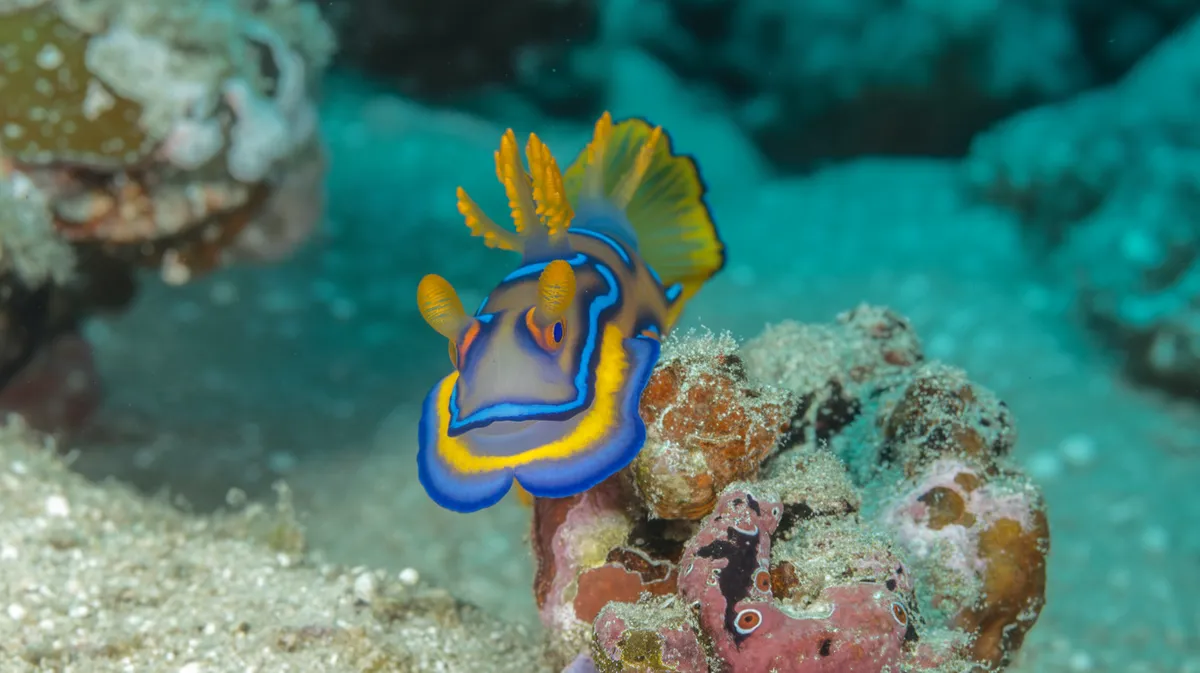
About the Mandarinfish Nudibranch
The Mandarin Dragon Nudibranch (Chelidonura varians) is a strikingly colorful sea slug found in tropical Indo-Pacific waters. Its elongated, smooth body displays vibrant blue, black, and orange markings, making it a favorite among underwater photographers. Unlike true nudibranchs, Chelidonura varians belongs to the order Cephalaspidea and is sometimes called a 'headshield slug.' This invertebrate glides gracefully along sandy bottoms and coral reefs, where it actively hunts small flatworms. Its unique appearance and specialized diet contribute to its allure in the marine aquarium trade.
Fascinating facts
Brilliant Colors
The Mandarin Dragon Nudibranch sports striking blue, orange, and black colors that make it one of the most visually stunning sea slugs.
Chemical Sensors
They use specialized head tentacles called rhinophores to sniff out flatworm prey hidden in the sand.
Habitat Specialist
They are typically found on sandy patches and coral rubble in shallow reef areas across the Indo-Pacific.
Detailed description
Chelidonura varians, commonly referred to as the Mandarin Dragon Nudibranch or sometimes erroneously as the 'Mandarinfish Nudibranch,' is a visually striking marine opisthobranch mollusk belonging to the family Aglajidae. This species is characterized by an elongated, flattened body reaching up to 7 cm in length, with a smooth, soft texture and a distinctive headshield structure that aids in burrowing and navigation through sandy substrates. Its coloration is highly vibrant, featuring a deep blue or black base adorned with intricate orange, yellow, and electric blue lines and spots, which serve as aposematic signals to potential predators. Unlike true nudibranchs, C. varians possesses a pair of prominent 'tails' at the posterior end, with the right tail typically longer than the left, a trait unique to the genus. The species lacks a shell and external gills, instead respiring through the body surface. Chelidonura varians is primarily nocturnal, emerging at dusk to actively forage for prey, and is renowned for its specialized diet of flatworms (Platyhelminthes), which it detects using chemosensory organs. Its streamlined body and ciliated foot enable efficient gliding across sandy and rubble substrates in shallow tropical Indo-Pacific reefs, typically at depths of 1–30 meters. Solitary by nature, individuals are rarely observed in groups except during breeding periods. The species is hermaphroditic, with reciprocal copulation observed during mating. Its unique coloration, specialized feeding habits, and ecological role as a flatworm predator make it a subject of interest in marine biology and aquarium trade.
Did you know?
Despite their name and appearance, Mandarin Dragon Nudibranchs are not true nudibranchs, but belong to a different order of sea slugs called Cephalaspidea.
Research & sources
Behaviour & social structure
Chelidonura varians exhibits primarily solitary and nocturnal behavior, spending daylight hours concealed under rocks, coral rubble, or within sand to avoid predation. At dusk or during overcast conditions, it emerges to actively hunt flatworms, using chemoreceptors on its headshield to track chemical cues left by prey. The animal glides smoothly over the substrate using rhythmic contractions of its muscular foot and cilia, often pausing to probe crevices with its anterior end. Feeding involves engulfing flatworms whole, aided by a muscular pharynx. Social interactions are minimal outside of mating, with individuals generally ignoring each other when encountered. When threatened, C. varians may secrete distasteful chemicals as a deterrent. Its daily routine is closely tied to prey availability and environmental conditions, with increased activity after rainfall or during plankton blooms, which may increase flatworm populations.
Reproduction & life cycle
Chelidonura varians is a simultaneous hermaphrodite, possessing both male and female reproductive organs. Mating typically occurs during the warmer months, coinciding with increased food availability. Reciprocal copulation is observed, where two individuals align head-to-tail and exchange sperm through a specialized copulatory organ. Fertilization is internal, and after mating, each individual lays a gelatinous, spiral-shaped egg mass on hard substrates or within crevices. Embryonic development is rapid, with eggs hatching within 5–10 days depending on water temperature. The larvae are planktonic veligers, drifting in the water column before settling to the substrate and metamorphosing into juvenile slugs. There is no parental care post-oviposition, and reproductive output is influenced by environmental factors such as temperature, food abundance, and population density.
Adaptations & survival
Chelidonura varians has evolved several adaptations for survival in its niche. The headshield, a broad, flattened extension at the anterior, protects the sensory organs and facilitates burrowing into sand to escape predators. Its vivid coloration serves as aposematic warning, signaling chemical defenses that deter fish and invertebrate predators. The elongated, asymmetrical tails may aid in maneuverability and may play a role in intraspecific recognition. Chemosensory organs allow precise detection of flatworm prey, while the ciliated foot ensures efficient locomotion over soft substrates. The absence of a shell reduces weight and enhances mobility, and the ability to secrete distasteful compounds provides an additional anti-predator mechanism. Hermaphroditism increases reproductive flexibility, allowing any two individuals to mate and maximize reproductive success in low-density populations.
Cultural significance
Chelidonura varians has limited direct cultural significance but is highly valued among underwater photographers and marine aquarists for its striking appearance and unique behaviors. It is sometimes featured in marine biodiversity exhibits and educational programs highlighting the diversity and ecological roles of opisthobranchs. The confusion with the Mandarinfish (Synchiropus splendidus) in popular literature underscores the importance of accurate scientific communication. There are no known traditional uses or symbolic associations in indigenous cultures.
Recent research
Recent research on Chelidonura varians has focused on its chemical ecology, particularly the identification of secondary metabolites involved in predator deterrence. Studies have also examined its role in controlling populations of pest flatworms in aquaria, suggesting potential applications in biological control. Molecular phylogenetic analyses have clarified its placement within the Aglajidae and highlighted evolutionary divergence from true nudibranchs. Ongoing research is investigating the species' reproductive strategies, larval dispersal, and responses to environmental stressors such as temperature fluctuations and pollution. Citizen science initiatives, including photographic surveys, are contributing to distribution mapping and population assessments.
Sources
Chelidonura varians (Gastropoda: Cephalaspidea): Distribution, Morphology, and Ecology
Rudman, W.B. & Gosliner, T.M. (2004)
scientificChelidonura varians (Gastropoda: Cephalaspidea): Morphology, Behavior, and Ecology
Rudman, W.B. (2000)
scientificVideos
Habitat
Coral reefs and sandy substrates in shallow tropical marine waters

Conservation
The Mandarinfish Nudibranch is currently classified as Least Concern on the IUCN Red List.
Threats & challenges
While Chelidonura varians is currently listed as Least Concern, it faces localized threats from habitat degradation, particularly the loss of coral reefs and sandy substrates due to coastal development, pollution, and destructive fishing practices. Overcollection for the aquarium trade poses a minor but growing risk in some regions. Climate change, resulting in ocean warming and acidification, may impact prey availability and reproductive success. The species' reliance on specific flatworm prey makes it vulnerable to ecosystem imbalances. However, its broad distribution and adaptability to various reef and sandy habitats buffer it against immediate population declines. Continued monitoring is recommended to assess long-term trends and potential emerging threats.
Taxonomy
Scientific name
Chelidonura varians
- Kingdom
- Animalia
- Phylum
- Mollusca
- Class
- Gastropoda
- Order
- Cephalaspidea
- Family
- Aglajidae
- Genus
- Chelidonura
- Species
- varians
Community notes
Share your observations about the Mandarinfish Nudibranch.
No community notes yet. Be the first!
Discover more wildlife
More fascinating animals from the encyclopedia.