
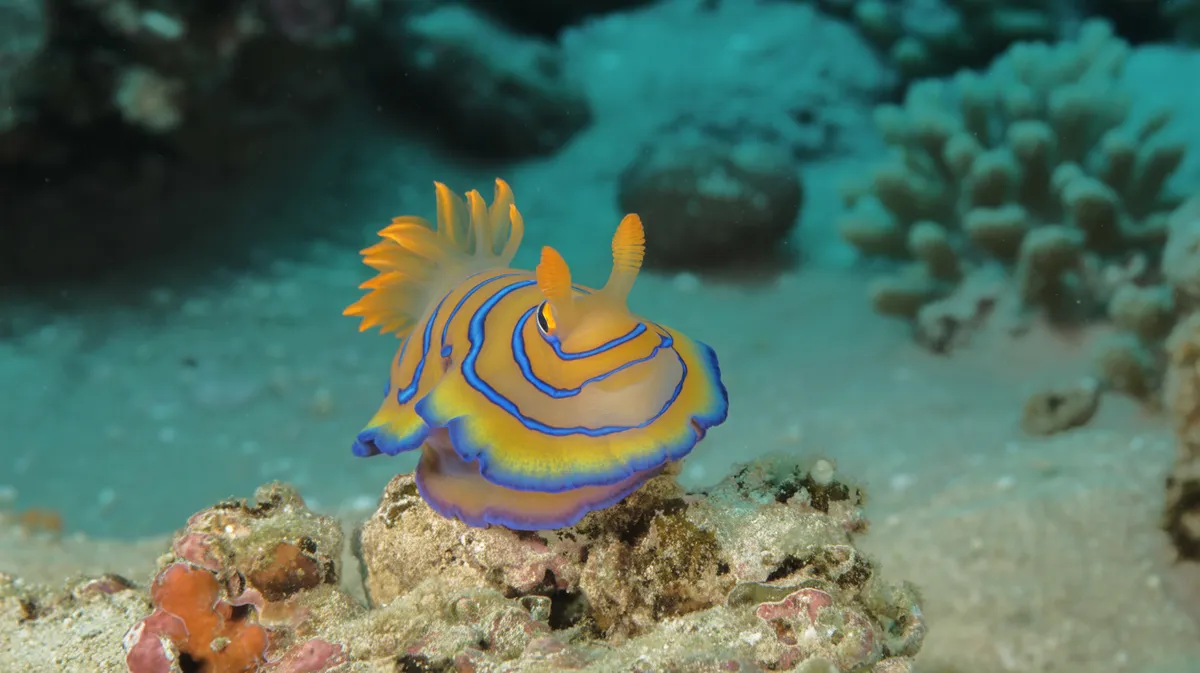
About the Mandarinfish Sea Slug
The Mandarinfish Sea Slug, also known as Chelidonura mandroroa, is a small, vibrantly colored sea slug found in tropical coral reefs of the Indo-Pacific region. Despite its common name, it is not related to the Mandarinfish (Synchiropus splendidus) but is named for its similarly striking blue-and-orange coloration. This species is a member of the order Cephalaspidea, a type of headshield slug, and is known for its smooth, elongated body with distinctive blue and orange patterns. Mandarinfish Sea Slugs are often spotted gliding over sandy or rubble substrates, hunting for small prey. Their unique appearance makes them a favorite among underwater photographers and marine enthusiasts.
Fascinating facts
Vivid Colors
Mandarinfish Sea Slugs are renowned for their bright blue and orange patterns, which serve as a warning to potential predators.
Headshield Slug
They belong to the Cephalaspidea order, characterized by a distinctive headshield used for burrowing and protection.
Hermaphroditic Nature
Each individual possesses both male and female reproductive organs, increasing their chances of successful mating.
Detailed description
Chelidonura mandroroa, commonly known as the Mandarinfish Sea Slug, is a small, vividly colored marine opisthobranch mollusk belonging to the family Aglajidae within the order Cephalaspidea. Adult individuals typically reach lengths of 15–25 mm, with a slender, elongated body that tapers at both ends. The dorsal surface is smooth and adorned with intricate blue and orange patterns, which serve as both camouflage and warning coloration. The anterior end features a broad, shield-like head (the 'headshield') used for burrowing and detecting prey. Unlike true nudibranchs, C. mandroroa retains a reduced internal shell during early development, which is lost in adulthood. The species is benthic, gliding over sandy bottoms and rubble zones adjacent to coral reefs, where it is most active at dusk and night. Its sensory organs, known as rhinophores, are highly developed and aid in chemical detection of prey and mates. C. mandroroa is a carnivore, preying primarily on small flatworms and other soft-bodied invertebrates. The species exhibits simultaneous hermaphroditism, with both individuals exchanging sperm during copulation. Its striking coloration and secretive habits make it a subject of interest for marine biologists and underwater photographers alike.
Did you know?
Unlike many sea slugs, the Mandarinfish Sea Slug cannot photosynthesize and must actively hunt for small invertebrates to survive.
Research & sources
Behaviour & social structure
Chelidonura mandroroa is primarily nocturnal or crepuscular, emerging from shelter in the late afternoon or after dark to forage. It moves via muscular undulations of the foot, gliding smoothly over substrates. The species is a specialized predator of acoel flatworms, using chemosensory cues to locate prey beneath the sand or among detritus. Upon encountering prey, it envelops the flatworm with its headshield and rapidly ingests it. Social interactions are minimal outside of mating, as individuals are generally solitary and exhibit little territorial behavior. When threatened, C. mandroroa may secrete distasteful chemicals from specialized glands as a deterrent to predators. During the day, it often hides under rocks or within crevices to avoid predation and desiccation.
Reproduction & life cycle
Chelidonura mandroroa is a simultaneous hermaphrodite, meaning each individual possesses both male and female reproductive organs. Mating typically occurs during the warmer months, often coinciding with lunar cycles that influence reproductive timing in many marine invertebrates. During copulation, two individuals align head-to-tail and exchange sperm via a specialized copulatory organ. After fertilization, each slug lays a gelatinous ribbon of eggs, often attached to the underside of rocks or within crevices. Embryonic development is direct, with larvae hatching as miniature versions of adults, bypassing a planktonic stage. There is no parental care after egg deposition. The reproductive output and frequency are influenced by environmental factors such as temperature, food availability, and population density.
Adaptations & survival
Chelidonura mandroroa exhibits several adaptations for survival in its reef-associated habitat. Its cryptic coloration provides camouflage among brightly colored corals and sponges, while also serving as aposematic (warning) coloration to deter predators. The headshield is a key adaptation, allowing the animal to burrow into sand and avoid detection. Chemosensory rhinophores enable precise detection of prey and potential mates. The ability to secrete distasteful or toxic compounds from skin glands is an effective anti-predator adaptation, common among many opisthobranchs. Its specialized diet on flatworms reduces competition with other carnivorous gastropods. The loss of a protective shell in adulthood allows for greater mobility and access to narrow crevices.
Cultural significance
Chelidonura mandroroa holds limited direct significance in human culture, but its striking appearance has made it a popular subject in underwater photography and marine life field guides. The species is sometimes featured in public aquaria and educational materials to highlight the diversity and beauty of reef invertebrates. Its resemblance to the more widely known Mandarinfish (Synchiropus splendidus) has led to confusion in common naming, but also increased its visibility among marine enthusiasts. There are no known traditional uses or symbolic associations in indigenous cultures.
Recent research
Recent research on Chelidonura mandroroa and related aglajid sea slugs has focused on their chemical ecology, particularly the identification of defensive compounds used against predators. Studies have also examined their feeding specialization on flatworms and the ecological role they play in regulating flatworm populations on reefs. Molecular phylogenetics has clarified the evolutionary relationships within the Aglajidae family, confirming the distinctiveness of the Chelidonura genus. Ongoing research is investigating the impact of habitat changes on population dynamics and reproductive success. There is growing interest in the potential biomedical applications of opisthobranch-derived chemicals.
Sources
Chelidonura mandroroa: A new species of Aglajidae from the Indo-Pacific
Rudman, W.B. (1999)
scientificChelidonura mandroroa: A New Species of Cephalaspidean Opisthobranch from the Indo-Pacific
Rudman, W.B. (1999)
scientificPhylogenetic relationships within the Cephalaspidea (Gastropoda: Opisthobranchia)
Malaquias, M.A.E. et al. (2009)
scientificChelidonura mandroroa: A New Species of Aglajid Sea Slug from the Indo-Pacific
Rudman, W.B. (1999)
scientificVideos
Habitat
Coral reefs and sandy substrates in the Indo-Pacific region

Conservation
The Mandarinfish Sea Slug is currently classified as Least Concern on the IUCN Red List.
Threats & challenges
Currently, Chelidonura mandroroa is not considered threatened and is classified as Least Concern. However, like many reef-associated species, it faces indirect threats from habitat degradation, coral reef loss, and water pollution. Coastal development, destructive fishing practices, and climate change-induced coral bleaching can reduce available habitat and prey abundance. The species is not targeted by fisheries or the aquarium trade, but localized collection for scientific or hobbyist purposes may occur. Population trends are not well-studied, but the species appears to be stable in most areas of its range.
Taxonomy
Scientific name
Chelidonura mandroroa
- Kingdom
- Animalia
- Phylum
- Mollusca
- Class
- Gastropoda
- Order
- Cephalaspidea
- Family
- Aglajidae
- Genus
- Chelidonura
- Species
- mandroroa
Community notes
Share your observations about the Mandarinfish Sea Slug.
No community notes yet. Be the first!
Discover more wildlife
More fascinating animals from the encyclopedia.