
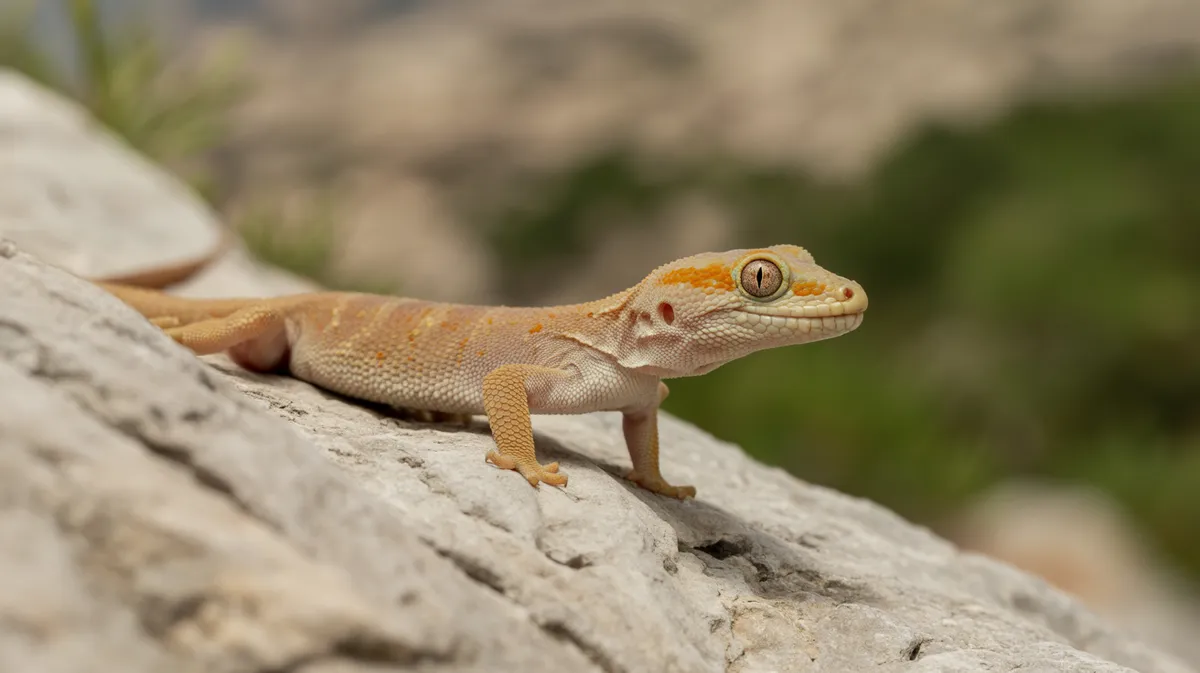
About the Mediterranean House Gecko
Hemidactylus turcicus is one of the most successful stowaways in the reptile world. Native to the Mediterranean basin and the Middle East, it has been carried by ship and cargo to the southern United States, Mexico, Cuba, Panama and beyond, and it now lives in essentially every warm port city it has reached. Its success rests on a simple behavioural shift: it hunts at artificial lights. Streetlamps, porch lights and neon signs concentrate moths, mosquitoes and beetles into a dense, reliable food supply that no natural habitat can match, and the gecko simply waits beside the bulb. Its toes bear lamellae covered in millions of microscopic setae that grip by van der Waals forces, letting it hang upside down on painted stucco and glass. It is nocturnal, with vertical pupils and no eyelids - it cleans the transparent scale covering each eye by licking it. Unlike most lizards, geckos vocalise, and this species gives a sharp clicking chirp used in territorial disputes, which is often the first sign of one on a wall. It can drop its tail and regrow it, and the discarded tail thrashes for minutes to hold a predator's attention. It seems mostly to occupy the human-built niche rather than displacing native species, though it competes with other geckos in some cities.
Fascinating facts
Nocturnal Hunters
Mediterranean House Geckos are primarily active at night, preying on insects attracted to lights.
Urban Adaptation
They readily adapt to human habitats, frequently living in buildings, homes, and urban environments.
Climbing Experts
Special structures on their toe pads allow them to climb smooth surfaces, including glass and polished walls.
Detailed description
The Mediterranean House Gecko (Hemidactylus turcicus) is a small, slender lizard typically measuring 4–6 cm in snout-to-vent length, with a total length (including tail) of up to 10 cm. Its skin is semi-translucent, ranging from pale pinkish-gray to light brown, often mottled with darker spots, and covered in small granular scales interspersed with tubercles. The gecko's large, lidless eyes possess vertical pupils and are highly adapted for nocturnal vision, lacking eyelids but equipped with a transparent scale (spectacle) for protection. To maintain eye cleanliness, it uses its long, flexible tongue to lick the spectacle. The digits are expanded and bear adhesive lamellae, enabling it to climb smooth vertical surfaces and even traverse ceilings with ease. Hemidactylus turcicus is primarily nocturnal, emerging at dusk to hunt, and is highly synanthropic, thriving in close association with human dwellings. Its vocalizations, consisting of quiet chirps and clicks, are used for communication, especially during territorial disputes or courtship. The species is solitary outside of the breeding season, with individuals occupying overlapping home ranges but rarely interacting except during mating. Its remarkable adaptability has facilitated its spread to diverse habitats, from rocky outcrops and ruins to modern urban environments across multiple continents.
Did you know?
Unlike many reptiles, Mediterranean House Geckos thrive in human dwellings and are often more common in cities than in the wild.
Research & sources
Wikipedia summary
The Mediterranean house gecko is a species of house gecko native to the Mediterranean region, from which it has spread to many parts of the world including parts of East Africa, South America, the Caribbean, and the Southern and Southeastern United States. It is commonly referred to as the Turkish gecko as represented in its Latin name and also as the moon lizard because it tends to emerge in the evening.
Behaviour & social structure
Mediterranean House Geckos are crepuscular to nocturnal, spending daylight hours hidden in crevices, under bark, or behind shutters to avoid predators and desiccation. At night, they become active hunters, employing a sit-and-wait strategy near artificial lights where insects congregate. Their diet consists mainly of arthropods such as moths, flies, beetles, and spiders, but they may also consume smaller geckos or their own shed skin. Geckos use their acute vision and sensitive mechanoreceptors to detect prey, followed by a rapid dash and capture with their jaws. Social interactions are generally limited to antagonistic encounters between males, who may display by arching their bodies, vocalizing, and engaging in tail waving or biting. Females are less territorial and may tolerate the presence of conspecifics. Geckos exhibit site fidelity, often returning to the same refuge or hunting ground night after night.
Reproduction & life cycle
Reproduction in Hemidactylus turcicus is oviparous, with breeding typically occurring in the warmer months (late spring to early autumn) in temperate regions, though reproduction may occur year-round in tropical or subtropical climates. Males court females through tactile and vocal displays, and copulation is brief. Females lay one or two leathery-shelled eggs per clutch, often in communal nesting sites where multiple females deposit eggs together, enhancing thermal stability and reducing predation risk. Incubation lasts 6–10 weeks depending on ambient temperature, with hatchlings emerging fully independent and measuring about 2–2.5 cm in snout-to-vent length. There is no parental care post-oviposition. Females may produce several clutches per season, contributing to the species' rapid population expansion in suitable environments.
Adaptations & survival
Key adaptations include specialized toe pads with microscopic setae that exploit van der Waals forces, allowing adhesion to smooth surfaces—a trait critical for urban survival. Their cryptic coloration and semi-translucent skin provide camouflage against stone and plaster. Nocturnal vision is enhanced by a high density of rod cells and multifocal lenses, enabling them to hunt efficiently in low light. The ability to autotomize (shed) the tail as a defense mechanism against predators is well developed, with subsequent tail regeneration. Behavioral plasticity, including tolerance of a wide range of temperatures and humidity levels, underpins their success in both natural and anthropogenic habitats.
Cultural significance
In Mediterranean cultures, geckos are often seen as benign or even auspicious creatures, believed to bring good luck or act as protectors of the home by consuming pests. The nickname 'moon lizard' reflects their nocturnal habits and association with nighttime. In some regions, geckos are featured in folklore and traditional medicine, though Hemidactylus turcicus is less commonly used for such purposes than some Asian gecko species. Their presence in homes is generally tolerated or welcomed, and they are sometimes kept as pets due to their manageable size and insectivorous habits.
Recent research
Recent research has focused on the biomechanics of gecko adhesion, with Hemidactylus turcicus serving as a model for developing synthetic adhesives and climbing robots. Studies on urban ecology have examined its role in controlling pest insect populations and its interactions with other synanthropic species. Genetic analyses have revealed multiple introductions and founder events in non-native ranges, providing insights into invasion biology. Ongoing research includes the impact of artificial lighting on gecko foraging behavior and the potential for hybridization with closely related species in overlapping ranges.
Videos
Habitat
Urban areas, rocky terrains, and coastal regions
 Arid Regions
Desert
Arid lands with minimal rainfall, extreme temperatures, and specialized wildlife adapted to harsh conditions.
 Various Continental Regions
Grassland
Open areas dominated by grasses rather than trees, supporting numerous herbivores and their predators.
 Global
Forest
Wooded areas with significant tree cover and diverse plant and animal communities.
Conservation
The Mediterranean House Gecko is currently classified as Least Concern on the IUCN Red List.
Threats & challenges
Currently, Hemidactylus turcicus faces few significant threats and is classified as Least Concern by the IUCN. Its adaptability to human-modified environments has buffered it from many of the pressures affecting other reptiles. However, localized threats include predation by domestic cats, competition with other invasive gecko species (such as Hemidactylus mabouia in the Americas), and pesticide use reducing prey availability. In some introduced regions, it may impact native arthropod populations or compete with indigenous lizards, though evidence for significant ecological disruption is limited. Climate change may alter distribution patterns, but the species' broad environmental tolerance suggests continued resilience.
Taxonomy
Scientific name
Hemidactylus turcicus
- Kingdom
- Animalia
- Phylum
- Chordata
- Class
- Reptilia
- Order
- Squamata
- Family
- Gekkonidae
- Genus
- Hemidactylus
- Species
- turcicus
Community notes
Share your observations about the Mediterranean House Gecko.
No community notes yet. Be the first!
Discover more wildlife
More fascinating animals from the encyclopedia.