
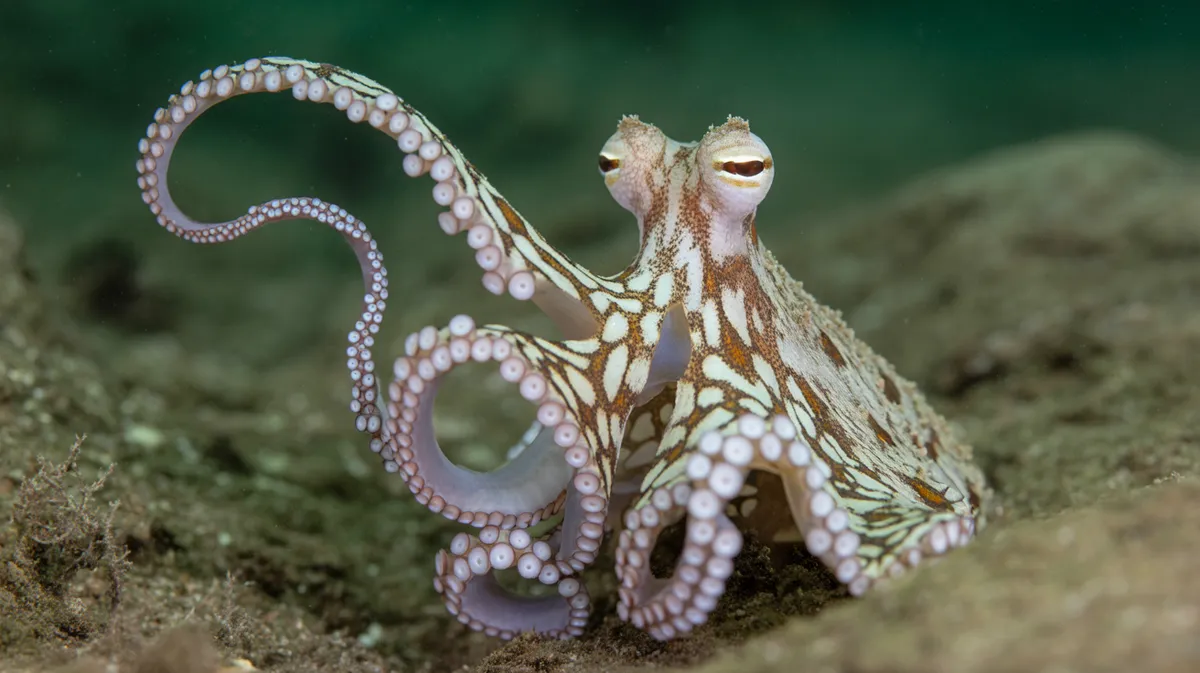
About the Mimic Octopus
The mimic octopus is the only animal known to impersonate several different species and to choose between them. It can flatten itself and ripple across the seabed as a toxic flatfish, bury six arms and extend the other two in opposite directions to become a banded sea snake, or hang in the water with arms spread and trailing to pass for a venomous lionfish. What lifts this above ordinary camouflage is the evidence that it selects the impersonation to fit the threat — it has been reported to adopt the sea snake when harassed by damselfish, whose predator the sea snake happens to be. It achieves it with the standard octopus toolkit — chromatophores for colour, muscular papillae for texture, and an entirely boneless body — but applied with a specificity nothing else matches. It was not described by science until 1998, in the silty estuaries of Indonesia, precisely the kind of open, featureless seabed where hiding is impossible and pretending to be something venomous is the only option left.
Fascinating facts
Master of Disguise
The Mimic Octopus can impersonate venomous animals such as lionfish, sea snakes, and flatfish to deter predators.
Limited Range
It is primarily found in the coastal waters of Indonesia and Malaysia, favoring muddy estuarine habitats.
Highly Intelligent
This species exhibits advanced problem-solving skills and complex behaviors, highlighting its intelligence among invertebrates.
Detailed description
The mimic octopus (Thaumoctopus mimicus) is a medium-sized cephalopod, typically reaching a total arm span of up to 60 cm, with a slender, elongated body and long, flexible arms. Its skin is equipped with highly developed chromatophores, allowing rapid changes in color and pattern, often displaying contrasting brown and white bands. Unlike most octopuses, it possesses the remarkable ability to impersonate multiple venomous or unpalatable marine species, such as lionfish, banded sea snakes, flatfish, and even jellyfish, by altering its posture, arm arrangement, and movement. The mimic octopus inhabits shallow, muddy estuarine and coastal habitats, usually at depths of 2–15 meters, where its cryptic coloration and mimicry provide effective camouflage against both predators and prey. It is a solitary and highly intelligent animal, relying on keen vision and a sophisticated nervous system to interpret environmental cues and select appropriate mimicry strategies. Its diet consists mainly of small fish, crustaceans, and worms, which it captures using stealth and rapid strikes. The species is known for its inquisitive and exploratory behavior, often observed probing the substrate with its arms. Reproduction involves a brief mating encounter, after which females lay eggs in hidden burrows and guard them until hatching. The mimic octopus is a relatively recent scientific discovery, first described in 1998 and formally named in 2005, and remains a subject of ongoing research due to its unique behavioral repertoire and evolutionary adaptations.
Did you know?
The Mimic Octopus can choose which animal to mimic based on the type of predator it faces, tailoring its disguise for maximum survival.
Research & sources
Wikipedia summary
The mimic octopus is a species of octopus from the Indo-Pacific region. Like other octopuses, it uses its chromatophores to disguise itself. It is noteworthy for being able to impersonate a wide variety of other marine animals. While many animals mimic either their environment or other animals to avoid predation, the mimic octopus and its close relative the wunderpus are the only ones known to actively imitate several animals in order to elude predators.
Behaviour & social structure
The mimic octopus is primarily diurnal, actively foraging during daylight hours when its mimicry is most effective against visually hunting predators. It exhibits a diverse range of locomotor behaviors, including crawling, jet propulsion, and undulating arm movements to simulate the swimming patterns of other species. When threatened, it rapidly selects and performs an impersonation based on the local predator community—flattening its body and trailing arms to mimic a flatfish, raising arms to resemble lionfish spines, or tucking arms and displaying banded patterns to imitate sea snakes. Hunting involves stealthy approach and sudden pouncing on prey, often using its arms to probe burrows and flush out hidden animals. Social interactions are minimal, as individuals are generally solitary outside of mating. The mimic octopus is known for its problem-solving abilities and can navigate complex environments, suggesting advanced cognitive skills among cephalopods.
Reproduction & life cycle
Reproduction in Thaumoctopus mimicus follows the general pattern of octopuses: males use a specialized arm (the hectocotylus) to transfer spermatophores to the female. Mating is brief and can be risky for males due to the risk of cannibalism. Females lay several hundred small eggs in concealed burrows or crevices in the substrate, attaching them to hard surfaces. There is no true gestation period, but the incubation of eggs lasts approximately 3–4 weeks, depending on water temperature. During this period, the female guards and aerates the eggs but does not feed, dying shortly after the eggs hatch. The planktonic hatchlings are highly vulnerable and undergo a pelagic larval stage before settling to the benthos and adopting adult behaviors.
Adaptations & survival
The mimic octopus displays a suite of remarkable adaptations for survival. Its chromatophores and muscular hydrostat arms enable rapid changes in color, texture, and shape, facilitating both camouflage and mimicry. Behavioral plasticity allows it to select from a repertoire of at least 15 different mimicry forms, each tailored to specific predators or environmental contexts. Its slender body and long arms are well-suited for navigating soft substrates and crevices. Highly developed vision and a large brain support complex decision-making and learning. Unlike most octopuses, it often forages in open, exposed habitats, relying on active mimicry rather than concealment for protection.
Cultural significance
The mimic octopus has captured the public imagination since its discovery, becoming a symbol of adaptability and intelligence in marine life. It is frequently featured in documentaries, educational materials, and popular science media as an example of animal mimicry and cephalopod cognition. While it does not have a significant role in traditional folklore or fisheries, its unique abilities have inspired artistic representations and discussions about animal consciousness and evolution.
Recent research
Recent research has focused on the neural and behavioral mechanisms underlying mimicry in T. mimicus, with studies using video analysis to catalog the full range of impersonations and the decision-making processes involved. Genetic studies are clarifying its evolutionary relationships within the Octopodidae. Field observations have documented context-dependent mimicry, suggesting that the octopus can assess predator type and select the most effective mimicry strategy. Ongoing research is investigating the ecological role of mimicry in predator-prey dynamics and the potential for undiscovered mimicry forms. The species' relatively recent formal description (2005) means that much remains to be learned about its life history, population structure, and conservation needs.
Videos
Habitat
Shallow coastal waters and muddy estuaries

Conservation
The Mimic Octopus is currently classified as Least Concern on the IUCN Red List.
Threats & challenges
Currently, the mimic octopus is classified as Least Concern, but its populations are not well-studied, and it may be vulnerable to habitat degradation, coastal development, and pollution in its estuarine environments. Bycatch in trawl fisheries poses a localized threat. The species' reliance on specific muddy and sandy habitats makes it sensitive to sedimentation and water quality changes. There is limited evidence of collection for the aquarium trade, but this is not considered a major threat at present. Climate change and associated shifts in coastal ecosystems could impact its distribution and prey availability.
Taxonomy
Scientific name
Thaumoctopus mimicus
- Kingdom
- Animalia
- Phylum
- Mollusca
- Class
- Cephalopoda
- Order
- Octopoda
- Family
- Octopodidae
- Genus
- Thaumoctopus
- Species
- mimicus
Community notes
Share your observations about the Mimic Octopus.
No community notes yet. Be the first!
Discover more wildlife
More fascinating animals from the encyclopedia.