
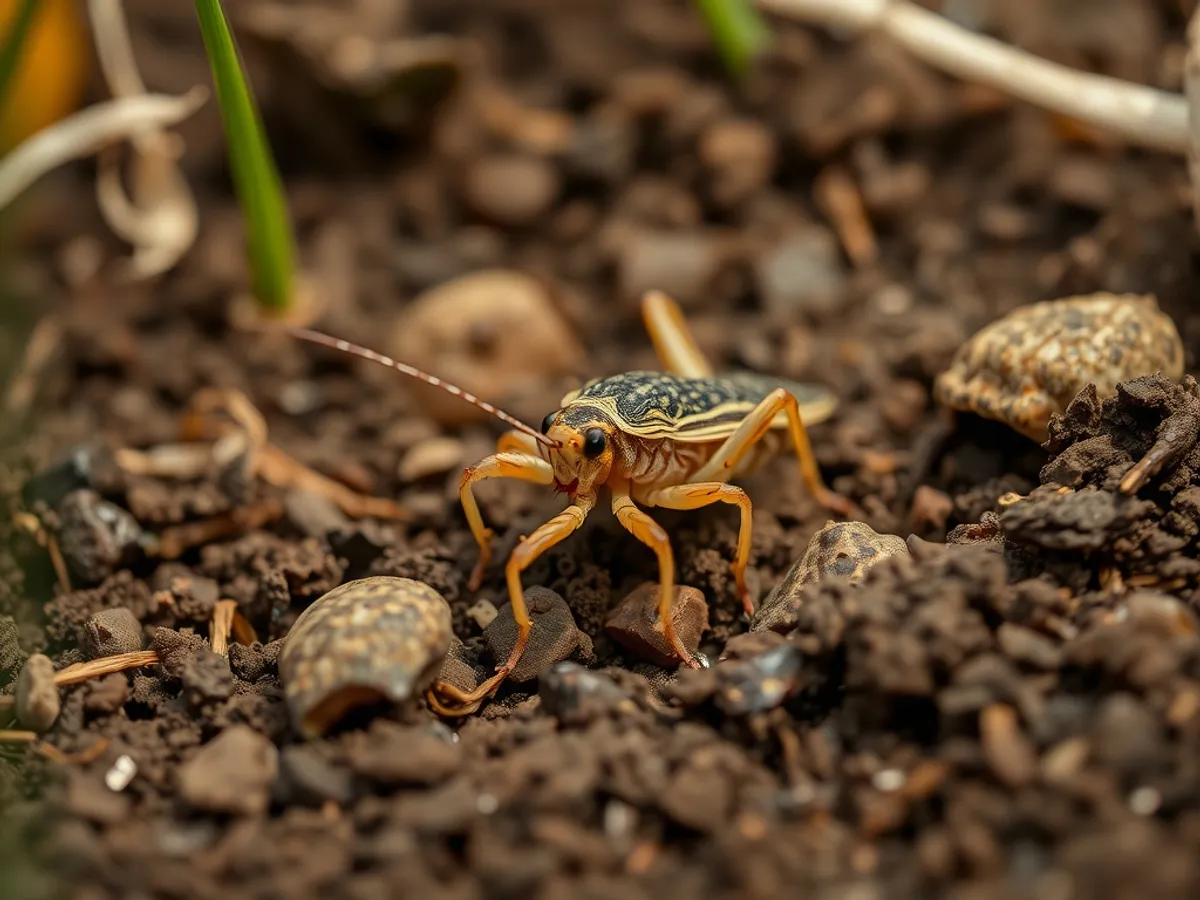
About the Mole Cricket
The mole cricket is a burrowing insect known for its unique, spade-like forelimbs adapted for digging in soil. It is nocturnal and spends much of its life underground, where it constructs elaborate tunnel systems. Mole crickets feed on roots, tubers, and small invertebrates, which can make them agricultural pests in some regions. Their distinctive, low-pitched song is produced by males to attract mates from within their burrows.
Fascinating facts
Expert Diggers
Mole crickets have powerful, shovel-like forelimbs that allow them to tunnel rapidly through moist soil, similar to the way moles dig.
Unique Love Songs
Male mole crickets produce deep, trilling songs by rubbing their wings together, attracting females to their underground burrows.
Underground Lifestyle
Most of a mole cricket's life is spent beneath the surface, where it feeds, mates, and avoids many predators.
Detailed description
The European mole cricket (Gryllotalpa gryllotalpa) is a robust, medium-to-large orthopteran insect, typically measuring 35–50 mm in length, with a cylindrical, velvety-brown body well adapted for subterranean life. Its most distinctive feature is the pair of enlarged, spade-like forelegs, heavily sclerotized and equipped with toothed projections for efficient digging. The head is broad with prominent compound eyes and long, thread-like antennae, while the hind legs are less developed for jumping compared to other crickets. The thorax is shielded by a pronotum that protects the body during burrowing. Mole crickets are primarily nocturnal and spend most of their lives underground, constructing complex tunnel systems that can extend up to 1 meter in length. These tunnels serve as both feeding galleries and acoustic chambers for males to amplify their mating calls. Gryllotalpa gryllotalpa is an omnivore, feeding on plant roots, tubers, seeds, and a variety of soil invertebrates, including earthworms and larvae. Adults possess functional wings and are capable of short flights, especially during dispersal or mating periods. Their lifecycle includes incomplete metamorphosis, with nymphs resembling adults but lacking wings. The species is solitary outside of the breeding season, and individuals are highly territorial within their burrow systems.
Did you know?
Mole crickets can create 'singing chambers' underground that amplify their calls, making them some of the loudest insects relative to their size.
Research & sources
Behaviour & social structure
Mole crickets exhibit primarily solitary and territorial behavior, with individuals aggressively defending their burrow systems from conspecifics. They are most active during the night, emerging briefly to forage or disperse, but spending the majority of their time underground. Feeding occurs within the tunnels, where they use their sensitive palps and antennae to locate food. They are opportunistic omnivores, consuming both plant material and small invertebrates, and may cause significant damage to crops by severing roots. Males are notable for their calling behavior; they construct specialized acoustic chambers with smooth, bulbous walls that amplify their low-frequency, trilling song, which can be heard up to 600 meters away on still nights. Calling peaks during warm, humid evenings in spring and early summer. While generally solitary, brief interactions occur during mating, after which individuals return to their solitary habits.
Reproduction & life cycle
Breeding typically occurs from late spring to early summer, depending on local climate. Males attract females by producing a continuous, low-pitched song from within their burrow’s acoustic chamber. After mating, the female excavates a separate nursery chamber, where she lays 100–350 eggs in a single clutch. Incubation lasts 10–20 days, depending on soil temperature and moisture. Females exhibit a degree of parental care by guarding the eggs and newly hatched nymphs for several days, protecting them from predators and fungal infections. Nymphs undergo 7–10 molts over a period of 1–2 years before reaching maturity, with development rate influenced by environmental conditions. There is typically one generation per year in temperate regions, but development may extend over two years in cooler climates.
Adaptations & survival
Gryllotalpa gryllotalpa is highly specialized for a fossorial lifestyle. Its forelegs are modified into powerful digging appendages, while the body is streamlined and covered in fine setae to reduce friction with soil. The pronotum acts as a protective shield during tunneling. Sensory adaptations include elongated antennae and palps for detecting vibrations and chemical cues underground. The male’s ability to construct and utilize an acoustic chamber is a unique behavioral adaptation for mate attraction in a subterranean environment. Their cuticle is thickened to resist abrasion, and they possess spiracles with protective hairs to prevent soil ingress during respiration. Behavioral plasticity allows them to adjust tunnel architecture in response to soil moisture and temperature, optimizing survival and reproductive success.
Cultural significance
Mole crickets have been referenced in European folklore as omens of rain or poor harvests, likely due to their nocturnal calls and association with moist soils. In some cultures, their distinctive song is considered a sign of impending weather changes. While generally regarded as agricultural pests, they have also been used as fishing bait in parts of Europe and Asia. Their unique morphology and acoustic behavior have made them subjects of scientific curiosity and natural history collections since the 18th century.
Recent research
Recent research has focused on the bioacoustics of mole cricket calling behavior, revealing that their burrow architecture significantly enhances sound transmission and mate attraction efficiency. Studies using molecular markers have clarified species boundaries within the Gryllotalpa genus, aiding conservation and pest management efforts. Ongoing ecological research examines their role in soil aeration and nutrient cycling, as well as their interactions with natural predators and parasitoids. There is increasing interest in the impact of climate change on their phenology and distribution, particularly in northern Europe where range shifts have been documented. Advances in integrated pest management are exploring environmentally sustainable control methods to mitigate crop damage while preserving beneficial soil functions.
Videos
Habitat
Moist soils in grasslands, agricultural fields, and gardens
 Various Continental Regions
Grassland
Open areas dominated by grasses rather than trees, supporting numerous herbivores and their predators.
 Global
Forest
Wooded areas with significant tree cover and diverse plant and animal communities.
 Global
Freshwater
Lakes, rivers, and wetlands with diverse aquatic ecosystems.
Conservation
The Mole Cricket is currently classified as Least Concern on the IUCN Red List.
Threats & challenges
While currently classified as Least Concern by the IUCN, Gryllotalpa gryllotalpa faces localized threats from habitat loss due to agricultural intensification, urban development, and drainage of wetlands. Pesticide use in agricultural areas can reduce populations directly through toxicity and indirectly by diminishing prey availability. In some regions, over-collection for bait and control measures against perceived pest outbreaks have led to local declines. Climate change, particularly shifts in soil moisture and temperature regimes, may also impact distribution and reproductive success. Despite these challenges, the species remains widespread and adaptable, with stable populations in much of its range.
Taxonomy
Scientific name
Gryllotalpa gryllotalpa
- Kingdom
- Animalia
- Phylum
- Arthropoda
- Class
- Insecta
- Order
- Orthoptera
- Family
- Gryllotalpidae
- Genus
- Gryllotalpa
- Species
- gryllotalpa
Community notes
Share your observations about the Mole Cricket.
No community notes yet. Be the first!
Discover more wildlife
More fascinating animals from the encyclopedia.