
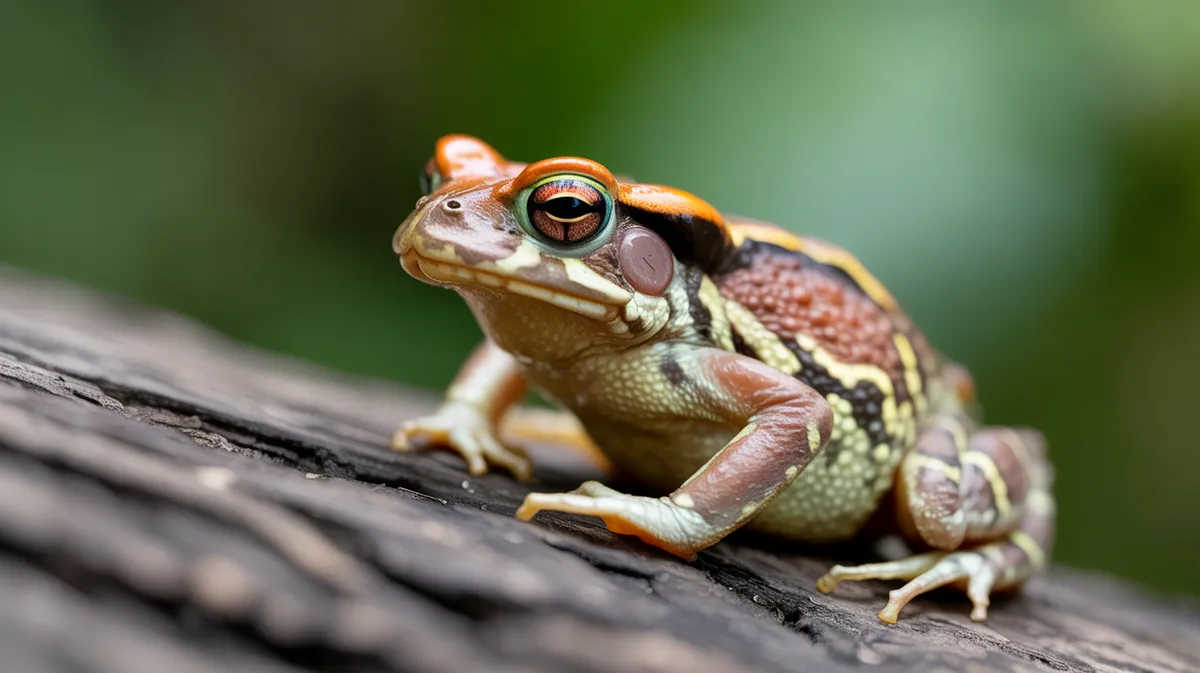
About the Morogoro Tree Toad
The Morogoro Tree Toad is a small, terrestrial frog native to eastern Africa, particularly found in the Morogoro region of Tanzania. Despite its common name, this species spends much of its time on the forest floor among leaf litter, rather than in trees. It is characterized by its slender body, long digits, and brown or mottled coloration, which provides camouflage among the undergrowth. The Morogoro Tree Toad is a secretive species, often heard more than seen, with males producing distinctive calls during the rainy season.
Fascinating facts
Leaf Litter Dweller
The Morogoro Tree Toad spends most of its life hidden in leaf litter on the forest floor, using its coloration to remain undetected.
Unique Breeding
Females lay their eggs on land, where the young skip the tadpole stage and hatch directly into miniature frogs.
Distinctive Calls
Males produce loud, high-pitched calls during the rainy season to attract mates, and each individual's call is slightly different.
Detailed description
The Morogoro Tree Toad (Arthroleptis stenodactylus) is a small, slender-bodied amphibian, typically measuring between 20 to 35 mm in snout-vent length. Its dorsal coloration ranges from light brown to dark mottled patterns, often with subtle striping or speckling that provides effective camouflage among leaf litter. The ventral surface is usually lighter, sometimes with faint marbling. This species has relatively long, thin limbs and elongated digits, though it lacks the expanded toe pads typical of arboreal frogs, reflecting its primarily terrestrial lifestyle. The skin is smooth to slightly granular, aiding in moisture retention and defense against desiccation. Eyes are moderately large and positioned laterally, providing a wide field of vision to detect both predators and prey. The Morogoro Tree Toad is primarily nocturnal, emerging at dusk to forage and call. Males are known for their distinctive, high-pitched advertisement calls, which are produced from concealed positions within leaf litter during the rainy season. Unlike many amphibians, this species exhibits direct development, with eggs hatching directly into miniature froglets rather than aquatic tadpoles.
Did you know?
Despite being called a 'tree toad,' this species is primarily terrestrial and seldom climbs trees.
Research & sources
Behaviour & social structure
Arthroleptis stenodactylus is a secretive, ground-dwelling species that spends most of its life hidden among leaf litter and under logs or stones. It is primarily nocturnal, becoming active at dusk when humidity is higher, which reduces the risk of desiccation. Its diet consists mainly of small invertebrates, such as ants, termites, beetles, and other arthropods, which it locates using both visual and chemical cues. The toad employs a sit-and-wait foraging strategy, remaining motionless until prey approaches, then making rapid lunges. Social interactions are limited outside of the breeding season; individuals are generally solitary, with males establishing calling territories during periods of peak rainfall. Aggressive encounters between males are rare but may involve short bouts of physical posturing or calling contests. During the day, the species seeks refuge in moist microhabitats to avoid dehydration.
Reproduction & life cycle
Breeding in the Morogoro Tree Toad is closely tied to the onset of the rainy season, typically from November to April in its native range. Males call from concealed positions to attract females, producing a series of short, high-pitched notes. Courtship involves amplexus, with the male grasping the female in an axillary position. Females lay small clutches of 10–30 eggs in moist, protected sites within the leaf litter or under debris. The species exhibits direct development: embryos bypass the free-swimming tadpole stage and hatch as fully formed, miniature froglets after an incubation period of approximately 14–21 days, depending on temperature and humidity. Parental care is minimal or absent, though egg-laying sites are often carefully selected to maximize offspring survival.
Adaptations & survival
Arthroleptis stenodactylus has evolved several adaptations for terrestrial life. Its cryptic coloration and patterning provide effective camouflage against the forest floor, reducing predation risk. The lack of toe pads and the presence of elongated digits facilitate movement through leaf litter rather than climbing. Direct development eliminates the need for standing water, allowing the species to exploit habitats far from permanent water bodies and reducing vulnerability to aquatic predators. Its nocturnal activity pattern minimizes water loss and exposure to diurnal predators. The species also exhibits a high tolerance for microhabitat variability, enabling it to persist in both primary and secondary forests, as well as in disturbed areas such as plantations and gardens.
Cultural significance
There is little documented cultural or symbolic significance of Arthroleptis stenodactylus in local human societies. Unlike some larger or more conspicuous amphibian species, it does not feature prominently in folklore, traditional medicine, or local mythology. Its secretive habits and small size likely contribute to its relative obscurity in cultural contexts. However, as an insectivore, it may play an indirect role in controlling pest populations in agricultural areas.
Recent research
Recent research on Arthroleptis stenodactylus has focused on its reproductive biology, particularly the mechanisms and evolutionary advantages of direct development. Molecular studies have clarified its phylogenetic relationships within the Arthroleptidae family, revealing significant genetic diversity across its range, which may indicate the presence of cryptic species. Ecological studies have examined its role in leaf litter decomposition and nutrient cycling, highlighting its importance in forest ecosystem functioning. Ongoing research is investigating the species' resilience to habitat disturbance and climate variability, with particular attention to its adaptability in fragmented landscapes. There is also interest in using this species as a bioindicator for forest health due to its sensitivity to microhabitat changes.
Sources
Amphibian Species of the World: Arthroleptis stenodactylus
Frost, D.R. (American Museum of Natural History) (2024)
scientificAmphibian Species of the World: Arthroleptis stenodactylus
Frost, D.R. (American Museum of Natural History) (2024)
scientificVideos
Habitat
Subtropical or tropical moist lowland forest
 Africa
Savanna
Grasslands with scattered trees, characterized by seasonal rainfall and home to diverse grazing animals and predators.
 Various Continental Regions
Grassland
Open areas dominated by grasses rather than trees, supporting numerous herbivores and their predators.
 Elevated Terrain
Mountain
High-altitude environments with varying climates and specialized wildlife adapted to rugged terrain and thin air.
 Global
Forest
Wooded areas with significant tree cover and diverse plant and animal communities.
Conservation
The Morogoro Tree Toad is currently classified as Least Concern on the IUCN Red List.
Threats & challenges
Currently classified as Least Concern by the IUCN, the Morogoro Tree Toad is considered widespread and adaptable within its range, which includes Tanzania, Kenya, Malawi, Mozambique, and possibly parts of the Democratic Republic of the Congo. However, localized threats include habitat loss due to deforestation, agricultural expansion, and urbanization. While the species tolerates some habitat modification, extensive clearing of forest can reduce suitable microhabitats and breeding sites. Climate change, particularly changes in rainfall patterns, may also pose future risks by altering breeding cycles and microhabitat moisture levels. There is limited evidence of population decline, but ongoing habitat degradation could impact local populations if not managed.
Taxonomy
Scientific name
Arthroleptis stenodactylus
- Kingdom
- Animalia
- Phylum
- Chordata
- Class
- Amphibia
- Order
- Anura
- Family
- Arthroleptidae
- Genus
- Arthroleptis
- Species
- stenodactylus
Community notes
Share your observations about the Morogoro Tree Toad.
No community notes yet. Be the first!
Discover more wildlife
More fascinating animals from the encyclopedia.