
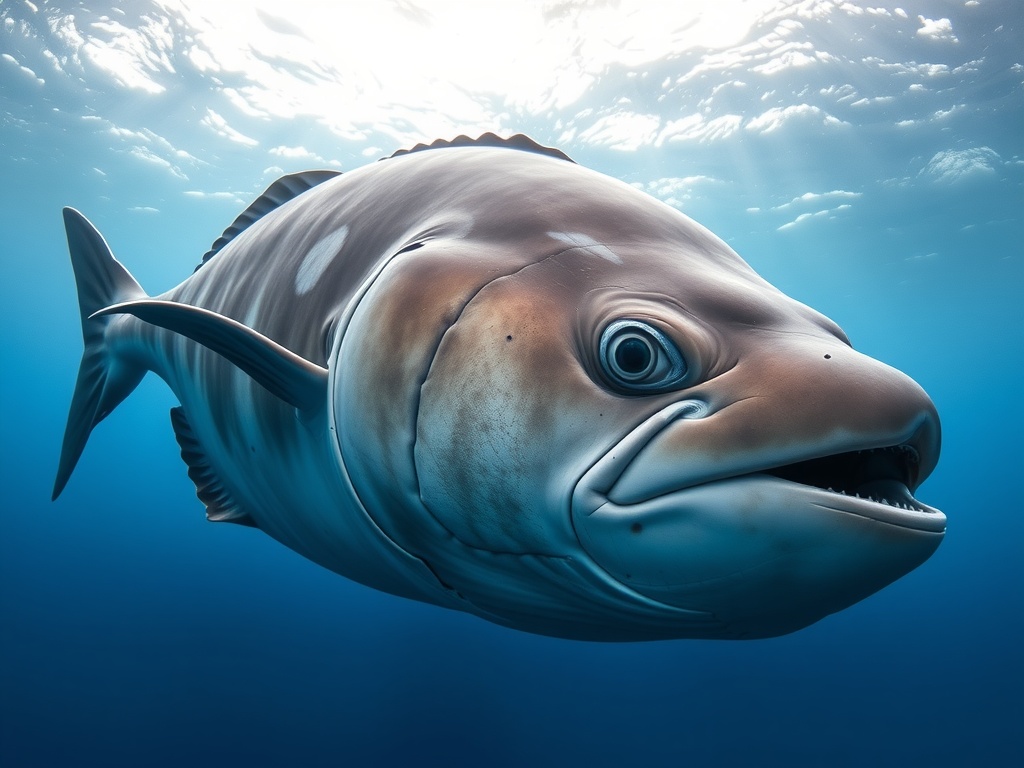
About the Ocean sunfish
The ocean sunfish is the heaviest bony fish in the world and looks like a fish that has been bitten in half. It effectively has no tail — the rear of the body ends in a clavus, a rudder formed from fused fin rays — and it swims instead by sculling its enormous dorsal and anal fins like a pair of wings, flapping rather than undulating. It was long written off as a helpless drifter, but tracking has shown the opposite: it swims purposefully, and it dives repeatedly into cold, deep water to feed on gelatinous prey, then returns to the surface and lies on its side in the sun — which both rewarms it and appears to invite seabirds and cleaner fish to pick at its extraordinary parasite load, which can run to dozens of species. A female may carry hundreds of millions of eggs at once, more than any other known vertebrate, and the hatchling is a tiny spiked speck that will grow tens of millions of times in mass on its way to adulthood.
Fascinating facts
Heaviest Bony Fish
Ocean sunfish are the heaviest bony fish in the world, with some individuals weighing over 2,000 kg (4,400 lbs).
Egg-Laying Champions
Female ocean sunfish can produce and release up to 300 million eggs in a single spawning event, the most of any vertebrate.
Surface Sunbathers
They are often seen basking at the ocean's surface, which may help them warm up after deep dives into colder waters.
Detailed description
The ocean sunfish (Mola mola) is a remarkable pelagic fish distinguished by its laterally compressed, almost circular body and truncated, rudder-like clavus (pseudo-tail), which replaces the typical fish caudal fin. Adults can reach lengths of up to 3.3 meters (10.8 ft) and heights (dorsal to anal fin tip) of 4.2 meters (13.8 ft), with recorded weights up to 2,300 kg (5,100 lbs), though most individuals are considerably smaller. The skin is thick, rough, and often hosts numerous parasites, which the sunfish mitigate by seeking cleaning from smaller fish and even seabirds. The body is silvery-gray to brownish, sometimes with mottled patterns, and lacks scales except for a layer of small, rough denticles. Mola mola has tiny pectoral fins, long dorsal and anal fins, and a small mouth that is perpetually open due to fused teeth forming a beak-like structure. Internally, it possesses a reduced skeleton and lacks a swim bladder, relying on its gelatinous tissues for buoyancy. The species is ectothermic but displays some regional endothermy in its muscles, allowing brief forays into cooler, deeper waters. Its brain-to-body weight ratio is among the lowest of all vertebrates, yet it displays complex behaviors. Ocean sunfish are solitary or loosely aggregating, often observed basking at the surface, possibly for thermoregulation or parasite removal. They are oviparous, with females capable of producing up to 300 million eggs per spawning event—the highest fecundity known among vertebrates. Larvae are minuscule (2.5 mm) and undergo dramatic metamorphosis, increasing in size by more than 60 million times to reach adulthood.
Did you know?
Despite their size, ocean sunfish are often mistaken for sharks or other sea creatures due to their enormous dorsal and anal fins breaking the surface.
Research & sources
Wikipedia summary
The ocean sunfish, also known as the common mola, is one of the largest bony fish in the world. It is the type species of the genus Mola, and one of five extant species in the family Molidae. It was once misidentified as the heaviest bony fish, which was actually a different and closely related species of sunfish, Mola alexandrini. Adults typically weigh between 247 and 1,000 kg. It is native to tropical and temperate waters around the world. It resembles a fish head without a tail, and its main body is flattened laterally. Sunfish can be as tall as they are long when their dorsal and ventral fins are extended.
Behaviour & social structure
Ocean sunfish exhibit primarily solitary behavior but may form loose aggregations, especially in areas with abundant food or cleaning stations. They are diurnal, spending daylight hours alternating between deep dives (up to 600 meters) to forage and surface basking. Basking may serve to elevate body temperature after cold-water dives or to facilitate parasite removal by birds and cleaner fish. Their feeding is opportunistic; while gelatinous zooplankton like jellyfish comprise the bulk of their diet, they also consume salps, comb jellies, small fish, squid, crustaceans, and occasionally algae. Mola mola are slow swimmers, propelling themselves by synchronous undulation of their dorsal and anal fins, while the clavus acts as a rudder. They are known to breach the surface, leaping up to 3 meters, possibly to dislodge parasites. Social interactions are limited, but some evidence suggests temporary groupings during feeding or cleaning. They are not territorial and show little aggression.
Reproduction & life cycle
Reproduction in Mola mola is oviparous, with external fertilization. Spawning likely occurs in warm surface waters during late summer and autumn, though precise locations remain poorly documented due to the species’ pelagic lifestyle. Females are extraordinarily fecund, releasing up to 300 million eggs per season, which are fertilized by multiple males. Eggs are spherical, pelagic, and measure about 1.3 mm in diameter. Embryonic development is rapid, with larvae hatching in 2-3 days. The larvae are initially covered in spines and resemble miniature pufferfish, reflecting the family’s evolutionary history. There is no parental care; larvae are planktonic and undergo several morphological changes before developing the adult form. Sexual maturity is reached at an estimated 4-5 years, with adults capable of repeated spawning.
Adaptations & survival
Ocean sunfish possess several unique adaptations for a pelagic lifestyle. Their laterally compressed, disk-shaped body minimizes drag and allows for efficient vertical movement in the water column. The absence of a swim bladder is compensated by a high proportion of low-density, gelatinous tissue, aiding buoyancy. Fused teeth form a beak-like structure, ideal for consuming gelatinous prey. Their thick, rough skin (up to 7.3 cm) provides protection from predators and parasites. The ability to bask at the surface aids in thermoregulation after deep, cold dives. Mola mola’s high fecundity offsets high larval mortality rates. They also exhibit behavioral adaptations such as seeking cleaning stations and breaching to remove parasites. Their slow, energy-efficient swimming style is well-suited to a diet of low-calorie prey.
Cultural significance
Ocean sunfish have fascinated humans for centuries, appearing in European bestiaries, Japanese folklore, and maritime art. In Japan, they are called "マンボウ" (manbō) and are sometimes featured in cuisine and aquaria, though their delicate flesh and high parasite load limit their culinary use. In some cultures, sunfish are viewed as symbols of good luck or curiosity due to their unusual appearance. Their docile nature and impressive size make them popular attractions in public aquariums, though their care is challenging. Mola mola have also inspired scientific and artistic representations, highlighting their role as icons of marine biodiversity.
Recent research
Recent research has clarified the taxonomy of the Molidae family, distinguishing Mola mola from the similar Mola alexandrini (bump-head sunfish), which is now recognized as the heaviest bony fish. Satellite tagging and telemetry studies have revealed extensive migratory patterns, with individuals traveling thousands of kilometers and diving to depths exceeding 800 meters. Stable isotope analysis has improved understanding of their diet and trophic role, indicating a more varied diet than previously thought. Studies on parasite loads and cleaning symbioses have provided insights into their health and behavior. Genomic research is ongoing to elucidate the evolutionary adaptations underlying their unique morphology and rapid growth rates. Conservation efforts are increasingly focused on bycatch reduction and improved monitoring of population trends.
Videos
Habitat
Open ocean (pelagic zones) of temperate and tropical seas

Conservation
The Ocean sunfish is currently classified as Vulnerable on the IUCN Red List.
Threats & challenges
The primary threats to ocean sunfish include bycatch in drift gillnets, trawl fisheries, and longlines, particularly in the Mediterranean and Pacific. They are also vulnerable to boat strikes due to their surface basking behavior. Marine debris, especially plastic bags, pose a significant risk as they can be mistaken for jellyfish and ingested, leading to injury or death. Ocean sunfish are occasionally targeted for food, medicine, or curios in some regions, though not on a large scale. Natural predators include orcas, large sharks, and sea lions. Population trends are difficult to assess due to their wide distribution and pelagic habits, but regional declines have been noted. Climate change and ocean warming may alter prey availability and distribution, further impacting populations. The IUCN currently lists Mola mola as Vulnerable, emphasizing the need for improved bycatch mitigation and further research.
Taxonomy
Scientific name
Mola mola
- Kingdom
- Animalia
- Phylum
- Chordata
- Class
- Actinopterygii
- Order
- Tetraodontiformes
- Family
- Molidae
- Genus
- Mola
- Species
- mola
Where to see an ocean sunfish
1 zoo and aquarium in 1 country are recorded as keeping this species.

Community notes
Share your observations about the Ocean sunfish.
No community notes yet. Be the first!
Discover more wildlife
More fascinating animals from the encyclopedia.