
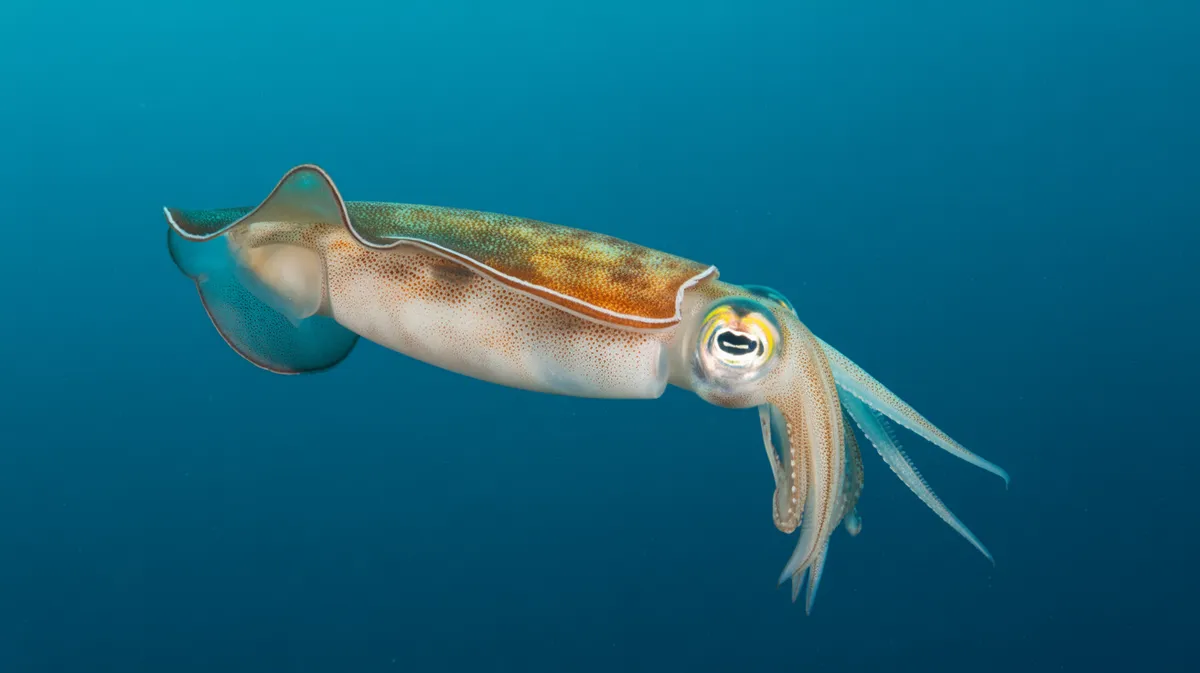
About the Oceanic Squid
The Oceanic Squid, also known as the Neon Flying Squid, is a pelagic mollusk found throughout the world's temperate and tropical oceans. This agile invertebrate is renowned for its streamlined, torpedo-shaped body and its ability to leap above the water's surface to escape predators. Oceanic Squids are fast-growing and short-lived, with a lifespan of only about a year. They play a vital ecological role as both predator and prey, feeding on fish, crustaceans, and other cephalopods while serving as an important food source for many marine animals.
Fascinating facts
Bioluminescent Displays
Oceanic Squids possess photophores along their bodies that allow them to produce light, which can be used for camouflage, attracting mates, or confusing predators.
Jet Propulsion
These squids move by rapidly expelling water from their mantle cavity, allowing for sudden bursts of speed and even brief glides above the water surface.
Long-distance Travelers
Oceanic Squids perform daily vertical migrations and can cover vast horizontal distances, making them one of the most widespread squid species.
Detailed description
The Oceanic Squid (Ommastrephes bartramii), commonly called the Neon Flying Squid, is a large pelagic cephalopod distinguished by its elongated, muscular mantle that can reach lengths of 40–60 cm, with some reports of individuals exceeding 1 meter. Its body is streamlined for rapid swimming, aided by a pair of large, triangular fins that extend along the posterior half of the mantle. The species exhibits a striking reddish-pink coloration, with photophores (light-producing organs) distributed along the ventral surface, which are believed to play a role in counter-illumination camouflage. Ommastrephes bartramii possesses eight arms and two longer tentacles equipped with powerful suckers and hooks for grasping prey. This squid is renowned for its ability to propel itself out of the water, gliding above the surface for several meters, a behavior thought to evade predators such as tuna, billfish, and marine mammals. Its large, complex eyes provide acute vision in the dimly lit mesopelagic zone (200–1000 m depth), where it spends daylight hours before migrating closer to the surface at night. The species is highly migratory, undertaking extensive seasonal movements across ocean basins in response to water temperature, prey availability, and reproductive cycles. Ommastrephes bartramii is a keystone species, linking lower trophic levels (such as small fish and crustaceans) to apex predators. Its rapid growth rate and short lifespan, typically 1–1.5 years, are characteristic of r-selected species, with high fecundity and little parental investment. The species is known for forming large, loosely structured aggregations, especially during spawning events.
Did you know?
Oceanic Squids undertake extensive vertical migrations, traveling hundreds of meters up and down the water column daily to hunt and avoid predators.
Research & sources
Behaviour & social structure
Oceanic Squid are primarily nocturnal, exhibiting diel vertical migration: they inhabit deeper waters (400–800 m) during the day and ascend to the upper 100–200 m at night to feed. Their hunting strategy is active and opportunistic, targeting a variety of prey including small pelagic fish (e.g., myctophids), crustaceans, and other cephalopods. They use rapid bursts of jet propulsion to ambush prey, capturing it with their tentacles and subduing it with a sharp beak. Socially, Ommastrephes bartramii are not truly gregarious but may form transient schools, particularly during feeding or spawning, which may provide some protection from predators. They are known for their remarkable escape responses, including rapid color changes (chromatophore expansion), inking, and aerial gliding. Daily routines are closely tied to light levels, with feeding concentrated at night and resting or slow swimming during the day at depth.
Reproduction & life cycle
Ommastrephes bartramii exhibits semelparity, reproducing only once before dying. Spawning occurs in warm surface waters, typically between 15–25°C, with peak breeding seasons varying by hemisphere: summer to early autumn in the Northern Hemisphere and late spring to summer in the Southern Hemisphere. Females produce a single, large gelatinous egg mass containing up to 1–5 million eggs, which are released into the water column. Fertilization is external, with males transferring spermatophores to the female's mantle cavity prior to spawning. Embryonic development is rapid, with hatching occurring within 5–10 days depending on temperature. There is no parental care; hatchlings (paralarvae) are planktonic and highly vulnerable to predation. Sexual maturity is reached quickly, often within 9–12 months, reflecting the species' fast-paced life history.
Adaptations & survival
The Oceanic Squid possesses several adaptations for pelagic life. Its streamlined body and powerful mantle musculature enable high-speed swimming and rapid directional changes. The presence of photophores allows for counter-illumination, masking its silhouette from predators below. Chromatophores in the skin facilitate rapid color changes for camouflage or signaling. The squid's large eyes are adapted for detecting faint bioluminescence and movement in low-light environments. Jet propulsion, achieved by forcefully expelling water through the siphon, is used both for locomotion and for leaping out of the water. The hooks and suckers on the tentacles provide a secure grip on slippery prey. Its high fecundity and short generation time are evolutionary responses to high predation pressure and environmental variability.
Cultural significance
The Neon Flying Squid is an important resource in East Asian fisheries, particularly in Japan, China, and Taiwan, where it is harvested for food and bait. In Japanese culture, it is known as 'Tōtōika' and features in regional cuisine, often served grilled or as sashimi. The species' spectacular aerial gliding has inspired local folklore and is sometimes referenced in maritime legends as 'flying sea creatures.' While not as mythologized as giant squids, it holds economic and culinary significance in regions where it is abundant.
Recent research
Recent research has focused on the population genetics and migratory patterns of Ommastrephes bartramii, revealing distinct stocks in the North and South Pacific, which has implications for fisheries management. Satellite tagging and stable isotope analysis have improved understanding of its vertical and horizontal movements. Studies on its role in marine food webs highlight its importance as both predator and prey, especially in supporting populations of commercially valuable fish and marine mammals. Ongoing research is examining the effects of ocean warming on its distribution and reproductive timing, as well as the accumulation of microplastics and heavy metals in its tissues. Advances in cephalopod genomics are beginning to shed light on the molecular basis of its rapid growth and unique adaptations.
Sources
Ommastrephes bartramii (Lesueur, 1821): Taxonomy, Distribution, and Biology
FAO Species Catalogue for Fishery Purposes, Vol. 4: Cephalopods of the World (2010)
scientificOmmastrephes bartramii (Lesueur, 1821): Taxonomy, Distribution and Biology
Roper, C.F.E., Sweeney, M.J. & Nauen, C.E. (FAO Species Catalogue) (1984)
scientificVideos
Habitat
Open ocean (pelagic zone)

Conservation
The Oceanic Squid is currently classified as Least Concern on the IUCN Red List.
Threats & challenges
Although currently classified as Least Concern, Ommastrephes bartramii faces several threats. It is subject to significant fishing pressure, particularly in the North Pacific, where it is targeted by commercial jigging fleets. Bycatch in other fisheries and potential impacts from climate change—such as ocean warming, deoxygenation, and changes in prey distribution—pose additional risks. The species' population is thought to be resilient due to its rapid growth and high reproductive output, but localized declines have been observed in heavily fished areas. Monitoring is complicated by its wide distribution and migratory habits. Pollution, especially microplastics, has also been detected in the digestive tracts of some individuals, raising concerns about long-term impacts.
Taxonomy
Scientific name
Ommastrephes bartramii
- Kingdom
- Animalia
- Phylum
- Mollusca
- Class
- Cephalopoda
- Order
- Oegopsida
- Family
- Ommastrephidae
- Genus
- Ommastrephes
- Species
- bartramii
Community notes
Share your observations about the Oceanic Squid.
No community notes yet. Be the first!
Discover more wildlife
More fascinating animals from the encyclopedia.