
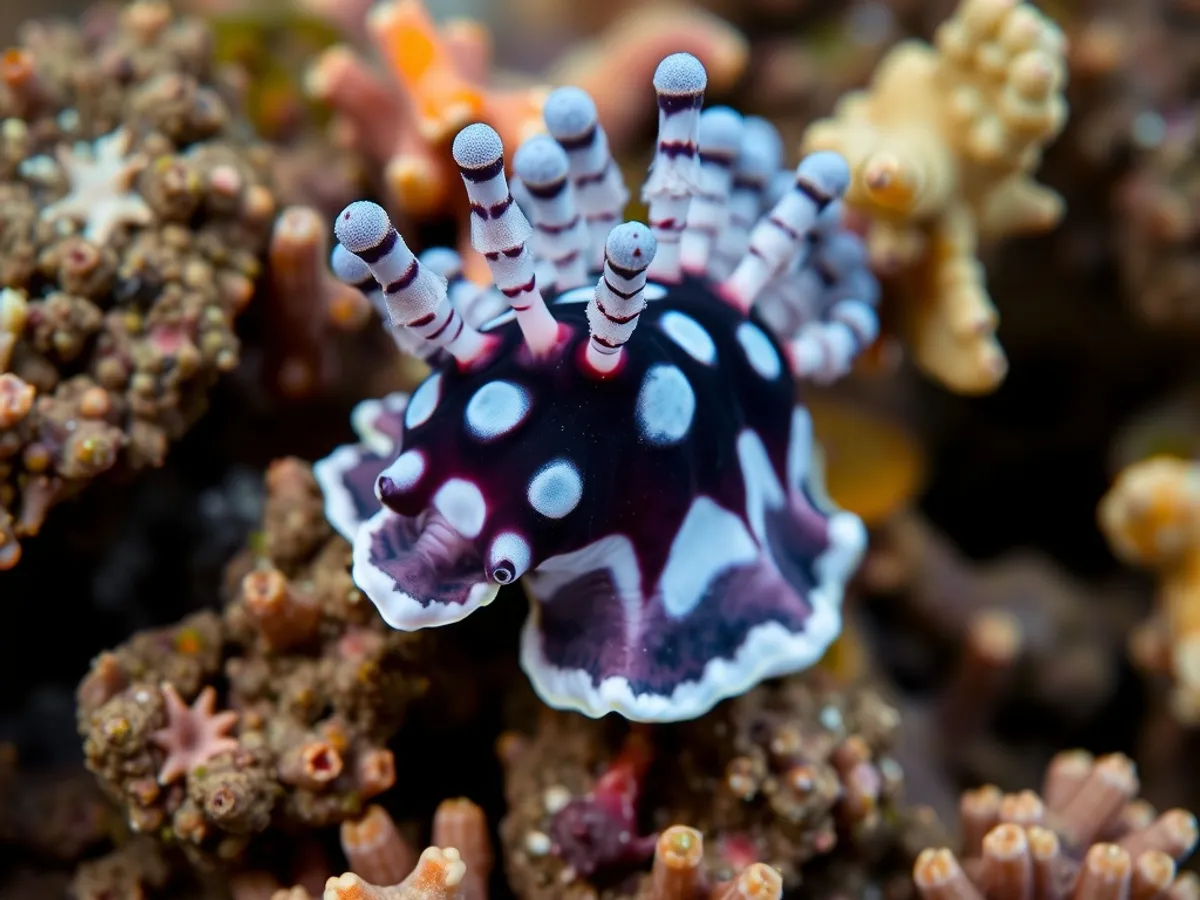
About the Ocellated Nudibranch
The Ocellated Nudibranch is a small, strikingly colorful sea slug known for its translucent white body adorned with vivid orange and yellow spots edged in black, resembling eyes or 'ocelli.' This nudibranch inhabits cold temperate waters and is typically found crawling on the ocean floor among bryozoans and hydroids, which it feeds upon. Its gills and rhinophores are prominently displayed, contributing to its ornate appearance and making it a favorite among underwater photographers. The species is an integral part of the benthic ecosystem, playing a role in controlling populations of its prey.
Fascinating facts
Colorful Defenses
The Ocellated Nudibranch's bright colors serve as a warning to predators that it is toxic and unpalatable.
Specialized Diet
This nudibranch primarily feeds on bryozoans and hydroids, using a specialized radula to scrape its prey.
Limited Range
Ocellated Nudibranchs are mostly found along the Pacific coasts of North America, particularly from Alaska to California.
Detailed description
The Ocellated Nudibranch (Ancula ocellata) is a small dorid nudibranch, typically measuring between 15 and 25 mm in length as an adult. Its translucent white body is adorned with conspicuous orange and yellow spots, each surrounded by a thin black ring, giving the appearance of eyes or 'ocelli'—a feature that likely serves as a deterrent to predators. The body is elongated and soft, with a pair of prominent, club-shaped rhinophores on the head that are finely lamellate and used for chemoreception. The branchial plume, consisting of feathery gills, is located dorsally towards the posterior and is often semi-retracted when the animal is disturbed. Along the sides of the body, Ancula ocellata possesses several lateral papillae, which are thought to enhance sensory perception and may mimic the tentacles of their bryozoan prey. The foot is broad and muscular, allowing for slow, gliding locomotion across substrates. This species is most commonly found on rocky reefs and kelp forests in cold temperate waters, particularly in the North Pacific, from Alaska to northern California. Its vivid coloration and ornate appendages make it highly recognizable to divers and researchers alike. As a benthic predator, it plays a specialized role in controlling populations of sessile invertebrates, particularly bryozoans and hydroids.
Did you know?
Despite their delicate appearance, Ocellated Nudibranchs can absorb toxins from their prey and use them as a chemical defense against predators.
Research & sources
Behaviour & social structure
Ancula ocellata is a solitary and slow-moving nudibranch, spending most of its time crawling over hard substrates in search of food. It exhibits a highly selective feeding behavior, using its radula—a ribbon-like organ with rows of chitinous teeth—to graze on bryozoan colonies and occasionally hydroids. The nudibranch is primarily active during the day, although some nocturnal activity has been observed in areas with high predation pressure. When threatened, it may retract its gill plume and papillae, relying on its aposematic coloration to warn off potential predators. Social interactions are minimal outside of mating, and individuals maintain small home ranges. Chemoreception via the rhinophores is crucial for locating both food and mates, as these organs can detect chemical cues released by prey and conspecifics.
Reproduction & life cycle
Like all nudibranchs, Ancula ocellata is a simultaneous hermaphrodite, possessing both male and female reproductive organs. Mating typically occurs in late winter to early spring, coinciding with the peak abundance of bryozoan prey. During copulation, two individuals align their bodies and exchange sperm via a protrusible copulatory organ. Fertilized eggs are laid in distinctive, coiled gelatinous ribbons attached to hard substrates near bryozoan colonies. Embryonic development is direct, with veliger larvae hatching after approximately 10–20 days, depending on water temperature. The larvae settle quickly and begin feeding on bryozoans, with no planktonic dispersal stage, which limits their dispersal range but increases juvenile survival rates. There is no parental care after egg deposition.
Adaptations & survival
Ancula ocellata exhibits several adaptations for survival in cold, temperate marine environments. Its bright coloration and eye-like spots serve as aposematic signals, warning predators of potential toxicity acquired from its prey. The lateral papillae and rhinophores are highly sensitive to chemical cues, enabling precise detection of food and mates in complex benthic habitats. Its radula is specialized for scraping bryozoan tissues, and the muscular foot provides strong adhesion to rocky substrates, even in areas with strong currents. The ability to retract gills and papillae reduces vulnerability to predation and physical damage. Evolutionarily, the loss of a planktonic larval stage reduces dispersal but increases the likelihood of juveniles settling in suitable habitats.
Cultural significance
While Ancula ocellata does not have a prominent role in traditional human culture or mythology, it is highly regarded by underwater photographers and marine enthusiasts for its striking appearance. The species is occasionally featured in educational materials and marine biodiversity exhibits to illustrate the diversity and beauty of nudibranchs. Its presence in healthy reef ecosystems is sometimes used as an indicator of environmental quality.
Recent research
Recent research on Ancula ocellata has focused on its ecological interactions with bryozoan prey and the chemical ecology of its aposematic coloration. Molecular studies are underway to clarify phylogenetic relationships within the Goniodorididae family. Observational studies have documented the species' limited dispersal and site fidelity, contributing to our understanding of nudibranch population dynamics. There is ongoing interest in the potential bioactive compounds sequestered from its prey, which may have pharmaceutical applications. Climate change impact studies are also being initiated to assess potential range shifts and changes in reproductive timing.
Videos
Habitat
Cold temperate coastal waters, often on rocky reefs and among bryozoans

Conservation
The Ocellated Nudibranch is currently classified as Least Concern on the IUCN Red List.
Threats & challenges
Currently, Ancula ocellata faces few direct threats and is considered of Least Concern. However, localized population declines may occur due to habitat degradation, pollution (especially from coastal development and runoff), and climate change, which can affect the abundance of bryozoan prey. Ocean acidification and warming may alter the distribution of both the nudibranch and its food sources. Collection for scientific study and the aquarium trade is minimal and not considered a significant threat. Long-term monitoring is recommended to detect any emerging conservation concerns, particularly in regions experiencing rapid environmental change.
Taxonomy
Scientific name
Ancula ocellata
- Kingdom
- Animalia
- Phylum
- Mollusca
- Class
- Gastropoda
- Order
- Nudibranchia
- Family
- Goniodorididae
- Genus
- Ancula
- Species
- ocellata
Community notes
Share your observations about the Ocellated Nudibranch.
No community notes yet. Be the first!
Discover more wildlife
More fascinating animals from the encyclopedia.