
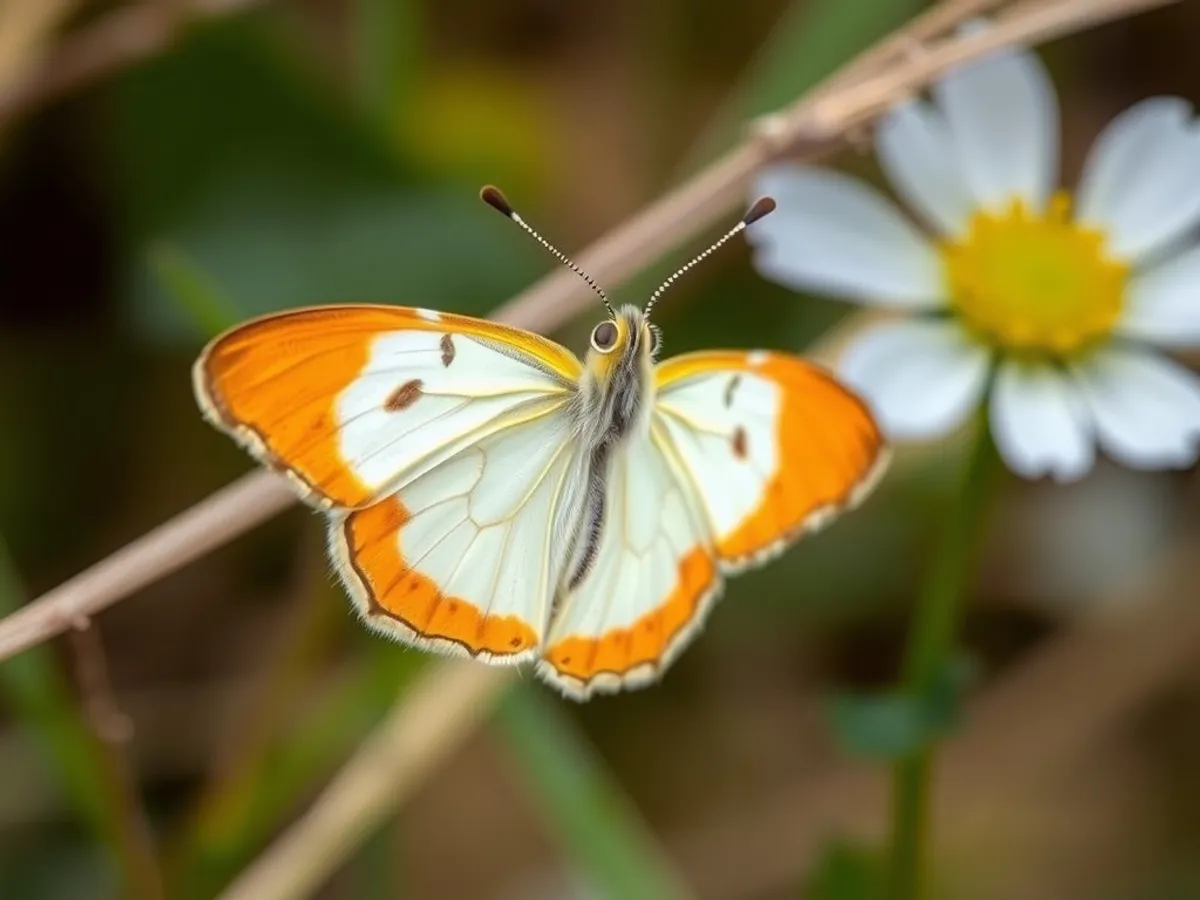
About the Orange-tip butterfly
The Orange-tip butterfly is a striking and easily recognizable butterfly, known for the vivid orange patches on the forewings of the males. Females lack the orange coloring, instead having mottled green and white hindwings and plain white forewings, making them harder to spot among flowers and foliage. This butterfly is commonly found in meadows, hedgerows, and woodland edges across Europe and parts of Asia. Its larvae specialize in feeding on cruciferous plants, particularly those in the cabbage family.
Fascinating facts
Sexual Dimorphism
Only male Orange-tip butterflies have the signature orange-tipped wings, while females are mostly white with mottled green hindwings.
Egg Laying Strategy
Females lay a single egg per host plant to reduce the risk of caterpillar cannibalism since larvae will eat eggs or other caterpillars if encountered.
Host Plant Specialization
The caterpillars feed primarily on cruciferous plants, especially cuckooflower and garlic mustard, which are vital for their development.
Detailed description
The Orange-tip butterfly (Anthocharis cardamines) is a medium-sized butterfly with a wingspan typically ranging from 45 to 52 mm. Males are easily identified by their bright orange tips on the forewings, which serve as a warning to predators and a signal to potential mates, while females lack the orange coloration and are predominantly white with small black spots. Both sexes have a distinctive mottled green and white pattern on the underside of their hindwings, providing excellent camouflage when at rest among vegetation. The body is slender, covered in fine hairs, and the antennae are clubbed, typical of the Pieridae family. Orange-tips are diurnal and are among the earliest butterflies to emerge in spring, often seen from April to early June in temperate regions. Their flight is characteristically fast and erratic, especially in males patrolling territories. The species is univoltine, producing one generation per year. Larvae are green with a white lateral stripe, blending seamlessly with their host plants. Adults feed primarily on nectar from a variety of wildflowers, while larvae are specialist feeders on the seed pods of cruciferous plants, particularly those in the genera Cardamine (cuckooflower) and Alliaria (garlic mustard). The Orange-tip butterfly plays a significant role in pollination and is considered an indicator species for healthy, flower-rich habitats.
Did you know?
The Orange-tip’s eggs are laid singly on flower buds, as the caterpillars will often eat any siblings they encounter!
Research & sources
Behaviour & social structure
Orange-tip butterflies exhibit pronounced sexual dimorphism in behavior. Males are highly territorial and spend much of their active hours patrolling linear habitats such as hedgerows and woodland edges in search of females, often engaging in aerial chases with rivals. Females are more secretive, spending time searching for suitable host plants on which to lay eggs. Feeding occurs mainly during sunny periods, with adults visiting flowers such as cuckooflower, garlic mustard, bluebell, and bugle for nectar. The larvae are solitary and cannibalistic, often consuming rival eggs or larvae on the same host plant. Adults are most active during warm, sunny weather and are rarely seen flying in overcast or windy conditions. Roosting occurs on tall vegetation, where their cryptic hindwing pattern provides camouflage from predators.
Reproduction & life cycle
Mating typically occurs soon after adult emergence, with peak activity in late April and May. Males locate females by patrolling and may attempt to mate immediately upon encounter. Courtship is brief, and copulation can last up to an hour. Females lay single, conical, pale orange eggs on the flower buds or stems of suitable cruciferous host plants. Each female may lay up to 60 eggs during her lifespan. The eggs hatch after 7-10 days, and the larvae feed on the developing seed pods, growing rapidly over 3-4 weeks. Pupation occurs in a pale green or brown chrysalis, attached upright to stems or other vegetation by a silk girdle. The pupal stage lasts through the summer, autumn, and winter (diapause), with adults emerging the following spring. There is no parental care; all life stages are solitary.
Adaptations & survival
The Orange-tip butterfly exhibits several key adaptations for survival. The orange forewing tips in males serve both as a warning to avian predators (aposematism) and as a sexual signal. The cryptic green-and-white mottling on the hindwings provides excellent camouflage against foliage, especially when roosting. Larvae are highly specialized feeders, adapted to detoxify glucosinolates found in cruciferous plants. Cannibalistic behavior in larvae reduces competition for limited food resources. The timing of adult emergence is synchronized with the flowering of host plants, ensuring optimal conditions for egg-laying and larval development. The overwintering pupal stage allows the species to survive adverse conditions and emerge in synchrony with spring plant growth.
Cultural significance
The Orange-tip butterfly is a familiar and cherished sign of spring in many parts of Europe and the UK, often featured in nature writing and children's literature as a harbinger of warmer weather. Its striking appearance has made it a popular subject for artists and naturalists. In some cultures, butterflies symbolize transformation and renewal, and the Orange-tip's early emergence is associated with the awakening of the natural world. There are no known traditional medicinal or utilitarian uses.
Recent research
Recent research on Anthocharis cardamines has focused on its phenological responses to climate change, with studies indicating shifts in emergence dates linked to warmer springs. Genetic studies have explored population structure and dispersal, revealing moderate gene flow across fragmented landscapes. Ecological research has highlighted the importance of landscape connectivity and the availability of native cruciferous plants for sustaining populations. The species is also used as a model for studying the evolution of warning coloration and larval host plant specialization.
Sources
The Ecology and Conservation of the Orange-tip Butterfly Anthocharis cardamines
Thomas, J.A. & Lewington, R. (2010)
scientificThe Ecology and Evolution of the Orange-tip Butterfly (Anthocharis cardamines)
J. Dover, Journal of Insect Conservation (2021)
scientificVideos
Habitat
Meadows, hedgerows, and woodland edges


Conservation
The Orange-tip butterfly is currently classified as Least Concern on the IUCN Red List.
Threats & challenges
While currently listed as Least Concern, the Orange-tip butterfly faces several localized threats. Habitat loss due to agricultural intensification, removal of hedgerows, and reduction of wildflower-rich meadows can limit breeding and feeding sites. Pesticide use poses a risk to both larvae and adults. Climate change may alter the phenology of host plants, potentially leading to mismatches between butterfly emergence and food availability. However, the species has shown some adaptability by utilizing garden habitats and a range of cruciferous plants. Population trends are stable across much of its range, but local declines have been noted in areas of intensive land use.
Taxonomy
Scientific name
Anthocharis cardamines
- Kingdom
- Animalia
- Phylum
- Arthropoda
- Class
- Insecta
- Order
- Lepidoptera
- Family
- Pieridae
- Genus
- Anthocharis
- Species
- cardamines
Community notes
Share your observations about the Orange-tip butterfly.
No community notes yet. Be the first!
Discover more wildlife
More fascinating animals from the encyclopedia.