
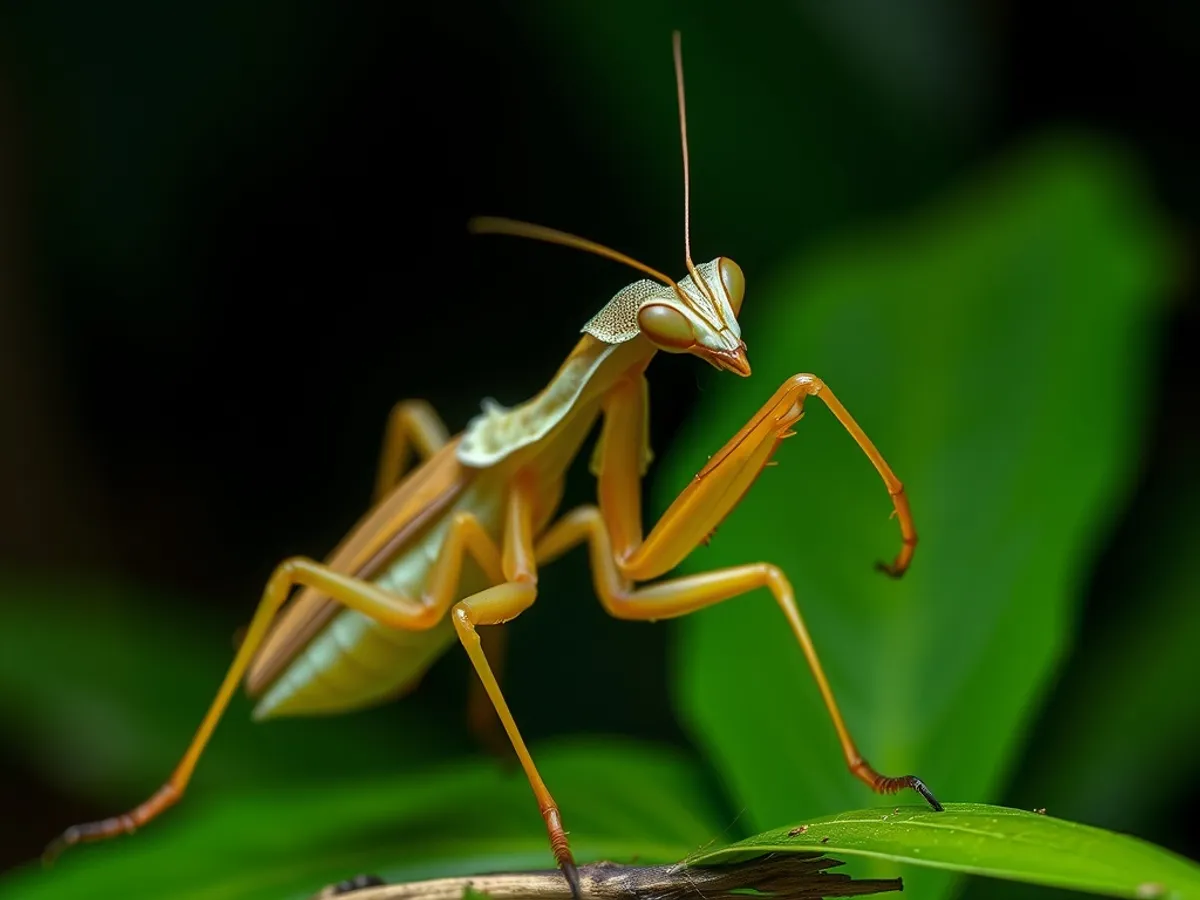
About the Orchid Mantis
The orchid mantis appears to be a flower, and for a long time that was assumed to be the whole story: a predator hiding among blossoms, waiting for a pollinator to blunder past. The truth turned out to be stranger and better. When researchers actually tested it, they found that the mantis attracts more pollinating insects than the flowers around it do — bees and flies fly to the mantis in preference to the real thing. It is not hiding among flowers at all; it is impersonating a flower so effectively that it out-competes them, functioning as a lure in its own right. This is aggressive mimicry taken to an extreme, and it was the first case ever demonstrated in which a predator's floral imitation is more attractive than the model it imitates. Its lobed legs resemble petals, and its colour can shift, over successive moults, between white and pink. It does not wait beside a flower. It simply sits in the open, and the pollinators come to it.
Fascinating facts
Flower Impersonator
The Orchid Mantis perfectly mimics the shape and color of orchid petals, making it nearly invisible to both predators and prey.
Huge Females
Females can reach up to 7 cm in length, while males are usually half that size, a rare case of extreme sexual dimorphism in insects.
Lures Pollinators
By resembling flowers, Orchid Mantises attract bees and butterflies, which they swiftly snatch for a meal.
Detailed description
The Orchid Mantis (Hymenopus coronatus) is a visually striking mantid species, renowned for its extraordinary floral mimicry. Adult females, which can reach up to 6–7 cm in length, are significantly larger than males, which typically measure only 2.5–3 cm. The body is laterally flattened and adorned with lobes on the legs and thorax that resemble orchid petals, displaying a palette of white, pink, and sometimes yellow hues. This coloration can be adjusted slightly by individuals in response to environmental conditions, enhancing their camouflage. The head is triangular with large, forward-facing compound eyes that provide excellent binocular vision for detecting prey. The raptorial forelegs are equipped with sharp spines for grasping and immobilizing insects. Orchid mantises are ambush predators, relying on their flower-like appearance to attract pollinators such as bees, butterflies, and flies. Sexual dimorphism is pronounced, with females not only being larger but also more ornate, while males are more agile and capable of flight. The species is solitary outside of mating, and individuals are highly territorial. Their life cycle includes several molts (instars), with nymphs resembling miniature adults and already exhibiting mimicry. The lifespan in captivity ranges from 5 to 9 months, with females generally living longer than males.
Did you know?
The Orchid Mantis is one of the only insects that doesn't just blend into flowers—it actively mimics them to attract and ambush pollinators for food.
Research & sources
Wikipedia summary
Hymenopus coronatus is a mantis from the tropical forests of Southeast Asia. It is known by various common names, including walking flower mantis, orchid-blossom mantis and (pink) orchid mantis. It is one of several species known as flower mantis, a reference to their unique physical form and behaviour, which often involves moving with a “swaying” motion, as if being “blown” in the breeze. Several species have evolved to mimic orchid flowers as a hunting and camouflaging strategy, “hiding” themselves in plain view and preying upon pollinating insects that visit the blooms. They are known to grab their prey with blinding speed.
Behaviour & social structure
Orchid mantises are predominantly sit-and-wait predators, remaining motionless for extended periods while perched on or near flowers. They employ a characteristic swaying motion that mimics the movement of flowers in the breeze, further enhancing their disguise. When prey approaches, they strike with remarkable speed, capturing insects with their spined forelegs. Feeding is opportunistic, and larger females can subdue relatively large prey, including other mantids. Cannibalism, particularly sexual cannibalism, is observed, with females sometimes consuming males during or after mating. Orchid mantises are diurnal, being most active during daylight hours when pollinators are abundant. They are solitary and exhibit aggressive territorial behavior, especially among nymphs and females. Communication is limited to visual cues during courtship and threat displays, such as raising the forelegs and spreading the wings to appear larger.
Reproduction & life cycle
Reproduction in Hymenopus coronatus involves complex courtship behaviors, with males approaching females cautiously to avoid predation. Mating typically occurs during the wet season, coinciding with increased prey availability. After copulation, females lay oothecae (egg cases) containing 50–100 eggs, which are attached to vegetation. Incubation lasts 4–6 weeks, depending on temperature and humidity. There is no parental care; hatchlings are independent from birth and immediately begin hunting small insects. Sexual cannibalism is common, with up to 50% of matings resulting in the male being consumed, which may provide nutritional benefits to the female and enhance reproductive success. The species undergoes incomplete metamorphosis, progressing through 5–7 nymphal instars before reaching adulthood.
Adaptations & survival
The most notable adaptation of the Orchid Mantis is its exquisite floral mimicry, which serves both as camouflage from predators and as aggressive mimicry to lure prey. The lobed legs and variable coloration closely resemble orchid petals, while the swaying motion simulates the movement of flowers. Vision is highly developed, allowing precise targeting of prey. The ability to adjust coloration in response to background hues is a rare trait among mantids. Sexual dimorphism, with smaller, more agile males, may have evolved as an adaptation to reduce predation risk during mate searching. The rapid strike mechanism of the forelegs is an evolutionary specialization for capturing fast-moving insects.
Cultural significance
The Orchid Mantis has captivated naturalists and collectors since its discovery, often featured in documentaries and popular media for its beauty and mimicry. In local folklore, it is sometimes associated with themes of deception and transformation. The species is popular among insect enthusiasts and is occasionally kept in captivity, contributing to educational outreach about insect biodiversity. There are no significant traditional uses or medicinal associations reported in indigenous cultures.
Recent research
Recent research has focused on the biomechanics of floral mimicry and the evolutionary pathways leading to aggressive mimicry in mantids. Studies using spectrophotometry have demonstrated that the coloration of H. coronatus closely matches the reflectance spectra of local orchid species, effectively deceiving both prey and potential predators. Behavioral experiments have shown that pollinators are more likely to approach mantises than real flowers under certain conditions, highlighting the effectiveness of their mimicry. Genetic studies are ongoing to clarify phylogenetic relationships within the Hymenopodidae family. Conservation research is monitoring the impact of habitat loss and the pet trade on population dynamics.
Videos
Habitat
Tropical rainforest


Conservation
The Orchid Mantis is currently classified as Least Concern on the IUCN Red List.
Threats & challenges
Currently classified as Least Concern, the Orchid Mantis faces localized threats from habitat loss due to deforestation and agricultural expansion in Southeast Asia. Collection for the pet trade, while regulated, can also impact wild populations. Climate change poses a potential long-term threat by altering the distribution of suitable habitats and the availability of floral resources. Predators include birds, reptiles, and larger arthropods. Despite these pressures, the species remains relatively common in undisturbed forest habitats, but ongoing habitat fragmentation could lead to future declines.
Taxonomy
Scientific name
Hymenopus coronatus
- Kingdom
- Animalia
- Phylum
- Arthropoda
- Class
- Insecta
- Order
- Mantodea
- Family
- Hymenopodidae
- Genus
- Hymenopus
- Species
- coronatus
Community notes
Share your observations about the Orchid Mantis.
No community notes yet. Be the first!
Discover more wildlife
More fascinating animals from the encyclopedia.