
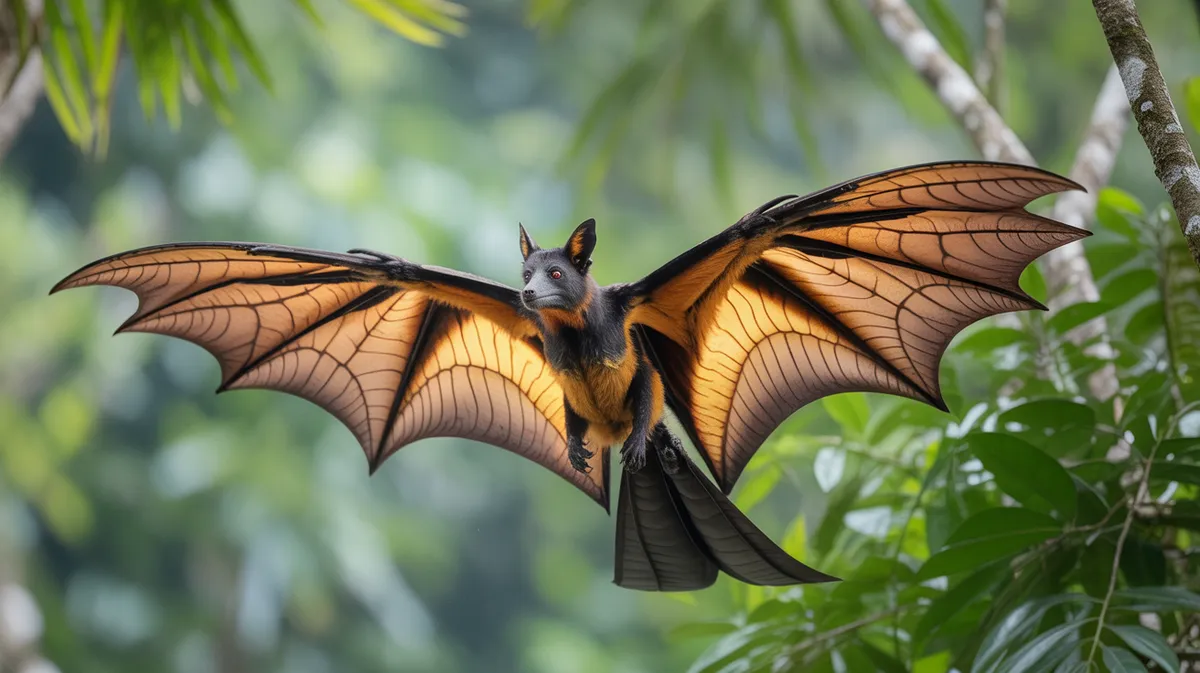
About the Ornate Flying Fox
The Ornate Flying Fox is a large species of fruit bat native to the islands of New Caledonia. It is distinguished by its striking coloration, which includes a mantle of golden or orange fur around its head and shoulders and dark brown or black wings. This bat plays a crucial ecological role as a pollinator and seed disperser in its tropical forest habitat. The Ornate Flying Fox is primarily nocturnal, roosting high in the forest canopy during the day and foraging for fruit at night. Due to habitat loss and hunting, its population is considered vulnerable.
Fascinating facts
Striking Appearance
The Ornate Flying Fox is known for its vibrant golden-orange fur around the head and shoulders, setting it apart from other flying fox species.
Forest Guardians
They play a vital role in maintaining forest health by dispersing seeds and pollinating native plants throughout New Caledonia.
Fruit Lovers
Their diet consists almost entirely of fruits, nectar, and flowers, which they help propagate by spreading seeds as they feed.
Detailed description
The Ornate Flying Fox (Pteropus ornatus) is a large, visually striking megabat endemic to New Caledonia, with a forearm length typically ranging from 135 to 160 mm and an average wingspan of approximately 1 meter. Adults weigh between 500 and 800 grams, making them one of the largest bat species in their range. Their pelage is characterized by a dense, golden-orange mantle around the head, neck, and shoulders, contrasting sharply with the dark brown to black fur covering the rest of the body and wings. The face is fox-like with large, dark eyes adapted for nocturnal vision, and their ears are relatively short and rounded. The species lacks a tail, a trait common among Pteropus bats. Ornate Flying Foxes are highly social, forming large communal roosts—sometimes numbering in the hundreds—in tall trees within lowland and montane dry forests. They are primarily frugivorous, feeding on a variety of native fruits, flowers, and nectar, and play a vital ecological role as pollinators and seed dispersers. Their strong, elongated tongues and robust jaws are well-adapted for extracting juice from tough fruits. The species exhibits high roost-site fidelity, often returning to the same trees for generations. Activity is mostly nocturnal, with foraging flights beginning at dusk and lasting several hours. During the day, individuals engage in grooming, social interactions, and thermoregulation behaviors such as wing fanning.
Did you know?
Unlike many bats, Ornate Flying Foxes do not use echolocation; instead, they rely on their excellent vision and sense of smell to find food.
Research & sources
Wikipedia summary
The ornate flying fox is a species of flying fox in the family Pteropodidae. It is endemic to New Caledonia. Its natural habitat is subtropical or tropical dry forests. It is threatened due to habitat destruction and hunting, the former exacerbated by high roost-site fidelity.
Behaviour & social structure
Ornate Flying Foxes are gregarious, roosting in large colonies that can include multiple age and sex classes. Social interactions include mutual grooming, vocalizations for communication, and occasional aggressive displays to establish dominance or defend roosting space. Their foraging behavior is characterized by long-distance flights—sometimes exceeding 20 km per night—in search of fruiting trees. They exhibit a preference for native figs (Ficus spp.), Syzygium, and other local fruiting species, but will also exploit cultivated fruit when available. Feeding occurs by hanging upside down and manipulating fruit with their dexterous forelimbs. Ornate Flying Foxes are crepuscular to nocturnal, with peak activity during the first few hours after sunset and before dawn. They use visual and olfactory cues to locate food. During the day, colonies are relatively quiet but may become agitated by disturbances, leading to mass take-offs. Roosts are often located in forest patches near water sources, which provide microclimatic stability and access to foraging grounds.
Reproduction & life cycle
Breeding in Pteropus ornatus is seasonal, with mating typically occurring during the austral autumn (March–May). Females exhibit delayed implantation, with gestation lasting approximately 5 to 6 months. Most births occur between September and November, coinciding with the peak availability of fruit resources. Females usually give birth to a single pup per year, though twins are rare. Newborns are altricial, weighing about 50–60 grams, and are carried by the mother for the first few weeks. As the pup grows, it is left at the roost while the mother forages at night, returning periodically to nurse. Weaning occurs at around 3 to 4 months of age, and juveniles become volant (capable of flight) at about 2 months. Sexual maturity is reached at 1.5 to 2 years. Parental care is provided exclusively by the mother, with no involvement from males beyond mating.
Adaptations & survival
The Ornate Flying Fox possesses several adaptations for its frugivorous and volant lifestyle. Its elongated, brush-tipped tongue allows efficient extraction of nectar and juice from flowers and fruits. The species' large, forward-facing eyes provide excellent night vision, crucial for nocturnal foraging. Strong, clawed digits enable secure hanging from branches and manipulation of food. Their robust, membranous wings are adapted for sustained flight over long distances, facilitating access to dispersed food resources. Social roosting behavior aids in thermoregulation and predator avoidance. The species also demonstrates cognitive adaptations, such as spatial memory for locating fruiting trees and traditional roost sites. High roost-site fidelity, while beneficial for social cohesion, can be maladaptive in the face of habitat disturbance.
Cultural significance
In New Caledonia, flying foxes, including Pteropus ornatus, hold cultural importance for some indigenous Kanak communities, where they are occasionally featured in traditional stories and ceremonies. The species has historically been hunted for food, with bat meat considered a delicacy in some regions. However, there is increasing awareness of the ecological importance of flying foxes, and local conservation initiatives sometimes incorporate traditional knowledge and community engagement. There are no widespread myths or symbolic associations unique to the Ornate Flying Fox, but it is generally regarded as an emblematic species of New Caledonia's unique biodiversity.
Recent research
Recent research has focused on the species' role in forest regeneration, highlighting its effectiveness as a long-distance seed disperser for both native and endemic plant species. Genetic studies are underway to assess population structure and connectivity between isolated colonies, which is critical for conservation planning. Ongoing ecological monitoring aims to better understand roost site selection, seasonal movement patterns, and responses to habitat disturbance. There is also interest in the potential impacts of emerging infectious diseases, such as henipaviruses, which have been detected in related Pteropus species elsewhere in the Pacific. Conservationists are collaborating with local communities to develop sustainable management strategies that balance traditional practices with species protection.
Videos
Habitat
Tropical forest
 Elevated Terrain
Mountain
High-altitude environments with varying climates and specialized wildlife adapted to rugged terrain and thin air.
 Tropical Regions
Rainforest
Dense, wet forests with the highest biodiversity on Earth, containing more than half of the world's plant and animal species.
 Global
Forest
Wooded areas with significant tree cover and diverse plant and animal communities.
Conservation
The Ornate Flying Fox is currently classified as Vulnerable on the IUCN Red List.
Threats & challenges
The primary threats to Ornate Flying Fox populations are habitat loss due to deforestation, agricultural expansion, and urban development, which reduce the availability of suitable roosting and foraging sites. Hunting for bushmeat and traditional uses also poses a significant threat, particularly during the breeding season when colonies are more vulnerable. The species' strong fidelity to specific roost sites makes them especially susceptible to local extirpation if these sites are disturbed or destroyed. Additional challenges include climate change, which may alter fruiting phenology and reduce food availability, and potential disease transmission from increased contact with domestic animals and humans. Population trends indicate a continuing decline, with the IUCN listing the species as Vulnerable. Conservation efforts are hampered by limited ecological data and enforcement of protective regulations.
Taxonomy
Scientific name
Pteropus ornatus
- Kingdom
- Animalia
- Phylum
- Chordata
- Class
- Mammalia
- Order
- Chiroptera
- Family
- Pteropodidae
- Genus
- Pteropus
- Species
- ornatus
Community notes
Share your observations about the Ornate Flying Fox.
No community notes yet. Be the first!
Discover more wildlife
More fascinating animals from the encyclopedia.