
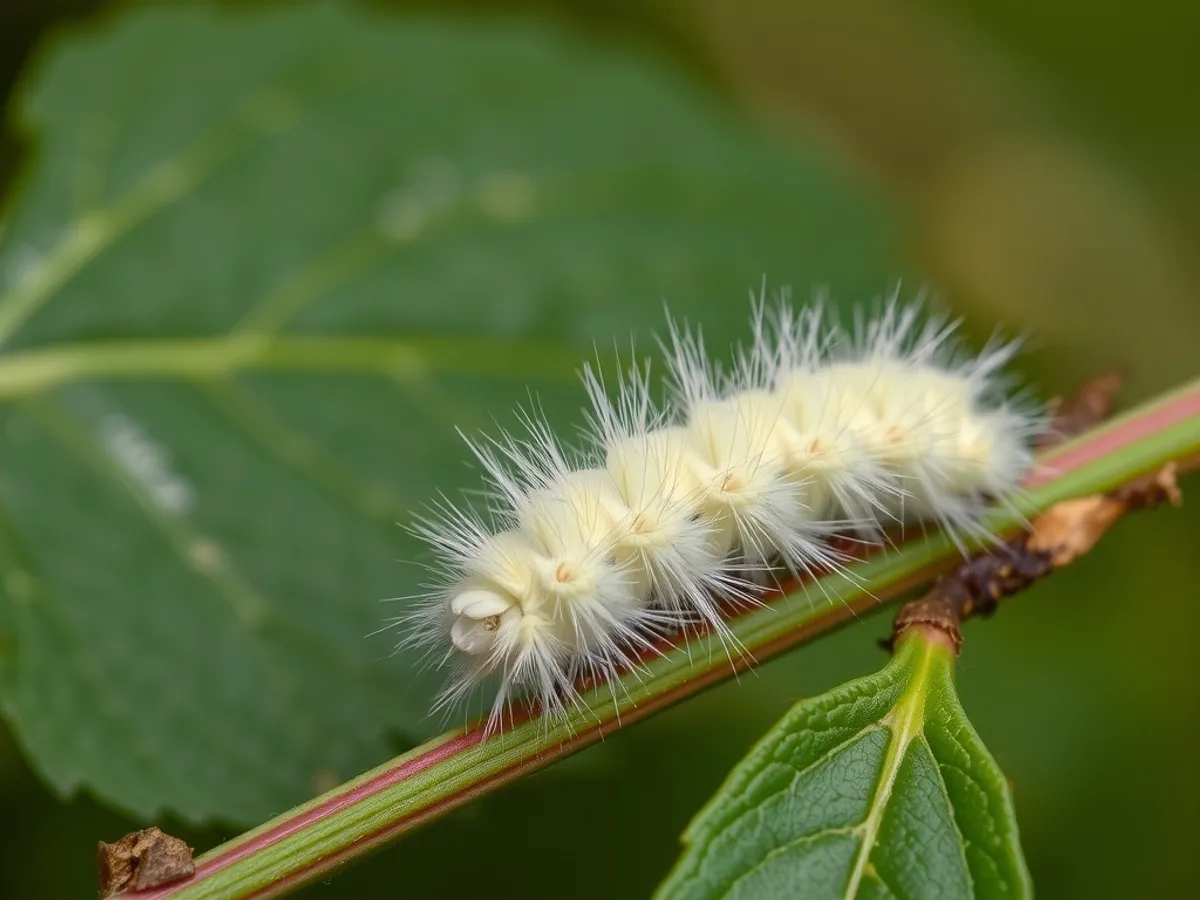
About the Pale tussock moth caterpillar
The pale tussock moth caterpillar is the larval stage of the pale tussock moth, easily recognizable by its bright yellow-green coloration and distinctive tufts of hair. This fuzzy caterpillar sports four dense, pale yellow tufts along its back and a striking tail-like pink or red 'horn' at its rear end. It is primarily found across Europe and parts of Asia, inhabiting woodlands, gardens, and hedgerows. The caterpillar feeds on a wide range of deciduous trees and shrubs before pupating and emerging as a subtly colored adult moth. Its unusual appearance serves as a warning to predators of its potential toxicity.
Fascinating facts
Distinctive Appearance
The caterpillar is famous for its lemon-yellow tufts and a bright red or pink tail, making it easily recognizable among European caterpillars.
Tree Lover
It feeds on the leaves of a wide variety of deciduous trees, such as oak, birch, hazel, and apple, making it a common sight in mixed woodlands.
Irritating Hairs
The caterpillar's hairs can cause mild skin irritation, providing it with protection from predators and curious humans alike.
Detailed description
The pale tussock moth caterpillar (Calliteara pudibunda) is a striking larval form, typically reaching lengths of 40–45 mm before pupation. Its body is covered in dense, lemon-yellow or greenish setae (hairs), with four prominent dorsal tufts (tussocks) that give the species its common name. The rear end is adorned with a conspicuous pink or crimson 'tail'—a pencil of longer hairs that acts as a visual deterrent. The head is small, dark, and partially hidden beneath the thoracic segments. The caterpillar possesses short, lateral setae that can cause mild skin irritation in humans (urticaria) due to histamine-like compounds. It is solitary and primarily active during the day, feeding voraciously on the leaves of various deciduous trees, including oak (Quercus), birch (Betula), hazel (Corylus), and beech (Fagus). Its bright coloration and hairy appearance are classic examples of aposematism, warning potential predators of its unpalatability. Upon reaching maturity, the caterpillar spins a loose cocoon incorporating its own hairs, usually attached to bark or leaf litter, where it pupates. The adult moth emerges in late spring to early summer, exhibiting cryptic, pale grey-brown coloration that contrasts sharply with its larval stage. The species is distributed widely across Europe and into temperate Asia, adapting well to both natural and anthropogenic habitats.
Did you know?
Despite its bright and fuzzy appearance, the caterpillar is harmless unless touched, when its hairs may cause an itchy rash.
Research & sources
Behaviour & social structure
Pale tussock moth caterpillars are primarily solitary feeders, dispersing themselves across host plants to minimize competition and predation risk. They exhibit a slow, deliberate locomotion, often pausing to feed for extended periods on the undersides of leaves. When threatened, the caterpillar may arch its body and display its bright tufts and tail, a defensive posture meant to startle or deter predators. Feeding occurs mainly during daylight hours, with the caterpillar consuming large quantities of foliage to fuel rapid growth. There is no evidence of social behavior or cooperative interactions among larvae. The adult moths are nocturnal, attracted to light sources, and do not feed, relying on energy reserves accumulated during the larval stage.
Reproduction & life cycle
Reproduction in Calliteara pudibunda is seasonal, with adults emerging from late May to early July, depending on latitude and local climate. Mating occurs shortly after emergence, typically at night. Females emit pheromones to attract males, which locate them using their highly sensitive, bipectinate antennae. After mating, females lay clusters of 100–300 eggs on the leaves or bark of suitable host plants. The eggs hatch after 10–14 days, depending on temperature. There is one generation per year (univoltine) throughout most of its range. There is no parental care; larvae are independent from hatching. The species overwinters in the pupal stage, with the cocoon providing protection from cold and desiccation.
Adaptations & survival
The caterpillar's vivid coloration and tufts are classic anti-predator adaptations, signaling toxicity or unpalatability (aposematism) to birds and small mammals. The setae contain irritant compounds that can deter predators and cause mild dermatitis in humans. The pink tail tuft may mimic the appearance of a stinger or inedible object. The larva's ability to feed on a wide variety of deciduous trees is an ecological adaptation, allowing it to exploit diverse habitats and avoid dependence on a single host. The cryptic coloration of the adult moth provides camouflage against tree bark, reducing predation risk during the vulnerable post-emergence period. Pupation in a cocoon incorporating larval hairs further deters parasitoids and predators.
Cultural significance
While not a major figure in folklore, the pale tussock moth caterpillar is often featured in European natural history literature and educational materials due to its distinctive appearance. Its urticating hairs have led to occasional mentions in public health advisories, warning against handling. In some regions, its presence is used as an indicator of healthy woodland ecosystems. The adult moth, being cryptic, is less frequently encountered and has little direct cultural impact.
Recent research
Recent research has focused on the chemical composition of the caterpillar's defensive setae and their effectiveness against avian predators. Studies have also examined the effects of climate change on phenology, noting earlier emergence in warmer years. Molecular phylogenetic work has clarified the species' relationships within the Erebidae family, supporting its placement in the subfamily Lymantriinae. Ongoing monitoring in urban environments has highlighted the species' adaptability and potential as a bioindicator for urban biodiversity.
Sources
Calliteara pudibunda (Linnaeus, 1758): Taxonomy, Biology, and Ecology
Fauna Europaea / GBIF Secretariat (2023)
scientificThe Lymantriidae of Europe (Lepidoptera): A Taxonomic Review
Witt, T.J. & Ronkay, L. (2011)
scientificVideos
Habitat
Forest edges, woodlands, gardens, and hedgerows
 Various Continental Regions
Grassland
Open areas dominated by grasses rather than trees, supporting numerous herbivores and their predators.
 Elevated Terrain
Mountain
High-altitude environments with varying climates and specialized wildlife adapted to rugged terrain and thin air.
 Global
Forest
Wooded areas with significant tree cover and diverse plant and animal communities.
Conservation
The Pale tussock moth caterpillar is currently classified as Least Concern on the IUCN Red List.
Threats & challenges
Currently, Calliteara pudibunda faces no major conservation threats and is classified as Least Concern. Its broad host range and adaptability to disturbed habitats, including gardens and urban parks, contribute to stable populations. Localized declines may occur due to intensive pesticide use, habitat loss, or climate change, which can alter the timing of life cycle events (phenology). Natural enemies include birds, parasitic wasps (Ichneumonidae, Braconidae), and tachinid flies. Outbreaks are rare and typically self-limiting due to natural predation and disease.
Taxonomy
Scientific name
Calliteara pudibunda
- Kingdom
- Animalia
- Phylum
- Arthropoda
- Class
- Insecta
- Order
- Lepidoptera
- Family
- Erebidae
- Genus
- Calliteara
- Species
- pudibunda
Community notes
Share your observations about the Pale tussock moth caterpillar.
No community notes yet. Be the first!
Discover more wildlife
More fascinating animals from the encyclopedia.