
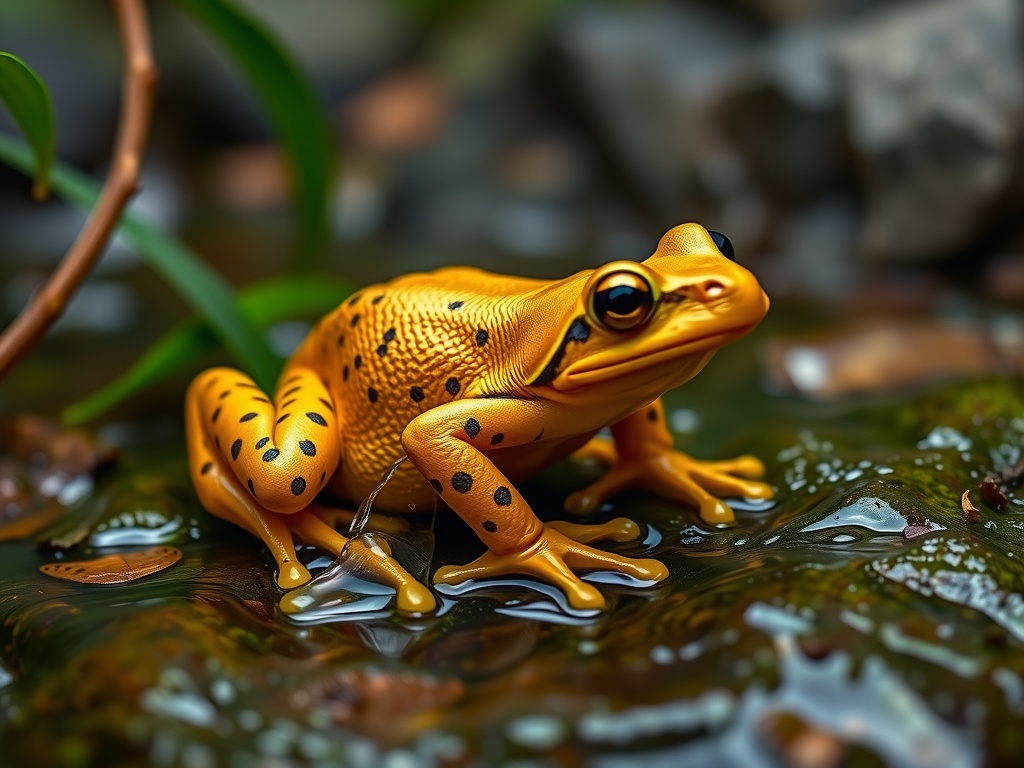
About the Panamanian Golden Frog
Atelopus zeteki is not a frog at all in the strict sense: it is a true toad, family Bufonidae, despite the smooth, brilliant yellow skin. It is the national animal of Panama, printed on lottery tickets and celebrated with a national day, and it is almost certainly extinct in the wild — the last confirmed wild individuals were seen around 2009, wiped out by the chytrid fungus Batrachochytrium dendrobatidis that swept across Central America. Several hundred survive in captive assurance colonies in Panama and North American zoos. Its skin carries zetekitoxin AB, a guanidinium alkaloid that is a potent sodium-channel blocker, more toxic by weight than tetrodotoxin and unlike anything else known in amphibians. Its most remarkable behaviour is semaphore: living beside loud, fast-flowing streams where calls are drowned out, the toads communicate by slowly rotating and waving a forelimb at rivals and mates, a visual signal used by very few amphibians. They still call, and they still hear, despite having no visible tympanic membrane. Males are much smaller than females and will cling to a female in amplexus for weeks or even months waiting for her to spawn.
Fascinating facts
Bright Warning Colors
The golden coloration of this frog serves as an aposematic warning to predators about its toxic skin.
Hand-Waving Communication
They use visual signals, like hand-waving, to communicate over the noise of rushing streams.
Victim of Disease
The deadly chytrid fungus (Batrachochytrium dendrobatidis) has wiped out most wild populations of this species.
Detailed description
The Panamanian golden frog (Atelopus zeteki) is a small, brightly colored toad endemic to the central mountainous regions of Panama. Adult individuals typically measure 35–63 mm in length, with females generally larger than males. Their skin is smooth and vividly colored, ranging from lemon yellow to deep gold, often adorned with irregular black markings that serve as warning coloration (aposematism) to potential predators. Unlike most toads, A. zeteki lacks prominent parotoid glands and has relatively long, slender limbs with partially webbed toes, an adaptation for life near fast-flowing streams. The species is diurnal, exhibiting peak activity during daylight hours. Panamanian golden frogs are primarily terrestrial but remain closely associated with rocky stream margins, where they are agile climbers and jumpers. Their skin secretes potent toxins, including zetekitoxin, a unique neurotoxin that deters predation. Notably, these frogs communicate using a combination of visual signals (such as 'waving' or semaphore-like limb movements) and vocalizations, an adaptation to the noisy environments of their native streams. The species is sexually dimorphic, with males possessing vocal sacs and nuptial pads for amplexus during the breeding season.
Did you know?
The Panamanian Golden Frog is believed to be extinct in the wild, with only a few individuals surviving in captive breeding programs and conservation facilities.
Research & sources
Wikipedia summary
The Panamanian golden frog, also known as Cerro Campana stubfoot toad and other names, is a species of toad endemic to Panama. Panamanian golden frogs inhabit the streams along the mountainous slopes of the Cordilleran cloud forests of west-central Panama. While the IUCN lists it as Critically Endangered, it may in fact have been extinct in the wild since 2007. Individuals have been collected for breeding in captivity in a bid to preserve the species. The alternative common name, Zetek's golden frog, and the epithet zeteki both commemorate the entomologist James Zetek.
Behaviour & social structure
Panamanian golden frogs are solitary outside the breeding season but may aggregate in suitable breeding habitats. They are active during the day, foraging along stream banks for small invertebrates such as ants, beetles, flies, and other arthropods. Their hunting strategy involves slow, deliberate movements and rapid tongue flicks to capture prey. Social interactions are most pronounced during the breeding season, when males establish territories along streams and engage in visual and acoustic displays to attract females and deter rivals. The species is renowned for its 'waving' behavior, where individuals raise and move their forelimbs in a conspicuous manner—believed to be a form of visual communication adapted to the loud, turbulent stream environment. Daily routines include basking on rocks, seeking shelter under debris, and frequent movement between terrestrial and aquatic microhabitats.
Reproduction & life cycle
Breeding occurs during the wet season, typically from late May through September, when stream levels are high. Males call from exposed rocks or stream banks to attract females, producing a soft, bird-like whistle. Amplexus is axillary, with the male grasping the female behind her forelimbs. Females lay clutches of 200–600 eggs in long gelatinous strings, which are attached to submerged rocks or vegetation in shallow, fast-flowing water. Embryonic development is rapid, with hatching occurring within 6–9 days. Tadpoles are adapted to cling to rocks in swift currents using specialized oral discs. Metamorphosis into juvenile frogs occurs after 6–7 months, depending on water temperature and food availability. There is no parental care beyond egg-laying.
Adaptations & survival
A. zeteki exhibits several adaptations to its montane stream habitat. Its vivid coloration and skin toxins provide effective chemical and visual deterrence against predators. The species' partially webbed feet and muscular limbs facilitate climbing and jumping on slippery rocks. Tadpoles possess ventral oral suckers, allowing them to adhere to substrates in turbulent water. The unique limb-waving communication compensates for the inefficacy of vocal calls in noisy stream environments. Diurnality may reduce predation risk and allow exploitation of specific prey resources. The species also demonstrates physiological tolerance to cooler, oxygen-rich waters typical of cloud forest streams.
Cultural significance
The Panamanian golden frog is a national symbol of Panama, representing good fortune and prosperity in local folklore. It appears on currency, stamps, and as a mascot for conservation organizations. Traditionally, it has been featured in indigenous art and mythology, often associated with rain and fertility. The species' decline has galvanized national and international conservation efforts, and August 14 is celebrated as 'National Golden Frog Day' in Panama to raise awareness about amphibian conservation.
Recent research
Recent research has focused on the species' susceptibility to chytridiomycosis, with studies investigating immune responses, microbiome composition, and potential probiotic treatments. Captive breeding programs, such as the Panama Amphibian Rescue and Conservation Project, have achieved successful reproduction and are developing protocols for eventual reintroduction. Genetic studies have clarified the species' taxonomic status and revealed low genetic diversity, underscoring the need for careful management of captive populations. Behavioral research has documented the unique visual signaling repertoire of A. zeteki, providing insights into amphibian communication in noisy environments. Ongoing studies are assessing habitat restoration and disease mitigation strategies in preparation for future reintroduction attempts.
Videos
Habitat
Cloud forests near fast-flowing streams
 Elevated Terrain
Mountain
High-altitude environments with varying climates and specialized wildlife adapted to rugged terrain and thin air.
 Global
Forest
Wooded areas with significant tree cover and diverse plant and animal communities.
 Global
Freshwater
Lakes, rivers, and wetlands with diverse aquatic ecosystems.
Conservation
The Panamanian Golden Frog is currently classified as Critically Endangered on the IUCN Red List.
Threats & challenges
The Panamanian golden frog has suffered catastrophic declines due to a combination of factors. The most significant threat is chytridiomycosis, a fungal disease caused by Batrachochytrium dendrobatidis, which has decimated amphibian populations throughout Central America. Habitat loss from deforestation, agricultural expansion, and infrastructure development has further reduced available habitat. Illegal collection for the pet trade and local use has also contributed to declines. As of 2007, the species is considered extinct in the wild, with remaining individuals found only in captive assurance colonies. Conservation challenges include managing captive populations, developing effective reintroduction protocols, and mitigating disease impacts in the wild. Population trends remain dire, with no confirmed wild sightings since the late 2000s.
Taxonomy
Scientific name
Atelopus zeteki
- Kingdom
- Animalia
- Phylum
- Chordata
- Class
- Amphibia
- Order
- Anura
- Family
- Bufonidae
- Genus
- Atelopus
- Species
- zeteki
Where to see a panamanian golden frog
12 zoos and aquariums in 1 country are recorded as keeping this species.
 Detroit Zoo🇺🇸 Royal Oak, United States
 Houston Zoo🇺🇸 Houston, United States
 National Aquarium🇺🇸 Baltimore, United States
 National Zoological Park🇺🇸 Washington, United States
 North Carolina Zoo🇺🇸 Asheboro, United States
Community notes
Share your observations about the Panamanian Golden Frog.
No community notes yet. Be the first!
Discover more wildlife
More fascinating animals from the encyclopedia.