
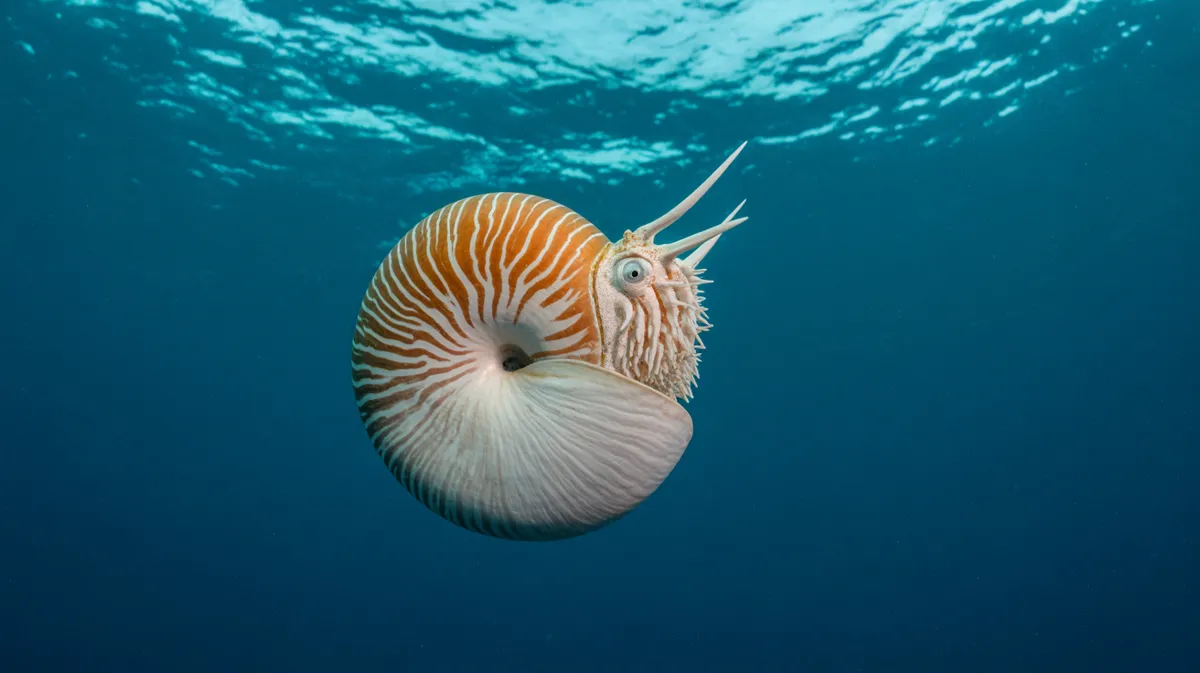
About the Paper Nautilus
The argonaut is not a nautilus and its "shell" is not a shell in the molluscan sense. Argonauta is an octopus, and only the female builds the paper-thin white case: she secretes it not from the mantle, as a snail or a true nautilus does, but from two greatly expanded webs at the tips of her dorsal arms, which she wraps around the structure and continually repairs. Aristotle thought she used those webs as sails, and the idea persisted for two thousand years; she does not. What the case is actually for was only demonstrated in 2010, when researchers watched wild argonauts in Japan gulp air at the surface, seal it into the apex of the shell with the arm webs, and then dive until the trapped air was compressed to exactly counteract their weight — giving neutral buoyancy at depth, with no swim bladder and no energy cost. The sexual dimorphism is among the most extreme in the animal kingdom: the female reaches 10 cm or more in the body and up to 30 cm across, while the male is around 2 cm and shell-less. He has a modified arm, the hectocotylus, loaded with sperm, which detaches inside the female and swims on its own; early naturalists collecting these wriggling arms from inside females described them as parasitic worms.
Fascinating facts
Unique Shell
The shell of the Paper Nautilus is not a true shell but a specialized egg case produced only by females to protect their eggs.
Extreme Sexual Dimorphism
Females can be more than ten times larger than males, and only females produce the characteristic paper shell.
Pelagic Lifestyle
Paper Nautiluses spend their entire lives drifting and swimming in the open ocean, rarely coming near the shore except when blown in by storms.
Detailed description
The Paper Nautilus (Argonauta argo) is a remarkable pelagic octopod distinguished by pronounced sexual dimorphism and unique reproductive adaptations. Females, which can reach up to 30 cm in shell (eggcase) diameter, secrete a delicate, calcareous eggcase that is not a true shell but an evolutionary innovation for brooding eggs and buoyancy control. Males are diminutive, rarely exceeding 2 cm in mantle length, and do not produce an eggcase. The female’s body is soft and gelatinous, with eight arms, two of which (the dorsal pair) are highly modified and used to secrete and manipulate the eggcase. The mantle is translucent and streamlined, facilitating efficient movement in the open ocean. Argonauta argo possesses large, well-developed eyes adapted for detecting prey and predators in the pelagic zone. The species exhibits countershading, with a silvery or bluish dorsal surface and a paler ventral side, aiding in camouflage. Unlike benthic octopuses, Argonauta argo spends its entire life in the water column, rarely descending to great depths. Its diet consists primarily of pelagic crustaceans, mollusks, and small fish, which it captures using its arms and beak. The Paper Nautilus is solitary, except during mating or when females aggregate in areas of high productivity. Its delicate eggcase is often mistaken for a shell and can be found washed ashore, contributing to its mystique.
Did you know?
Unlike true nautiluses, the Paper Nautilus is actually an octopus, not a close relative of the shelled nautiloids.
Research & sources
Wikipedia summary
The argonauts are a group of pelagic octopuses. They are also called paper nautili, referring to the paper-thin eggcase that females secrete; however, as octopuses, they are only distant relatives of true nautili. Their structure lacks the gas-filled chambers present in chambered nautilus shells and is not a true cephalopod shell, but rather an evolutionary innovation unique to the genus. It is used as a brood chamber, and to trap surface air to maintain buoyancy. It was once speculated that argonauts did not manufacture their eggcases but utilized shells abandoned by other organisms, in the manner of hermit crabs. Experiments by pioneering marine biologist Jeanne Villepreux-Power in the early 19th century disproved this hypothesis, as Villepreux-Power successfully reared argonaut young and observed their shells' development.
Behaviour & social structure
Argonauta argo is a highly mobile, solitary predator that uses jet propulsion to navigate the open ocean, expelling water through its funnel for rapid movement. Females exhibit a unique behavior of trapping air within their eggcase at the surface, which aids in buoyancy regulation and allows them to float or sink as needed. Hunting is primarily nocturnal, with individuals using their keen eyesight to locate prey in the dimly lit pelagic environment. Prey is subdued with the arms and consumed using a sharp beak. Social interactions are minimal, with the exception of brief mating encounters. Females are sometimes observed in loose aggregations, particularly in nutrient-rich waters. During daylight hours, individuals may remain at depth to avoid visual predators, ascending at night to feed—a behavior known as diel vertical migration. Defensive behaviors include rapid jetting, inking, and the use of the eggcase as a shield.
Reproduction & life cycle
Reproduction in Argonauta argo is characterized by extreme sexual dimorphism and a unique mating strategy. Males are much smaller and possess a specialized arm called the hectocotylus, which is detached and transferred to the female during mating, delivering spermatophores. After fertilization, the female secretes and enlarges her eggcase using her dorsal arms, depositing hundreds to thousands of eggs inside. The eggs are brooded within the eggcase for several weeks, during which the female continues to feed and maintain buoyancy. There is no parental care after hatching; planktonic paralarvae emerge and disperse into the pelagic zone. Breeding appears to be continuous in tropical and subtropical regions, with peaks in productivity linked to seasonal upwelling or food availability. Males are believed to die shortly after mating, while females may reproduce multiple times.
Adaptations & survival
Argonauta argo exhibits several remarkable adaptations for pelagic life. The female’s paper-thin eggcase serves both as a brood chamber and a buoyancy aid, allowing her to trap air and regulate depth. The modified dorsal arms are specialized for secreting and manipulating the eggcase. Both sexes possess large, complex eyes for detecting prey and predators in the open ocean. The soft, streamlined body and powerful jet propulsion enable rapid escape from threats. Countershading provides camouflage against both aerial and aquatic predators. The ability to produce ink offers an additional defense mechanism. The extreme sexual dimorphism and detachable hectocotylus represent evolutionary specializations for maximizing reproductive success in a vast, predator-rich environment.
Cultural significance
The Paper Nautilus has fascinated humans since antiquity, often appearing in art, mythology, and literature. Its delicate eggcase was historically mistaken for a true nautilus shell, inspiring legends of marine chariots and influencing the naming of the Argonauts in Greek mythology. In some cultures, the eggcase is collected as a curiosity or used in jewelry. The pioneering work of Jeanne Villepreux-Power in the 19th century, who demonstrated that argonauts produce their own eggcases, marked a significant milestone in marine biology and women’s scientific history. The Paper Nautilus continues to symbolize mystery and beauty in the ocean.
Recent research
Recent research has focused on the biomechanics of eggcase formation, genetic diversity across the species’ range, and the ecological role of Argonauta argo in pelagic food webs. Studies using stable isotope analysis have clarified dietary preferences and trophic position. Advances in molecular phylogenetics have helped resolve relationships within Argonautidae and between argonauts and other octopods. Ongoing research is investigating the impacts of ocean acidification on eggcase calcification and the potential for microplastic accumulation in pelagic cephalopods. Observational studies using remotely operated vehicles (ROVs) and open-ocean sampling have provided new insights into behavior, distribution, and reproductive strategies.
Videos
Habitat
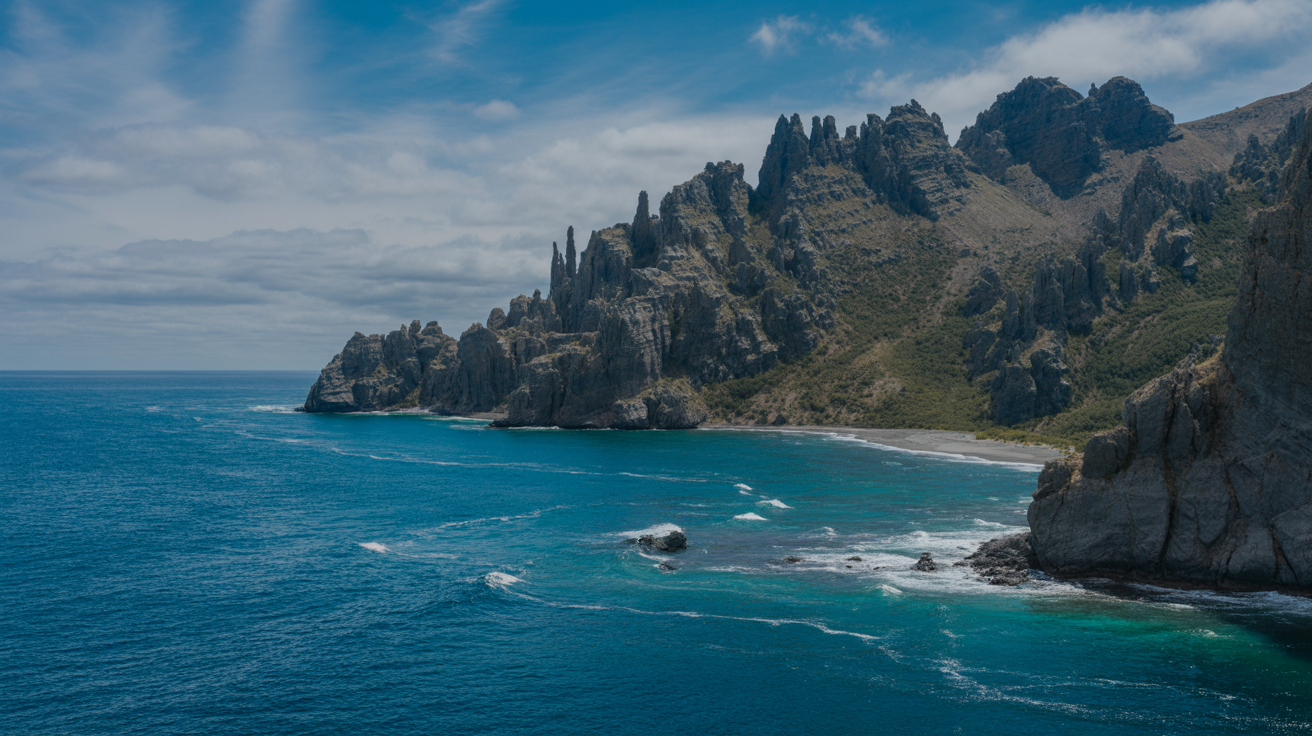
Open ocean (pelagic zone)
Conservation
The Paper Nautilus is currently classified as Least Concern on the IUCN Red List.
Threats & challenges
Currently, Argonauta argo is listed as Least Concern, with no evidence of significant population decline. However, the species faces indirect threats from ocean pollution, particularly plastics, which can be ingested or interfere with buoyancy. Climate change and ocean acidification may impact the availability of prey and the structural integrity of the eggcase. Bycatch in pelagic fisheries poses a localized threat. The species’ pelagic lifestyle and wide distribution buffer it from many coastal threats, but ongoing environmental changes could alter population dynamics in the future. There is limited targeted conservation action due to its abundance and broad range.
Taxonomy
Scientific name
Argonauta argo
- Kingdom
- Animalia
- Phylum
- Mollusca
- Class
- Cephalopoda
- Order
- Octopoda
- Family
- Argonautidae
- Genus
- Argonauta
- Species
- argo
Community notes
Share your observations about the Paper Nautilus.
No community notes yet. Be the first!
Discover more wildlife
More fascinating animals from the encyclopedia.