
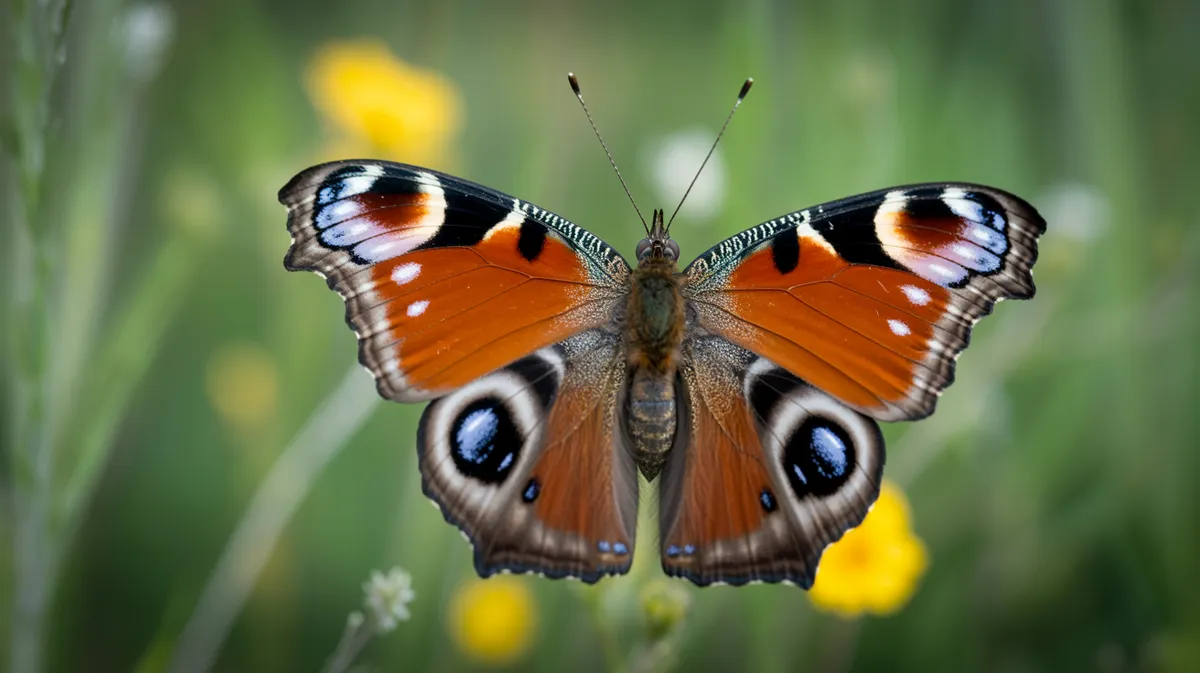
About the Peacock Butterfly
The Peacock Butterfly is a strikingly colorful butterfly native to Europe and temperate Asia. Renowned for its bold, eye-like markings on each wing, it uses these patterns to startle and deter predators. This species thrives in a range of habitats, from woodlands to gardens, and is often one of the first butterflies seen in spring due to its ability to overwinter as an adult. The Peacock Butterfly's life cycle includes four distinct stages: egg, larva (caterpillar), pupa (chrysalis), and adult.
Fascinating facts
Eye-Spot Defense
The eye-like patterns on each wing serve as an effective defense mechanism, startling birds and small mammals that may try to eat them.
Nectar Feeder
Adult Peacock Butterflies feed primarily on the nectar of flowers such as buddleia, thistles, and dandelions.
Winter Survivors
Peacock Butterflies hibernate in dark, sheltered places such as hollow trees and sheds, sometimes surviving temperatures below freezing.
Detailed description
The Peacock Butterfly (Aglais io) is a medium-sized nymphalid butterfly, with a wingspan ranging from 50 to 55 mm. Its most distinctive feature is the large, iridescent eyespots on each of its four wings—vivid blue, yellow, and black markings that mimic the eyes of vertebrate predators, serving as a powerful anti-predator adaptation. The dorsal wing surfaces are a rich reddish-brown, while the ventral sides are cryptically dark, providing camouflage when the butterfly is at rest with wings closed. Adults exhibit sexual monomorphism, with males and females appearing similar, though males can be slightly smaller. The body is robust and covered in fine hairs, aiding in thermoregulation. Aglais io is a strong flier, capable of rapid, erratic flight patterns that help evade predators. It is solitary outside of mating and overwintering periods, and is one of the few European butterflies that hibernate as adults, seeking sheltered locations such as hollow trees, outbuildings, or rock crevices. The species is univoltine in most of its range, producing one generation per year, though a partial second generation may occur in warmer regions. Larvae are black with white spots and spines, feeding gregariously on stinging nettles (Urtica dioica), while adults feed on nectar from a wide variety of flowering plants. The life cycle from egg to adult typically spans 6–8 weeks, with adults living up to 11 months if they successfully overwinter.
Did you know?
Unlike many butterflies, the Peacock Butterfly can overwinter as an adult and emerge as soon as the weather warms in early spring.
Research & sources
Wikipedia summary
Peacocks are adult male peafowl, known for their iridescent plumage.
Behaviour & social structure
Peacock Butterflies are diurnal and display territorial behavior, with males often defending sunlit patches or prominent perches to attract females. When threatened, they perform a startle display by suddenly opening their wings to reveal the conspicuous eyespots, accompanied by a hissing sound produced by rubbing their wings together (stridulation). Feeding is primarily on nectar, with a preference for buddleia, thistles, and willows, but adults will also feed on tree sap and rotting fruit. Larvae are highly gregarious in early instars, forming dense clusters on nettle leaves, which may deter predators through collective aposematism. Adults bask in the sun to elevate body temperature for flight, and are most active during warm, sunny conditions. During hibernation, they enter a state of torpor, reducing metabolic activity to survive cold months.
Reproduction & life cycle
Breeding occurs from late spring to early summer. Males establish territories and court females through aerial displays and pheromone release. After mating, females lay clusters of 100–400 pale green eggs on the underside of nettle leaves. The eggs hatch after 7–14 days, and larvae progress through five instars over 3–4 weeks. Pupation occurs in a suspended chrysalis, which lasts 2–3 weeks before eclosion. There is no parental care post-oviposition. In most of its range, only one brood is produced per year, but in southern Europe and Asia, a partial second brood may occur. Adults emerging in late summer enter reproductive diapause, delaying mating until the following spring after overwintering.
Adaptations & survival
Key adaptations include the prominent eyespots for predator deterrence, cryptic ventral wing coloration for camouflage, and the ability to overwinter as adults—a rare trait among European butterflies. Larvae possess urticating spines and feed on stinging nettles, which may confer chemical defenses. Adults are capable of rapid, erratic flight and can produce stridulatory sounds as a secondary defense. Physiologically, they can tolerate low temperatures and have biochemical adaptations for surviving winter torpor, such as accumulation of cryoprotectants (glycerol and other polyols).
Cultural significance
The Peacock Butterfly is celebrated in European folklore and art for its beauty and striking eyespots, which have been interpreted as symbols of protection and vigilance. Its early spring appearance is often associated with the arrival of warmer weather and renewal. In some cultures, butterflies in general are seen as symbols of transformation and the soul. The Peacock Butterfly is a popular subject in natural history education and citizen science projects, such as butterfly monitoring schemes.
Recent research
Recent research has focused on the genetic and developmental mechanisms underlying eyespot formation, revealing the role of specific signaling pathways (e.g., Wnt and Hedgehog). Studies on overwintering physiology have identified key metabolic adaptations for cold tolerance. Ongoing research is examining the impacts of climate change on phenology and range shifts, as well as the ecological interactions between Aglais io and its parasitoids and pathogens. Citizen science data have been instrumental in tracking population trends and distribution changes across Europe.
Videos
Habitat
Woodlands, meadows, gardens, and parks


Conservation
The Peacock Butterfly is currently classified as Least Concern on the IUCN Red List.
Threats & challenges
Currently listed as Least Concern, the Peacock Butterfly faces localized threats from habitat loss, agricultural intensification, and pesticide use, which reduce the availability of larval host plants and nectar sources. Climate change poses a potential long-term threat by altering phenology and overwintering success. Urbanization can fragment populations, though the species is highly adaptable and often thrives in gardens and parks. Population trends are generally stable or increasing in much of its range, but declines have been noted in areas with intensive land use changes.
Taxonomy
Scientific name
Aglais io
- Kingdom
- Animalia
- Phylum
- Arthropoda
- Class
- Insecta
- Order
- Lepidoptera
- Family
- Nymphalidae
- Genus
- Aglais
- Species
- io
Community notes
Share your observations about the Peacock Butterfly.
No community notes yet. Be the first!
Discover more wildlife
More fascinating animals from the encyclopedia.