
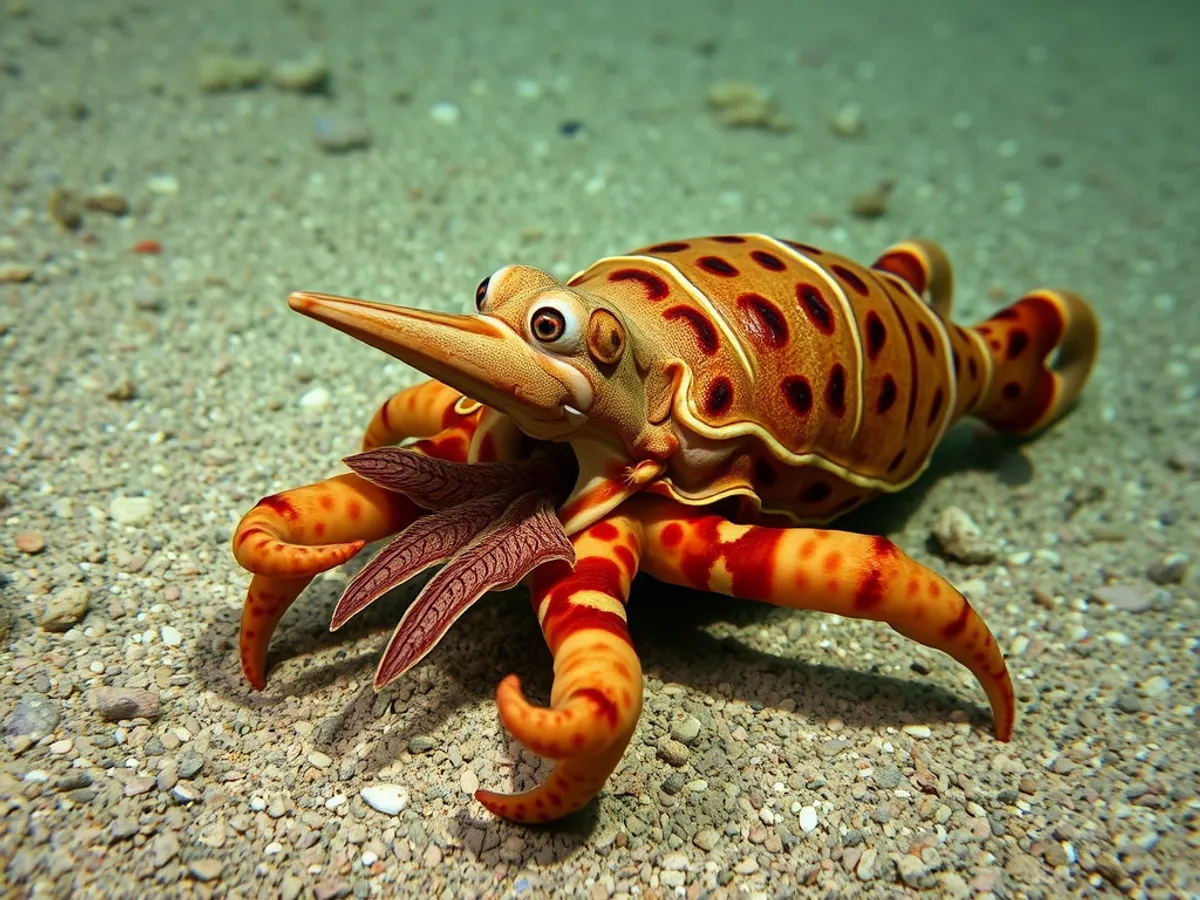
About the Pfeffer's flamboyant cuttlefish
Pfeffer's flamboyant cuttlefish is the only cuttlefish known to be toxic, and it advertises the fact loudly. It is small, and rather than swimming it usually walks along the seabed on two flattened arms and two fleshy lobes of the mantle — an odd gait for a cephalopod, and one that leaves it slow and thoroughly exposed. The compensation is the display: waves of vivid purple, yellow and red pulse across the skin in a rolling, hypnotic pattern, which is almost certainly aposematic, a warning that this is an animal not worth eating. Its muscle tissue carries a toxin comparable in potency to that of a blue-ringed octopus, which is unique among cuttlefish. It hunts by stalking slowly and then firing out two long feeding tentacles faster than the prey can respond. Like other cuttlefish it drives the display through chromatophores under direct nervous control, so the colour is not a slow blush but something closer to a screen, capable of changing in a fraction of a second.
Fascinating facts
Dazzling Display
The flamboyant cuttlefish can rapidly flash bright colors like yellow, red, and purple to communicate or deter predators.
Toxic Defense
Unlike most cephalopods, its flesh contains toxins, making it poisonous to eat—a rare trait among cuttlefish.
Walking Cuttlefish
This species often walks along the ocean floor using modified arms and fins, rather than swimming.
Detailed description
Pfeffer's flamboyant cuttlefish (Metasepia pfefferi) is a small cephalopod, typically reaching mantle lengths of 6–8 cm, with a distinctive, broad, flattened body and short, wide arms. Its most remarkable feature is its ability to rapidly flash vivid colors—yellows, reds, purples, and whites—across its skin, thanks to highly developed chromatophores, iridophores, and leucophores. The cuttlefish's dorsal surface is adorned with papillae and warty projections, enhancing its disruptive camouflage and warning displays. Unlike most cuttlefish, M. pfefferi spends much of its time 'walking' along the substrate using its arms and specialized, muscular fins, rather than swimming. Its eyes are large and W-shaped, providing excellent vision for detecting prey and predators in dimly lit, sandy or muddy habitats. The species is primarily benthic, favoring shallow coastal waters (3–86 m depth) in the Indo-Pacific, particularly around northern Australia, southern New Guinea, Indonesia, Malaysia, and the Philippines. Pfeffer's flamboyant cuttlefish is unique among cuttlefish in possessing toxic flesh containing unidentified toxins, making it unpalatable to most marine predators. Its internal cuttlebone is reduced, which limits its buoyancy and contributes to its bottom-dwelling lifestyle. The species is solitary or loosely associated, with individuals displaying complex body patterns for communication, mating, and deterrence.
Did you know?
Despite their stunning appearance, flamboyant cuttlefish have one of the shortest lifespans among cephalopods, living only about a year or two.
Research & sources
Wikipedia summary
Ascarosepion pfefferi, also known as the flamboyant cuttlefish, is a species of cuttlefish occurring in tropical Indo-Pacific waters off northern Australia, southern New Guinea, as well as numerous islands of the Philippines, Indonesia and Malaysia.
Behaviour & social structure
Metasepia pfefferi exhibits a suite of complex behaviors, including elaborate threat displays where it rapidly pulses contrasting colors and waves its arms to deter predators. It is an ambush predator, often remaining motionless and camouflaged until prey approaches, then striking with its two specialized feeding tentacles to capture small crustaceans, shrimp, fish, and other benthic invertebrates. The cuttlefish uses its arms to manipulate and subdue prey before consuming it with a strong, parrot-like beak. It is primarily diurnal, with peak activity during daylight hours, though some nocturnal foraging has been observed. Social interactions are generally limited outside the breeding season, but individuals may display to one another to establish territory or during courtship. Daily routines involve periods of hunting interspersed with rest, during which the animal may partially bury itself in substrate for camouflage.
Reproduction & life cycle
Reproduction in M. pfefferi is characterized by direct mating, where the male transfers spermatophores to the female's buccal area using a specialized arm called the hectocotylus. Courtship involves intricate visual displays and arm posturing. Females lay small clusters of eggs, attaching them to hard substrates such as shells, rocks, or coral rubble. The eggs are encased in a protective gelatinous coating and are left unattended, as there is no parental care post-oviposition. Embryonic development is temperature-dependent and typically lasts 3–4 weeks. Hatchlings are miniature versions of adults and are immediately independent, capable of hunting and displaying warning coloration. Breeding appears to occur year-round in some regions, but may peak seasonally in others, possibly linked to water temperature and food availability.
Adaptations & survival
Pfeffer's flamboyant cuttlefish has evolved several unique adaptations: its reduced cuttlebone limits buoyancy, facilitating a benthic lifestyle; its ability to 'walk' using muscular arms and fins allows precise movement over complex substrates. The species' rapid color-changing ability serves both as camouflage and as an aposematic (warning) signal, advertising its toxicity to potential predators. The presence of potent, yet chemically uncharacterized, toxins in its flesh is rare among cephalopods and provides a strong deterrent against predation. Its large, highly developed eyes offer acute vision in low-light environments, aiding in both hunting and predator detection. The cuttlefish's beak and radula are adapted for efficiently processing hard-shelled prey.
Cultural significance
While not a major figure in traditional folklore, Pfeffer's flamboyant cuttlefish has become an icon in underwater photography and marine ecotourism due to its spectacular appearance and behaviors. In some regions, it is featured in public aquaria, where it serves as an educational ambassador for cephalopod diversity and marine conservation. Its toxicity and unique behaviors have made it a subject of fascination among divers and marine enthusiasts, but there is no evidence of significant traditional use or consumption, likely due to its unpalatable flesh.
Recent research
Recent research has focused on the chemical nature of the toxins present in M. pfefferi, with preliminary studies suggesting the presence of compounds similar to those found in other toxic cephalopods, such as the blue-ringed octopus (tetrodotoxin-like substances), though definitive identification is pending. Behavioral studies have documented the species' complex visual signaling and its role in both intraspecific communication and predator deterrence. There is ongoing interest in the cuttlefish's chromatophore system as a model for bio-inspired materials and adaptive camouflage technologies. Genetic studies are clarifying its phylogenetic position within the Sepiidae and the evolutionary origins of its unique traits. Conservation research is hampered by the species' cryptic habits and patchy distribution, highlighting the need for improved survey methods and population assessments.
Videos
Habitat
Tropical coastal waters, sandy or muddy substrates

Conservation
The Pfeffer's flamboyant cuttlefish is currently classified as Data Deficient on the IUCN Red List.
Threats & challenges
The primary threats to Metasepia pfefferi include habitat degradation (particularly from coastal development, pollution, and sedimentation), over-collection for the aquarium trade due to its striking appearance, and incidental bycatch in fisheries. Its restricted and patchy distribution makes local populations vulnerable to disturbance. The species is currently listed as Data Deficient by the IUCN, reflecting a lack of comprehensive population data. Climate change and ocean acidification pose additional long-term risks by altering habitat quality and prey availability. There is little evidence of targeted fisheries, but increased interest from aquarists could impact wild populations if not managed sustainably.
Taxonomy
Scientific name
Metasepia pfefferi
- Kingdom
- Animalia
- Phylum
- Mollusca
- Class
- Cephalopoda
- Order
- Sepiida
- Family
- Sepiidae
- Genus
- Metasepia
- Species
- pfefferi
Community notes
Share your observations about the Pfeffer's flamboyant cuttlefish.
No community notes yet. Be the first!
Discover more wildlife
More fascinating animals from the encyclopedia.