
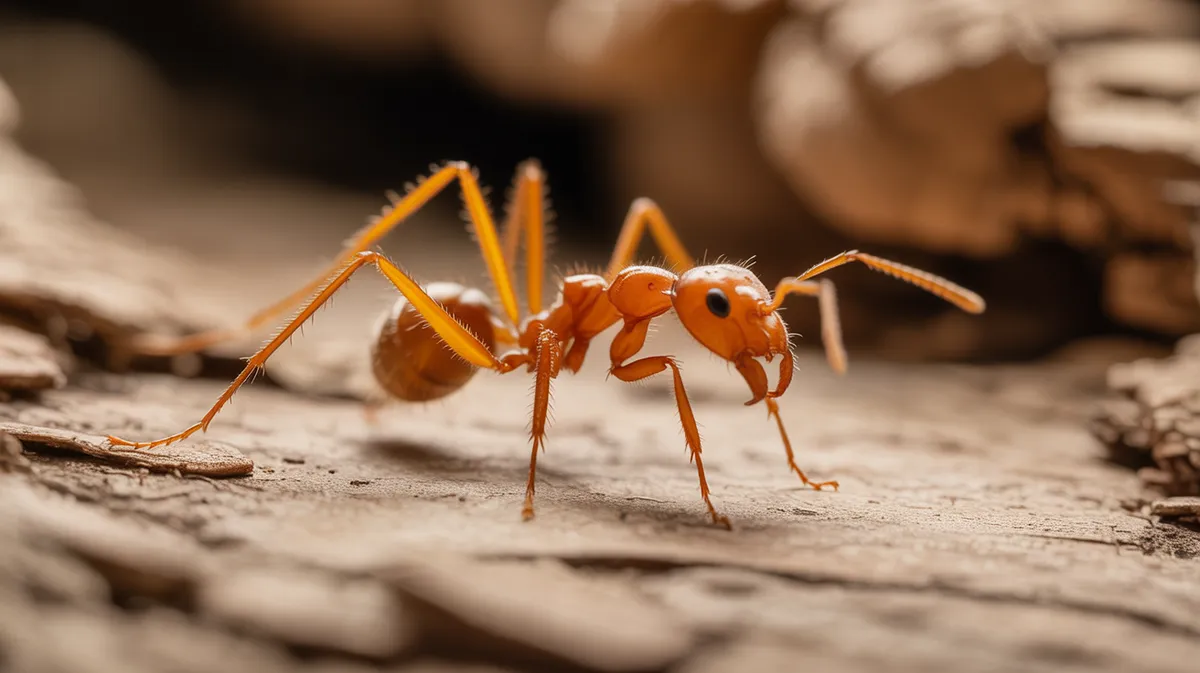
About the Pharaoh ant
The Pharaoh ant is a tiny, yellow or light brown ant species known for its persistent infestations in buildings worldwide. Originating from Africa, it has spread globally due to its ability to thrive in warm, indoor environments. These ants are notorious for forming massive colonies with multiple queens, making them difficult to eradicate. Pharaoh ants are highly adaptable and communicate using pheromones to organize foraging trails and rapidly locate food sources.
Fascinating facts
Tiny Invaders
Pharaoh ants measure only about 1.5–2 mm in length, allowing them to access even the smallest cracks and crevices in buildings.
Hospital Hazard
Their presence in hospitals is especially problematic, as they can spread bacteria and infect wounds or sterile equipment.
Multiple Queens
Unlike many other ant species, Pharaoh ant colonies can contain hundreds of queens, supporting rapid colony expansion.
Detailed description
The Pharaoh ant (Monomorium pharaonis) is a minute, soft-bodied ant measuring approximately 1.5–2.0 mm in length, with workers displaying a pale yellow to reddish-brown coloration and a darker abdomen, often appearing almost translucent. The species is characterized by its 12-segmented antennae ending in a three-segmented club, a lack of spines on the thorax, and a double petiole (waist) connecting the thorax and abdomen. Pharaoh ants are highly social and form extensive, polygynous colonies containing dozens to hundreds of queens and thousands of sterile workers. Their nests are typically hidden within wall voids, behind baseboards, or in other secluded indoor microhabitats, especially in heated buildings. Colonies are known for their ability to fragment and 'bud'—a process where a subset of workers and queens break away to establish new colonies, contributing to their persistence and rapid spread. Workers forage in well-organized trails, relying on pheromone communication to coordinate food retrieval and nest relocation. The species is omnivorous, feeding on a wide variety of organic materials, including sweets, proteins, and fats. Pharaoh ants are notable for their resilience to conventional pest control methods, as disturbed colonies readily split and relocate, making eradication challenging. Their small size allows them to access even the tiniest crevices, facilitating their success as indoor pests worldwide.
Did you know?
Pharaoh ants can have hundreds of queens in a single colony, which makes control and elimination extremely challenging.
Research & sources
Wikipedia summary
The pharaoh ant is a small (2 mm) yellow or light brown, almost transparent ant notorious for being a major indoor nuisance pest, especially in hospitals. A cryptogenic species, it has now been introduced to virtually every area of the world, including Europe, the Americas, Australasia and Southeast Asia. It is a major pest in the United States, Australia, and Europe. The ant's common name is possibly derived from the mistaken belief that it was one of the Egyptian (pharaonic) plagues.
Behaviour & social structure
Pharaoh ants exhibit complex social behaviors, with clear division of labor among workers, queens, and males. Workers are responsible for foraging, brood care, and nest maintenance, while queens focus on egg-laying. Foraging occurs both day and night, with workers forming persistent pheromone trails to food sources, which can be up to 30 meters from the nest. The species is highly opportunistic in its feeding, scavenging for sugars, proteins, and even dead insects or organic debris. Social grooming and trophallaxis (exchange of food and fluids) are common, facilitating colony cohesion and the spread of chemical cues. When threatened or disturbed, colonies readily fragment, with subgroups relocating to new nest sites—a behavior known as budding. This contributes to their invasive potential and resistance to eradication. Communication is primarily chemical, with pheromones mediating recruitment, alarm, and trail-following behaviors.
Reproduction & life cycle
Pharaoh ant colonies are polygynous, often containing dozens or even hundreds of queens. Reproduction occurs within the nest, as queens mate with males from the same colony. Unlike many ant species, Pharaoh ants do not engage in nuptial flights; instead, mating is intranidal (within the nest). Queens lay eggs continuously, and the development from egg to adult worker takes approximately 38–45 days at optimal temperatures (27–30°C). Eggs hatch into larvae after about 5–7 days, followed by a larval stage lasting 18–19 days, then a pupal stage of 9–12 days. Queens are long-lived, surviving up to 12 months, while workers typically live 9–10 weeks. Parental care is provided by workers, who feed and groom the developing brood. Colony budding, where a group of workers and queens splits off to establish a new nest, is a key reproductive strategy, especially in response to environmental stress or disturbance.
Adaptations & survival
Pharaoh ants possess several adaptations that contribute to their success as invasive pests. Their small body size allows them to exploit tiny cracks and crevices in human structures, while their translucent cuticle reduces visibility to predators. The polygynous colony structure and ability to reproduce via budding enable rapid population expansion and resilience to partial colony loss. Their omnivorous diet and low moisture requirements allow them to thrive in diverse indoor environments. Chemoreception is highly developed, with sophisticated pheromone systems guiding foraging, recruitment, and alarm responses. Behavioral plasticity, such as the ability to relocate nests quickly and fragment colonies, further enhances survival in dynamic or disturbed habitats.
Cultural significance
The Pharaoh ant's common name is rooted in the erroneous belief that it was one of the plagues of ancient Egypt, though there is no historical evidence for this. In modern times, the species is primarily associated with its negative impact on human health and infrastructure, particularly in hospitals, food processing facilities, and residential buildings. There are no known positive traditional uses or symbolic roles for this species in human culture.
Recent research
Recent research has focused on the mechanisms of colony budding and the genetic diversity within and between Pharaoh ant colonies, revealing high levels of inbreeding and low genetic differentiation. Studies have also examined the efficacy of novel bait formulations and integrated pest management strategies, with some success reported using slow-acting toxic baits that minimize colony fragmentation. Ongoing research explores the ant's role as a vector for nosocomial infections and the potential for biological control using entomopathogenic fungi or parasitoids. Genomic studies are underway to better understand the molecular basis of their social organization and adaptability.
Videos
Habitat
Human dwellings and heated buildings

Conservation
The Pharaoh ant is currently classified as Least Concern on the IUCN Red List.
Threats & challenges
Pharaoh ants face few natural predators or competitors in their introduced ranges, contributing to their invasive success. However, they are susceptible to desiccation and cannot survive outdoors in temperate climates, relying on heated buildings for year-round survival. Human pest control efforts, including insecticide baits and sprays, often inadvertently promote colony budding, making eradication difficult. In healthcare settings, Pharaoh ants pose a significant threat as vectors of pathogenic bacteria, including Staphylococcus, Salmonella, and Pseudomonas, potentially contaminating sterile equipment and patient wounds. Despite their pest status, global populations are stable and expanding, with no current conservation concerns.
Taxonomy
Scientific name
Monomorium pharaonis
- Kingdom
- Animalia
- Phylum
- Arthropoda
- Class
- Insecta
- Order
- Hymenoptera
- Family
- Formicidae
- Genus
- Monomorium
- Species
- pharaonis
Community notes
Share your observations about the Pharaoh ant.
No community notes yet. Be the first!
Discover more wildlife
More fascinating animals from the encyclopedia.