
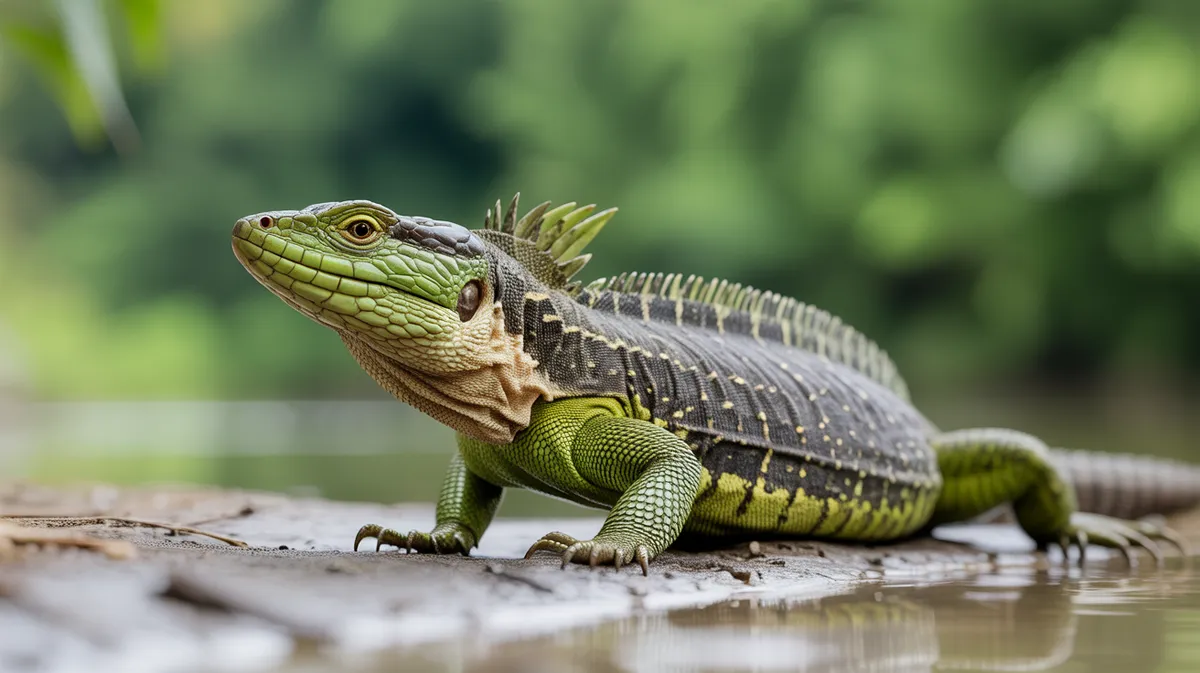
About the Philippine sailfin lizard
The Philippine sailfin lizard is a striking large-bodied reptile native to the riverbanks and forests of the Philippines. This semi-aquatic lizard is easily recognized by the prominent sail-like crest or fin on its tail, which is used for swimming and display. It is highly adapted to life near water, often seen basking on branches overhanging streams and able to run across water surfaces for short distances. The species displays vivid coloration, especially in males, with greens, blues, and purples, making it a popular subject for wildlife enthusiasts.
Fascinating facts
Semi-Aquatic Lizard
The Philippine sailfin lizard is highly adapted to aquatic environments and can swim swiftly, using its laterally compressed tail as a rudder.
Colorful Displays
Males exhibit bright and variable colors, which intensify during the breeding season, helping them establish dominance and attract females.
Water Run
Young and agile individuals can dash across the surface of the water for several meters to escape predators, similar to the basilisks of Central and South America.
Detailed description
The Philippine sailfin lizard (Hydrosaurus pustulatus) is a robust, large-bodied agamid reaching adult total lengths of 90–120 cm (3–4 ft), with males generally larger and more vividly colored than females. Its most distinctive feature is the tall, laterally compressed sail-like crest on the tail, formed by elongated neural spines and supported by skin, which can reach up to 8–10 cm in height. The body is laterally compressed, aiding in aquatic locomotion, and covered in granular scales interspersed with larger, keeled tubercles. Coloration varies by locality and sex, but males often exhibit iridescent greens, blues, and purples, especially during the breeding season, while females and juveniles are more subdued in hue. The head is angular with a pronounced gular pouch, and the limbs are strong and well-developed, ending in long, sharp claws for climbing. The species is semi-aquatic, spending much of its time basking on branches overhanging water, and is capable of rapid escape by diving or even running bipedally across water surfaces—a trait especially pronounced in juveniles. The eyes are large and positioned laterally, providing a wide field of vision, and the nostrils are set high on the snout, facilitating breathing while partially submerged. The tail, which comprises more than half the total body length, is laterally flattened and serves as a powerful paddle for swimming. Philippine sailfin lizards are diurnal and primarily arboreal, but frequently descend to the ground or water to forage.
Did you know?
This lizard is sometimes called the 'water dragon' due to its remarkable ability to swim, dive, and remain underwater for up to 15 minutes.
Research & sources
Wikipedia summary
Hydrosaurus pustulatus, commonly known as the Philippine sailfin lizard or the Philippine sailfin dragon, is a large semiaquatic agamid lizard endemic to all of the major island groups of the Philippines, with the exception of the Palawan islands. Like other sailfin lizards, they are characterized by large, sail-like dorsal crests on their tails. They can grow to a maximum length around 3 to 4 ft. They are strong swimmers, and smaller juvenile lizards can run briefly on the water surface. They inhabit areas of heavy vegetation near coastlines and low-lying rivers, particularly in mangrove forests. They are also known locally as layagan or balubid in Tagalog and ibid in the Visayan languages, among other names.
Behaviour & social structure
Philippine sailfin lizards are primarily diurnal, emerging at dawn to bask and regulate their body temperature. They are highly territorial, with dominant males defending prime basking and feeding sites along riverbanks and within mangrove forests. Social hierarchies are established through visual displays, including head-bobbing, lateral compression of the body, and erection of the nuchal and caudal crests. When threatened, they may drop from branches into water, swimming swiftly away or remaining submerged for up to 15 minutes. Their omnivorous diet consists of leaves, fruits, flowers, aquatic vegetation, insects, crustaceans, mollusks, and occasionally small vertebrates. Foraging is opportunistic, with individuals observed feeding both in trees and on the ground. Juveniles are more insectivorous, shifting to a more herbivorous diet as they mature. Sailfin lizards are generally solitary outside the breeding season, but loose aggregations may form in areas with abundant resources.
Reproduction & life cycle
Breeding typically occurs during the onset of the wet season (May–July), triggered by increased humidity and food availability. Males engage in ritualized combat and display behaviors to attract females, including head-bobbing, push-ups, and flaring of the sail. Females lay clutches of 5–8 leathery eggs in shallow nests dug in sandy or loamy soil near water. Incubation lasts approximately 70–90 days, depending on temperature and humidity. Hatchlings are precocial and fully independent, measuring about 15–20 cm in total length. There is no parental care post-oviposition, and juveniles must evade predators such as birds, snakes, and large fish. Sexual maturity is reached at around 2–3 years of age.
Adaptations & survival
Hydrosaurus pustulatus exhibits several unique adaptations for its semi-aquatic lifestyle. The laterally compressed tail and strong limbs facilitate efficient swimming and rapid movement through dense vegetation. The sail-like crest increases surface area for thermoregulation and may play a role in sexual selection and intraspecific communication. The ability to run bipedally across water, known as the 'Jesus lizard' effect, is most pronounced in lighter juveniles and serves as an effective escape mechanism. High-set nostrils and a nictitating membrane protect the eyes and allow for submerged respiration and vision. Their omnivorous dentition enables exploitation of a wide range of food resources, reducing competition and increasing ecological flexibility.
Cultural significance
Known locally as 'layagan' or 'balubid' in Tagalog and 'ibid' in Visayan languages, the sailfin lizard features in local folklore and is sometimes regarded as a symbol of agility and adaptability. In some rural areas, it is believed to bring good luck or serve as a guardian of rivers and forests. Historically, the species has been harvested for food and traditional medicine, though such practices are now less common. Its striking appearance and unique behaviors have made it a popular subject in ecotourism and wildlife photography, contributing to local awareness and appreciation of native biodiversity.
Recent research
Recent taxonomic studies have clarified the distinction between Hydrosaurus pustulatus and closely related species in the region, such as H. amboinensis and H. weberi, using molecular phylogenetics and morphological analyses (Siler et al., 2014). Ongoing research focuses on population genetics, habitat utilization, and the impact of habitat fragmentation. Behavioral ecologists are investigating the role of the caudal sail in thermoregulation and sexual selection. Conservation biologists are conducting field surveys to assess population densities and the effectiveness of protected areas. There is also interest in the physiological mechanisms underlying the species' ability to run across water and tolerate hypoxic conditions during submersion.
Videos
Habitat
Tropical riverbanks and lowland forests
 Tropical Regions
Rainforest
Dense, wet forests with the highest biodiversity on Earth, containing more than half of the world's plant and animal species.
 Global
Forest
Wooded areas with significant tree cover and diverse plant and animal communities.
 Global
Freshwater
Lakes, rivers, and wetlands with diverse aquatic ecosystems.
Conservation
The Philippine sailfin lizard is currently classified as Vulnerable on the IUCN Red List.
Threats & challenges
Despite being classified as Least Concern by the IUCN, Philippine sailfin lizard populations face significant localized threats. Habitat loss due to deforestation, conversion of mangroves to aquaculture or agriculture, and urban development are primary concerns. The species is also heavily collected for the pet trade, both domestically and internationally, and is hunted for food in some regions. Pollution of waterways and competition with invasive species further exacerbate population declines. Fragmentation of habitats has led to isolated populations, increasing vulnerability to stochastic events and genetic bottlenecks. Conservation efforts are hampered by limited enforcement of wildlife protection laws and lack of comprehensive population data.
Taxonomy
Scientific name
Hydrosaurus pustulatus
- Kingdom
- Animalia
- Phylum
- Chordata
- Class
- Reptilia
- Order
- Squamata
- Family
- Agamidae
- Genus
- Hydrosaurus
- Species
- pustulatus
Where to see a philippine sailfin lizard
4 zoos and aquariums in 3 countries are recorded as keeping this species.
 Dudley Zoo & Castle🇬🇧 Dudley, United Kingdom
 Śląski Ogród Zoologiczny🇵🇱 Chorzów, Poland
 Louisville Zoo🇺🇸 United States
 Birmingham Zoo🇺🇸 United States
Community notes
Share your observations about the Philippine sailfin lizard.
No community notes yet. Be the first!
Discover more wildlife
More fascinating animals from the encyclopedia.