
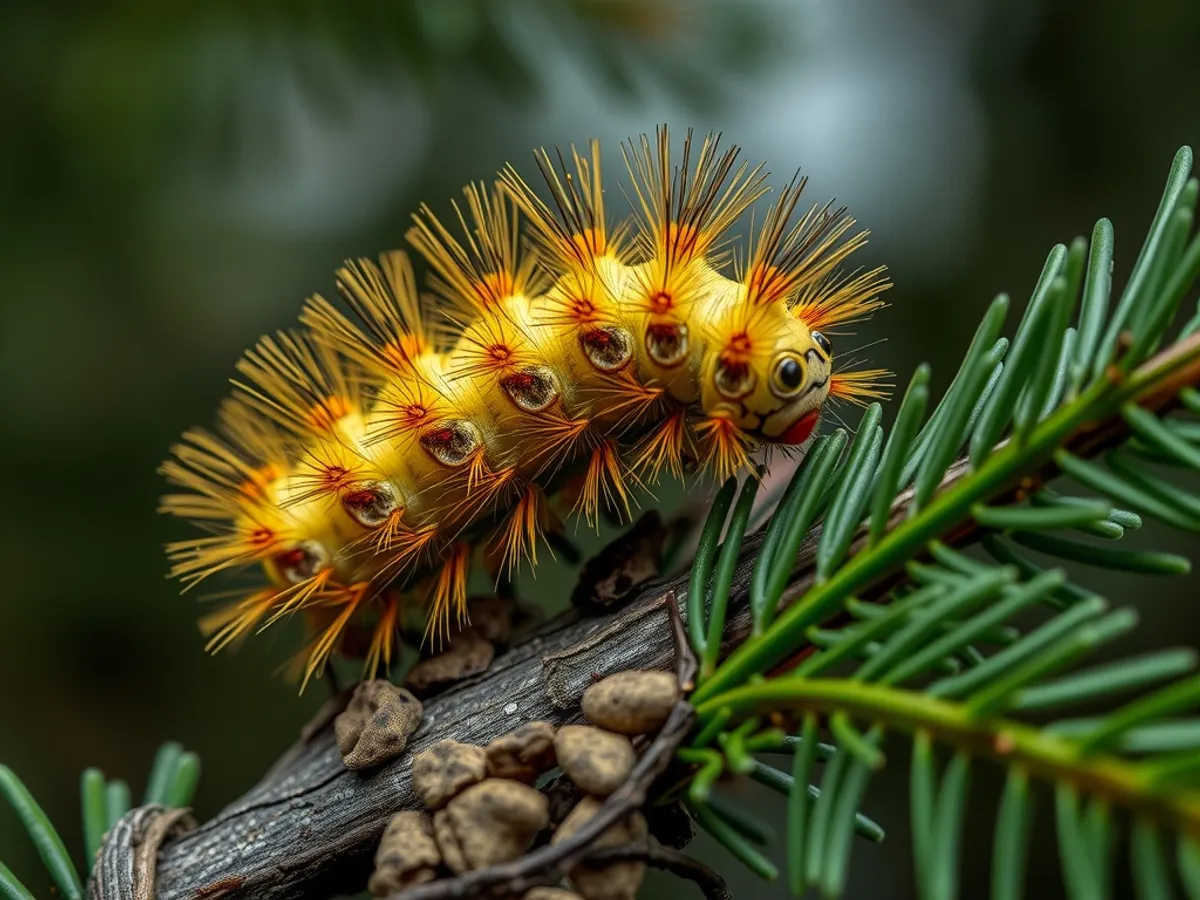
About the Pine processionary caterpillar
The pine processionary caterpillar is the larval stage of the pine processionary moth, notorious for its unique behavior of moving in long nose-to-tail processions. Native to southern Europe, North Africa, and parts of the Middle East, these caterpillars feed primarily on pine needles, sometimes causing significant defoliation in pine forests. Their bodies are covered in urticating hairs that can cause severe allergic reactions and skin irritations in humans and animals. The caterpillars build conspicuous silk nests in trees during the winter to protect themselves from cold temperatures and predators.
Fascinating facts
Processional Movement
These caterpillars get their name from their habit of traveling in long processions, sometimes numbering hundreds of individuals, to find food or new nesting sites.
Forest Pest
They can cause extensive defoliation in pine trees, weakening forests and making them more susceptible to disease and other pests.
Irritating Hairs
The caterpillar's body is covered with thousands of tiny, barbed hairs that can cause rashes, eye irritation, and respiratory distress in people and pets.
Detailed description
The pine processionary caterpillar (Thaumetopea pityocampa) is the larval stage of a moth species native to the Mediterranean basin, characterized by its striking social behavior and significant ecological impact. The caterpillars are typically 3–4 cm in length when mature, with a greyish body covered in dense, barbed urticating hairs that serve as a potent defense mechanism against predators. Their coloration provides camouflage among pine needles, while the bright orange dorsal patches signal warning to potential threats. The larvae are gregarious, forming large colonies that construct conspicuous silken nests in the branches of host trees, predominantly various species of pine (Pinus spp.), but also occasionally on cedars (Cedrus spp.). During the day, the caterpillars remain within these nests for thermoregulation and protection, emerging at dusk to feed collectively on pine needles. Their most distinctive behavior is their processional movement: when relocating, the caterpillars form long, single-file lines, each following the silk trail and pheromones of the individual ahead. This coordinated movement is both a defensive strategy and a means of efficient group navigation. The species undergoes five larval instars before pupating in the soil, where they remain for several months to years, depending on environmental conditions. The adult moths are nocturnal and short-lived, with a wingspan of 31–45 mm, and exhibit cryptic coloration. The life cycle is tightly synchronized with seasonal changes, enabling the larvae to exploit winter foliage when predation is lower.
Did you know?
The caterpillar's hairs can become airborne and cause respiratory problems in humans and animals, even without direct contact.
Research & sources
Wikipedia summary
The pine processionary is a moth of the subfamily Thaumetopoeinae in the family Notodontidae, known for the irritating hairs of its caterpillars, their processions, and the economic damage they cause in coniferous forests. The species was first described scientifically by Michael Denis and Ignaz Schiffermüller in 1775, though it was known to the ancients, with remedies described by Theophrastus, Dioscorides and Pliny the Elder. Its processionary behaviour was described in 1916 by the French entomologist Jean-Henri Fabre. It is one of the most destructive species to pines and cedars in Central Asia, North Africa and southern Europe.
Behaviour & social structure
Pine processionary caterpillars exhibit highly organized social behavior, rarely observed in Lepidoptera. Larvae communicate via tactile and chemical cues, maintaining contact through their processional lines and reinforcing trails with silk and pheromones. Feeding occurs primarily at night to minimize predation, with the group leaving the nest in a procession to defoliate nearby pine needles before returning by dawn. The caterpillars display division of labor within colonies, with some individuals specializing in nest construction and maintenance. When threatened, larvae collectively raise their bodies and expose their urticating hairs. Processions can involve up to several hundred individuals and may extend for several meters. The species is known for its remarkable navigational abilities, relying on both visual and chemical cues to orient processions, as demonstrated in classic experiments by Jean-Henri Fabre.
Reproduction & life cycle
Reproduction occurs in the summer, with adult moths emerging from the soil between June and September, depending on latitude and altitude. Mating is nocturnal and typically occurs soon after emergence, as adults do not feed and live only a few days. Females lay egg masses containing 70–300 eggs, usually on the needles of suitable host trees. Eggs are covered with scales from the female’s abdomen, providing camouflage and protection. Incubation lasts about 30–40 days, after which larvae hatch and immediately begin constructing communal nests. There is no parental care beyond egg-laying; all subsequent development is social and cooperative among larvae. The species is univoltine, producing one generation per year, although diapause in the pupal stage can extend for more than one year under adverse conditions.
Adaptations & survival
Key adaptations include the development of urticating hairs containing thaumetopoein, a protein that causes severe irritation in mammals and deters predators such as birds and small mammals. The communal nest-building behavior provides thermal insulation, allowing larvae to remain active during cold winter months when most insects are dormant. Processional behavior reduces predation risk and enhances foraging efficiency. The ability to synchronize development with seasonal cycles ensures larvae exploit periods of low predation and high food availability. Pupae can enter prolonged diapause, enabling the population to survive unfavorable years. The species also demonstrates host plant flexibility, occasionally utilizing alternative conifers when primary hosts are scarce.
Cultural significance
The pine processionary has been recognized since antiquity, with references in the works of Theophrastus, Dioscorides, and Pliny the Elder, who described both the caterpillar and remedies for its irritant effects. In Mediterranean folklore, the caterpillar is often cited as a symbol of collective action and cautionary tales about the dangers of blindly following others. Its striking processions have inspired scientific curiosity and popular fascination, notably influencing the pioneering behavioral studies of Jean-Henri Fabre. In some regions, the caterpillar’s presence is used as a natural calendar marker, signaling seasonal changes.
Recent research
Recent research has focused on the species’ rapid range expansion due to climate warming, with studies documenting its colonization of higher latitudes and elevations in Europe. Genomic analyses have revealed genetic adaptations underlying cold tolerance and chemical defense mechanisms. Ecological studies are investigating the impact of outbreaks on forest health and biodiversity, as well as the efficacy of biological control agents. There is ongoing interest in the allergenic properties of thaumetopoein and its implications for public health. Innovative management strategies, including the use of pheromone disruption and drone-based nest removal, are being trialed in affected regions.
Videos
Habitat
Pine forests


Conservation
The Pine processionary caterpillar is currently classified as Least Concern on the IUCN Red List.
Threats & challenges
While currently listed as Least Concern, pine processionary caterpillars face natural regulation from parasitoids (e.g., tachinid flies, ichneumonid wasps), predatory beetles, and pathogens such as Bacillus thuringiensis. However, their populations can reach outbreak levels, causing extensive defoliation and economic losses in forestry. Climate change is facilitating northward and altitudinal range expansion, increasing the risk to previously unaffected pine forests. Human health concerns are significant, as the caterpillars’ hairs can cause severe allergic reactions, dermatitis, and respiratory issues in people and domestic animals. Control measures, including biological control agents and pheromone traps, are employed in affected regions, but widespread pesticide use is discouraged due to ecological side effects.
Taxonomy
Scientific name
Thaumetopea pityocampa
- Kingdom
- Animalia
- Phylum
- Arthropoda
- Class
- Insecta
- Order
- Lepidoptera
- Family
- Thaumetopoeidae
- Genus
- Thaumetopea
- Species
- pityocampa
Community notes
Share your observations about the Pine processionary caterpillar.
No community notes yet. Be the first!
Discover more wildlife
More fascinating animals from the encyclopedia.