
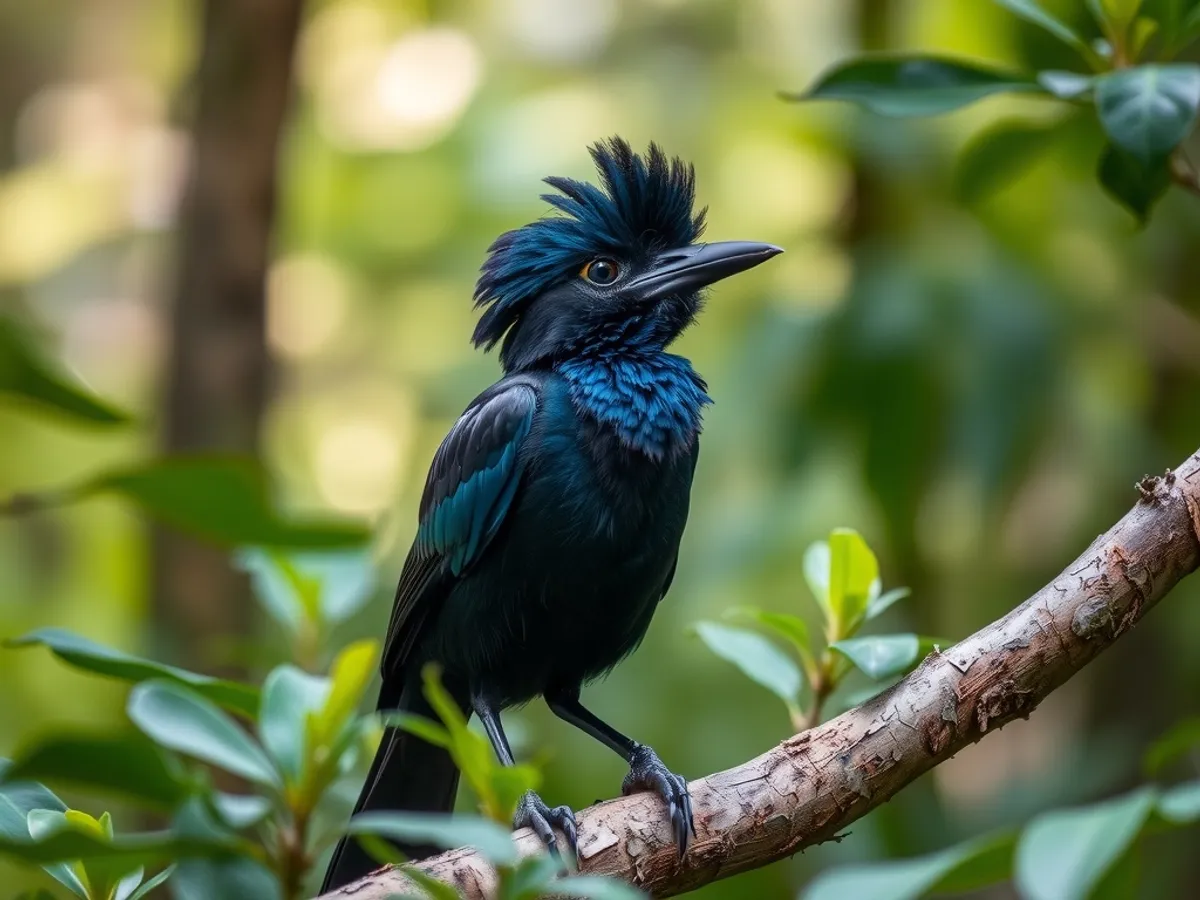
About the Plush-crested Jay
The Plush-crested Jay is a strikingly colorful bird native to South America, characterized by its deep blue upperparts, bright yellow underparts, and a distinctive crest of plush, black feathers atop its head. This intelligent bird is highly social and often found in small groups, communicating with a variety of loud, complex calls. Renowned for its curiosity and bold behavior, the Plush-crested Jay frequently explores its environment, sometimes even approaching humans in search of food. Its adaptability allows it to thrive in diverse habitats, ranging from forests to open woodlands.
Fascinating facts
Distinctive Crest
The Plush-crested Jay's black, velvety crest gives it a unique appearance among South American birds.
Vocal Communicators
These birds have a wide range of calls and are talented mimics, sometimes copying the sounds of other animals.
Cooperative Breeders
Juveniles from previous broods often help their parents feed and protect new chicks, showing complex social behavior.
Detailed description
The Plush-crested Jay (Cyanocorax chrysops) is a medium-sized corvid, measuring approximately 34–38 cm (13–15 in) in length and weighing 120–170 g. Its most distinctive feature is the plush, velvety black crest, which it can raise or lower depending on mood or social context. The bird's upperparts are a deep cobalt-blue, contrasting with a white throat and bright yellow underparts. The face is marked by a striking black mask, extending from the bill to the nape, and a vivid blue 'eyebrow' above the eye. The eyes themselves are pale yellow, adding to its expressive appearance. The wings and tail are blue with white tips, and the bill and legs are robust and black. Plush-crested Jays are highly vocal and intelligent, exhibiting a wide repertoire of calls and even mimicking the sounds of other species. They are social, often forming cohesive groups of 6–12 individuals, and display complex cooperative behaviors. Their adaptability allows them to exploit a range of habitats, from dense subtropical forests to open woodlands and forest edges, often near water sources. This species is known for its inquisitive nature, frequently investigating novel objects and exhibiting problem-solving skills. Their omnivorous diet and flexible foraging strategies contribute to their ecological success.
Did you know?
Despite their beautiful plumage, Plush-crested Jays can be quite audacious, often raiding other birds' nests for eggs or chicks.
Research & sources
Wikipedia summary
The plush-crested jay is a jay of the family Corvidae. It is found in central-southern South America: in southwestern Brazil, Bolivia, Paraguay, Uruguay, and northeastern Argentina, including southern regions of the Amazon Basin river systems bordering the Pantanal.
Behaviour & social structure
Plush-crested Jays are diurnal and spend much of their day foraging, socializing, and maintaining group cohesion through frequent vocalizations and displays. They forage both in trees and on the ground, searching for insects, small vertebrates, fruits, seeds, and occasionally eggs or nestlings of other birds. They are known to cache food, hiding surplus items for later retrieval, a behavior indicative of advanced memory and planning. Social interactions are complex, involving mutual preening, coordinated mobbing of predators, and cooperative defense of territory. Group members communicate with a variety of calls, including alarm notes, contact calls, and harsh scolding sounds. Dominance hierarchies exist within groups, often established through posturing and vocal displays. During the hottest parts of the day, jays may rest in the shade, engaging in preening or social grooming. At night, they roost communally in dense foliage.
Reproduction & life cycle
Breeding typically occurs during the austral spring and summer (September to December), though timing can vary with local climate. Plush-crested Jays are socially monogamous, with pairs forming long-term bonds. Nests are bulky, cup-shaped structures built high in trees, constructed from twigs and lined with softer materials. Clutch size ranges from 3 to 5 eggs, which are pale greenish or bluish with brown speckling. Incubation is performed primarily by the female and lasts about 17–18 days, while the male and other group members (helpers) provide food and protection. Both parents, and sometimes helpers, feed the chicks, which fledge after 22–24 days. Cooperative breeding is common, with non-breeding individuals assisting in chick rearing, a strategy that enhances reproductive success and group cohesion.
Adaptations & survival
Plush-crested Jays possess several adaptations for survival in variable environments. Their strong, versatile bills allow them to exploit a wide range of food sources, from hard seeds to soft fruits and animal prey. Their intelligence and problem-solving abilities facilitate food caching and retrieval, as well as predator avoidance. The plush crest is used in social signaling, raised during displays of aggression or excitement. Their complex vocalizations aid in group coordination and predator detection. Social living provides benefits such as cooperative defense, increased foraging efficiency, and enhanced care of offspring. Their plumage coloration offers camouflage in dappled forest light, while the conspicuous facial markings may aid in individual recognition within groups.
Cultural significance
In regions where they are common, Plush-crested Jays are often noted in local folklore for their intelligence and boldness. Their striking appearance and vocal nature have made them subjects of popular interest, sometimes featured in ecotourism and birdwatching literature. In some cultures, jays are associated with cleverness or trickster spirits, though specific myths about Cyanocorax chrysops are less documented than those of North American jays. Their habit of approaching human settlements has led to both admiration and annoyance, depending on their impact on crops or poultry.
Recent research
Recent research on Cyanocorax chrysops has focused on their cognitive abilities, social structure, and cooperative breeding behavior. Studies have documented sophisticated food-caching strategies and evidence of episodic-like memory. Genetic analyses have clarified phylogenetic relationships within the Cyanocorax genus, revealing historical biogeographic patterns linked to South American forest dynamics. Ongoing research is examining the impacts of habitat fragmentation on group cohesion and reproductive success. Vocalization studies have highlighted the complexity and regional variation in their calls, suggesting potential for local dialects. The species is also used as a model for understanding the evolution of cooperative breeding in birds.
Sources
Videos
Habitat
Subtropical and tropical forests, woodlands, and forest edges
 Africa
Savanna
Grasslands with scattered trees, characterized by seasonal rainfall and home to diverse grazing animals and predators.
 Various Continental Regions
Grassland
Open areas dominated by grasses rather than trees, supporting numerous herbivores and their predators.
 Global
Forest
Wooded areas with significant tree cover and diverse plant and animal communities.
Conservation
The Plush-crested Jay is currently classified as Least Concern on the IUCN Red List.
Threats & challenges
Currently classified as Least Concern by the IUCN, the Plush-crested Jay maintains stable populations across its range. However, localized threats include habitat loss due to deforestation, agricultural expansion, and urbanization, particularly in the Atlantic Forest and Pantanal regions. The species is adaptable and can persist in fragmented landscapes, but ongoing habitat degradation could pose future risks. In some areas, they are persecuted for raiding crops or preying on poultry eggs. Climate change may also alter habitat suitability and food availability. Despite these challenges, their broad distribution and ecological flexibility buffer them against severe declines at present.
Taxonomy
Scientific name
Cyanocorax chrysops
- Kingdom
- Animalia
- Phylum
- Chordata
- Class
- Aves
- Order
- Passeriformes
- Family
- Corvidae
- Genus
- Cyanocorax
- Species
- chrysops
Where to see a plush-crested jay
5 zoos and aquariums in 1 country are recorded as keeping this species.
 Houston Zoo🇺🇸 Houston, United States
 Memphis Zoo🇺🇸 Memphis, United States
- 🦁Greenville Zoo🇺🇸 Greenville, United States
 Birmingham Zoo🇺🇸 United States
 Los Angeles Zoo🇺🇸 United States
Community notes
Share your observations about the Plush-crested Jay.
No community notes yet. Be the first!
Discover more wildlife
More fascinating animals from the encyclopedia.