
About the Prairie Rattlesnake
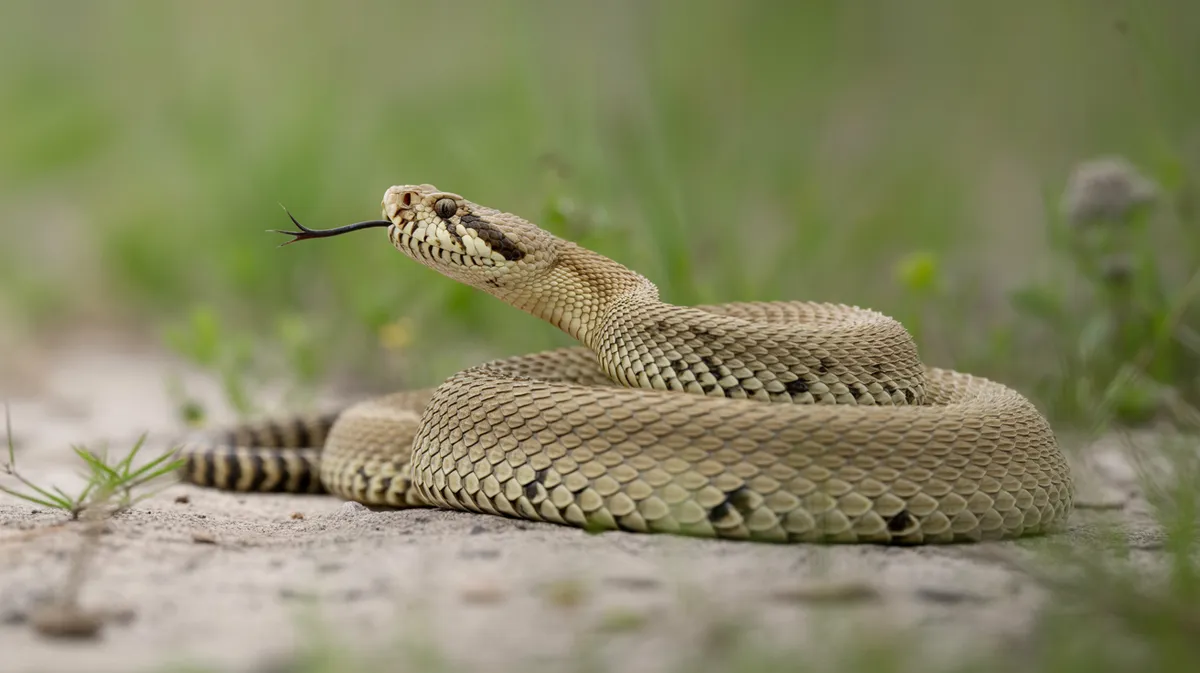
The Prairie Rattlesnake is a venomous pit viper native to the grasslands and prairies of North America, particularly the central United States, southwestern Canada, and northern Mexico. It is recognized by its triangular head, keeled scales, and distinctive rattle at the end of its tail, which it uses as a warning signal when threatened. This species is well-adapted to open habitats, displaying a light brown or greenish coloration with darker blotches that provide excellent camouflage. Prairie Rattlesnakes are ambush predators, relying on their heat-sensing pits and potent venom to subdue prey such as rodents, birds, and lizards.
Fascinating facts
Heat-Sensing Pits
Prairie Rattlesnakes have specialized pit organs between their eyes and nostrils that detect infrared radiation, allowing them to locate warm-blooded prey even in complete darkness.
Rattle Construction
The rattle is formed from modified scales, and a new segment is added each time the snake sheds its skin. However, the rattle can break off, so it does not always indicate the snake’s age.
Habitat Adaptation
Although primarily found in grasslands, these rattlesnakes can also inhabit rocky outcrops, sagebrush, and even agricultural areas, showing remarkable adaptability.
Detailed description
The Prairie Rattlesnake (Crotalus viridis) is a medium to large pit viper, with adults typically ranging from 90 to 120 cm (35–48 in) in length, though individuals up to 150 cm (59 in) have been recorded. Its robust body is covered in keeled dorsal scales, providing a rough texture, and its coloration varies from light brown, olive, or greenish-gray, adorned with a series of dark, rounded dorsal blotches bordered by lighter scales, aiding in camouflage among grasses and rocky outcrops. The head is broad and triangular, with a distinctive neck, and houses large venom glands. Heat-sensitive loreal pits between the eyes and nostrils allow the snake to detect infrared radiation from warm-blooded prey, even in total darkness. The eyes have vertical, elliptical pupils, typical of nocturnal or crepuscular predators. The tail ends in a keratinous rattle, formed by interlocking segments added with each shed, which produces a characteristic buzzing sound when vibrated as a warning. Prairie Rattlesnakes are primarily terrestrial but are capable climbers and swimmers. They are solitary outside of the breeding season, spending much of their time coiled in ambush or basking near burrow entrances. During colder months, they hibernate communally in deep crevices or mammal burrows, sometimes with other snake species. Their venom is a complex cocktail of hemotoxins and neurotoxins, adapted to quickly immobilize and pre-digest prey, and can pose a medical risk to humans, though bites are rarely fatal with prompt treatment.
Did you know?
Despite their fearsome reputation, Prairie Rattlesnakes are generally shy and will often try to flee or warn intruders with their rattle before resorting to biting.
Research & sources
Wikipedia summary
Crotalus viridis is a venomous pit viper species native to the western United States, southwestern Canada, and northern Mexico. Currently, two subspecies are recognized, including the prairie rattlesnake, the nominate subspecies, and the Hopi rattlesnake.
Behaviour & social structure
Prairie Rattlesnakes are primarily ambush predators, remaining motionless for extended periods while waiting for prey to approach. They are most active from late spring through early fall, with peak activity during dawn and dusk (crepuscular), though they may become nocturnal during hot summer months. Their diet consists mainly of small mammals (such as ground squirrels, mice, and voles), but also includes birds, lizards, and occasionally amphibians. Prey is detected using a combination of visual cues, chemical signals from the tongue-flicking Jacobson's organ, and heat-sensing pits. Upon striking, the snake injects venom and releases the prey, tracking it by scent until it succumbs. Feeding frequency depends on prey availability and temperature, with adults feeding every few weeks. Social interactions are limited; individuals are generally solitary except during hibernation or mating. Defensive behaviors include coiling, rattling, and striking when threatened. Prairie Rattlesnakes may also exhibit caudal luring (wiggling the tail tip) to attract prey, especially juveniles.
Reproduction & life cycle
Breeding occurs in spring (April to June) after emergence from hibernation, though some populations may also mate in late summer or early fall. Males engage in ritualized combat for access to receptive females, involving intertwining and pushing contests. Crotalus viridis is ovoviviparous: females retain eggs internally, and embryos develop within the oviduct. Gestation lasts approximately 3–4 months, with parturition occurring from late summer to early fall (August–September). Litters typically consist of 4–20 live young, each measuring 20–30 cm (8–12 in) at birth. Neonates are born fully equipped with venom and fangs, but their initial rattle consists of a single button, gaining additional segments with each molt. Females may not breed annually, often skipping years to recover energy reserves. There is no parental care after birth; young are independent from the outset.
Adaptations & survival
The Prairie Rattlesnake exhibits several adaptations for survival in open grassland and arid environments. Its cryptic coloration and dorsal patterning provide effective camouflage against predators and prey. The heat-sensing loreal pits enable precise detection of endothermic prey, even in low-light conditions. The rattle serves as an aposematic warning device, reducing the risk of predation and accidental encounters with large mammals. Venom composition is adapted for rapid immobilization and pre-digestion of small mammals, with both hemotoxic and neurotoxic components. Behavioral thermoregulation, such as basking and retreating to burrows, allows the snake to maintain optimal body temperature in variable climates. Seasonal communal hibernation in deep dens minimizes heat loss and conserves energy during winter. Juveniles may use caudal luring to attract prey, an adaptation to their smaller size and different prey spectrum.
Cultural significance
Prairie Rattlesnakes have played a role in the folklore and traditions of Indigenous peoples and settlers in North America. They are often featured in cautionary tales and as symbols of danger, vigilance, or transformation. Some Native American tribes regard rattlesnakes with respect, attributing to them spiritual or medicinal significance; rattles have been used in ceremonial rattles and regalia. In modern times, the species is both feared and admired, sometimes featured in local festivals or educational programs to promote awareness and conservation. Negative perceptions persist, contributing to intentional killing and habitat destruction.
Recent research
Recent research has focused on the population genetics and phylogeography of Crotalus viridis, revealing significant genetic structuring and historical biogeographic patterns across its range. Studies on venom composition have identified intraspecific variation, with implications for antivenom development and medical treatment. Radio-telemetry and mark-recapture studies have provided insights into home range size, movement ecology, and den site fidelity. Ongoing research addresses the impacts of habitat fragmentation and climate change on population dynamics. Conservation initiatives increasingly emphasize public education and the identification of critical hibernacula for protection.
Videos
Habitat
Grasslands and prairies
 Arid Regions
Desert
Arid lands with minimal rainfall, extreme temperatures, and specialized wildlife adapted to harsh conditions.
 Various Continental Regions
Grassland
Open areas dominated by grasses rather than trees, supporting numerous herbivores and their predators.
 Elevated Terrain
Mountain
High-altitude environments with varying climates and specialized wildlife adapted to rugged terrain and thin air.
Conservation
The Prairie Rattlesnake is currently classified as Least Concern on the IUCN Red List.
Threats & challenges
While classified as Least Concern by the IUCN, Prairie Rattlesnake populations face several localized threats. Habitat loss and fragmentation due to agriculture, urban development, and road construction reduce available territory and denning sites. Persecution by humans, often due to fear or misunderstanding, leads to direct mortality. Road mortality is significant in some regions, especially during seasonal migrations to and from hibernacula. Pesticide use may indirectly reduce prey availability. Climate change could alter hibernation patterns and habitat suitability. Despite these challenges, the species remains widespread and adaptable, with stable populations in many areas, though some local declines have been reported.
Taxonomy
Scientific name
Crotalus viridis
- Kingdom
- Animalia
- Phylum
- Chordata
- Class
- Reptilia
- Order
- Squamata
- Family
- Viperidae
- Genus
- Crotalus
- Species
- viridis
Community notes
Share your observations about the Prairie Rattlesnake.
No community notes yet. Be the first!
Discover more wildlife
More fascinating animals from the encyclopedia.