
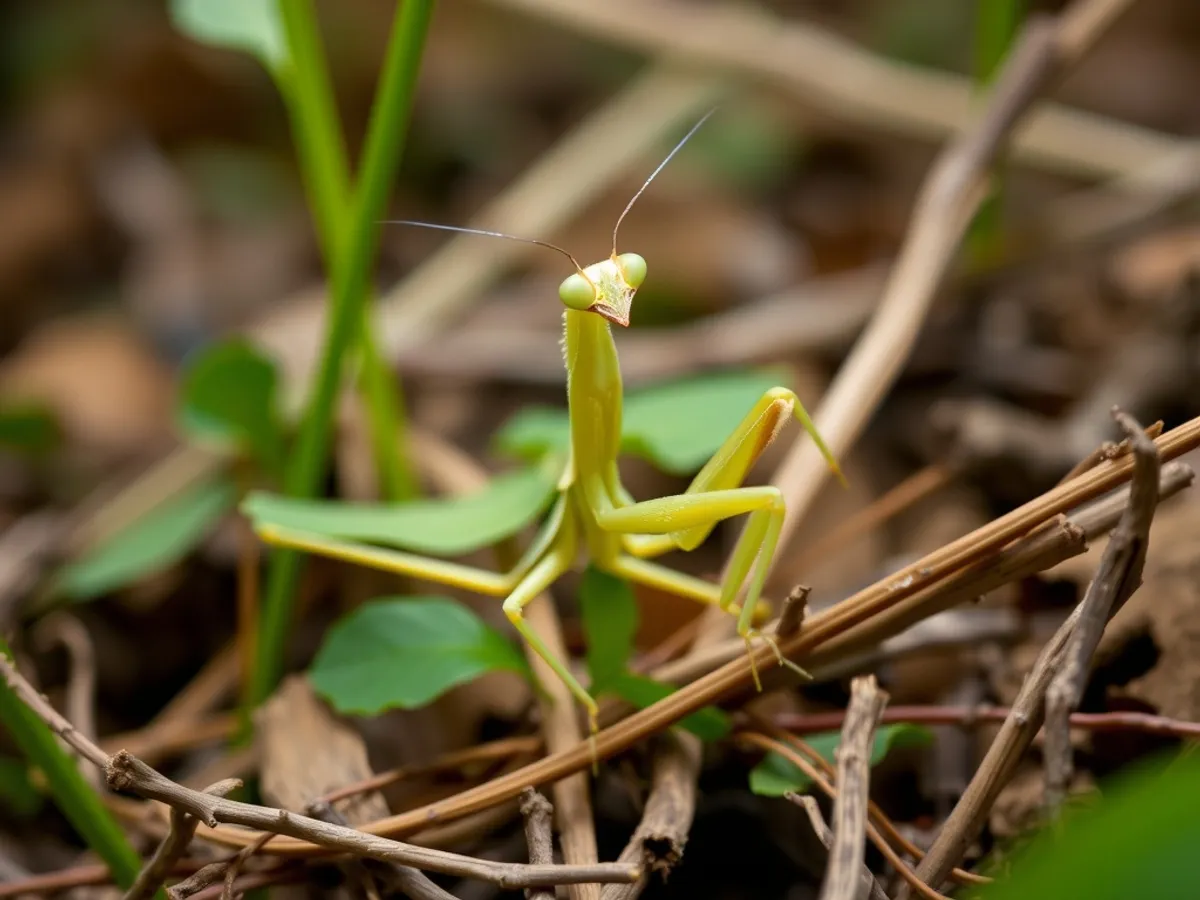
About the Praying Mantis
The most repeated fact about mantises is the least accurate. Sexual cannibalism is real, but the claim that females routinely bite off the male's head during mating is largely an artefact of early laboratory studies in which starved females were placed in bright cramped arenas under observation. In the field, cannibalism rates are far lower — typically well under a third of matings, and in many species close to zero — and males use elaborate cautious approaches, sometimes taking an hour to cover the last few centimetres. Where it happens, it is not senseless: isotope studies show nutrients from the consumed male end up directly in the eggs, so he does invest in his own offspring. Far less well known is that most mantises have a single ear, located in a groove on the midline of the thorax between the hind legs, tuned to ultrasound. A flying mantis that hears a hunting bat's echolocation calls goes into a steep, spiralling power dive to escape — an anti-bat system evolved independently of the one moths use. Mantises strike with raptorial forelegs in around 50 to 70 milliseconds, faster than a human can perceive, and they judge distance with true stereoscopic vision, confirmed with an experiment in which mantises wore tiny 3D glasses. Their heads swivel nearly 180 degrees, unique among insects.
Fascinating facts
Expert Ambushers
Praying Mantises rely on stillness and camouflage, waiting patiently to ambush unsuspecting prey with their powerful grasping forelegs.
Exceptional Vision
They have two large compound eyes and three simple eyes, giving them excellent vision and the ability to detect movement up to 60 feet away.
Flexible Necks
Unlike most insects, the Praying Mantis can rotate its head up to 180 degrees, providing a wide field of view to spot both prey and predators.
Detailed description
The Praying Mantis (Mantis religiosa) is a medium to large-sized insect, with adults typically measuring 6–8 cm in length, though females are generally larger than males. Its most distinctive anatomical features include a triangular, highly mobile head equipped with two large compound eyes and three simple ocelli, providing a wide field of vision and acute motion detection. The elongated thorax (prothorax) gives the mantis a 'neck,' allowing the head to rotate up to 180 degrees. Its raptorial forelegs are lined with sharp spines and fold in a characteristic 'praying' position, specialized for grasping and immobilizing prey. The body coloration varies from green to brown, offering effective camouflage among vegetation. Mantis religiosa is primarily diurnal, relying on excellent vision for hunting and navigation. The species is solitary and highly territorial, with individuals exhibiting aggressive behaviors toward conspecifics. Sexual dimorphism is evident, with females being bulkier and less agile fliers than males. The wings are well-developed in adults, with the forewings (tegmina) serving as protective covers for the hindwings, which are used for short, fluttering flights. The mantis's predatory lifestyle is supported by rapid reflexes, cryptic coloration, and an ability to remain motionless for extended periods, enhancing its ambush strategy.
Did you know?
Some larger praying mantis species are known to prey on small birds, frogs, and even lizards, not just insects.
Research & sources
Wikipedia summary
Mantises are an order (Mantodea) of insects that contains over 2,400 species in about 460 genera in 33 families. The largest family is the Mantidae ("mantids"). Mantises are distributed worldwide in temperate and tropical habitats. They have triangular heads with bulging eyes supported on flexible necks. Their elongated bodies may or may not have wings, but all mantodeans have forelegs that are greatly enlarged and adapted for catching and gripping prey; their upright posture, while remaining stationary with forearms folded, resembling a praying posture, has led to the common name praying mantis.
Behaviour & social structure
Praying mantises are sit-and-wait predators, remaining motionless and camouflaged among foliage until suitable prey approaches. Their hunting strategy involves sudden, rapid extension of the forelegs to snatch prey with remarkable speed (strike times as fast as 50–70 milliseconds). Diet consists mainly of other insects such as flies, grasshoppers, crickets, and moths, but larger individuals may capture small vertebrates including lizards and even hummingbirds. Mantises use binocular vision to judge distance and depth, enabling precise strikes. They are solitary, aggressively defending their hunting territories; encounters between adults can lead to cannibalism, especially during mating. Daily activity peaks during warm daylight hours, with individuals seeking shelter at night. Praying mantises exhibit a startle display when threatened, raising their forelegs and spreading their wings to appear larger and reveal warning coloration or eyespots.
Reproduction & life cycle
Mating in Mantis religiosa is complex and often risky for males due to the well-documented phenomenon of sexual cannibalism, where the female may consume the male before, during, or after copulation. Courtship involves cautious approach by the male, sometimes accompanied by rhythmic movements to avoid triggering the female's predatory instincts. Copulation may last several hours. After mating, females lay oothecae (egg cases) containing 100–300 eggs, attaching them to vegetation or other substrates. The ootheca is a frothy secretion that hardens to protect the eggs from desiccation and predation. Incubation lasts 3–6 weeks depending on temperature. Nymphs emerge in late spring or early summer, resembling miniature adults but lacking wings; they undergo 5–7 molts before reaching maturity. There is no parental care after egg-laying, and cannibalism among nymphs is common, reducing competition.
Adaptations & survival
Praying mantises possess several evolutionary adaptations for predation and survival. Their cryptic coloration and body shape mimic leaves or twigs, providing camouflage from both predators and prey. The raptorial forelegs are highly specialized, with spines for gripping and a locking mechanism for holding prey securely. Their compound eyes provide stereoscopic vision and are sensitive to movement, while the ability to rotate the head enhances environmental awareness. Mantises can also detect ultrasonic frequencies, allowing them to evade echolocating bats by initiating a controlled dive or spiral descent. The startle display, involving sudden exposure of brightly colored wings or eyespots, deters potential predators. Sexual cannibalism may provide nutritional benefits to females, increasing reproductive success.
Cultural significance
Praying mantises have held symbolic significance in various cultures. In Ancient Greece and Egypt, they were seen as mystical creatures with supernatural powers. In Chinese and Japanese folklore, mantises symbolize courage, patience, and mindfulness, inspiring martial arts forms such as 'Praying Mantis Kung Fu.' In Africa, they are sometimes considered omens or spiritual guides. The mantis's predatory prowess and unique appearance have made it a subject of fascination in art, literature, and popular media. Additionally, mantises are valued in agriculture for their role as natural pest controllers.
Recent research
Recent research has focused on the mantis's visual processing, revealing that Mantis religiosa is the only known insect to exhibit stereoscopic vision similar to vertebrates. Studies using 3D glasses have demonstrated depth perception and motion detection capabilities. Ongoing research explores the neural mechanisms underlying their rapid strike reflex and camouflage behaviors. Genetic studies are clarifying phylogenetic relationships within Mantodea, while ecological research examines the impact of climate change on distribution patterns. There is also interest in the potential use of mantises in integrated pest management.
Videos
Habitat
Grasslands, gardens, forests, and shrublands


Conservation
The Praying Mantis is currently classified as Least Concern on the IUCN Red List.
Threats & challenges
Currently, Mantis religiosa is classified as Least Concern by the IUCN, with stable populations across its native and introduced ranges. However, localized threats include habitat loss due to agricultural expansion, pesticide use, and urbanization, which can reduce prey availability and suitable breeding sites. In some regions, introduced mantis species may compete with native populations. Climate change could also impact distribution and phenology. Despite these challenges, the species demonstrates resilience due to its broad ecological tolerance and adaptability.
Taxonomy
Scientific name
Mantis religiosa
- Kingdom
- Animalia
- Phylum
- Arthropoda
- Class
- Insecta
- Order
- Mantodea
- Family
- Mantidae
- Genus
- Mantis
- Species
- religiosa
Community notes
Share your observations about the Praying Mantis.
No community notes yet. Be the first!
Discover more wildlife
More fascinating animals from the encyclopedia.