
About the Queen Alexandra's Birdwing Caterpillar
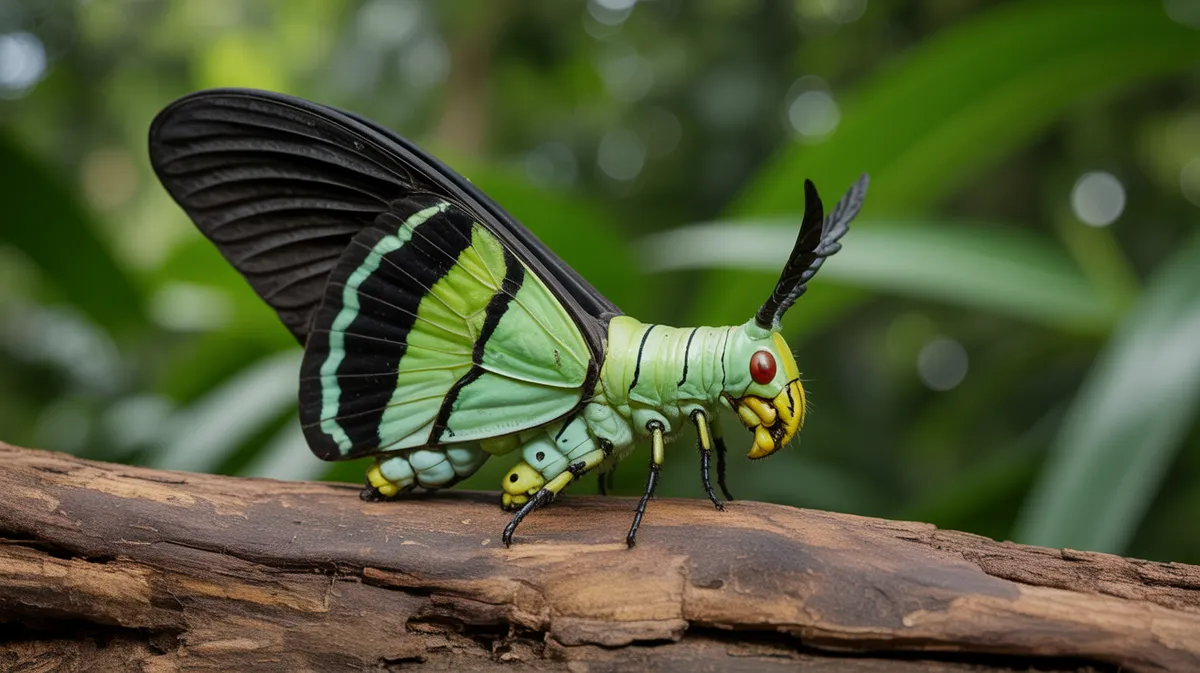
Queen Alexandra's birdwing caterpillar is the remarkable larval stage of the world's largest butterfly, native exclusively to Papua New Guinea. The caterpillar is dark brown to black in color, adorned with striking red tubercles along its body and a pale cream or yellow dorsal stripe. These larvae feed voraciously on toxic Aristolochia vines, storing the toxins in their bodies as a defense against predators. Their habitat is confined to the lowland rainforests, making them highly sensitive to habitat destruction. This caterpillar is a critical part of the butterfly's life cycle and is considered rare and vulnerable due to its restricted range and specialized diet.
Fascinating facts
Largest Butterfly Larva
Queen Alexandra's birdwing caterpillar can grow up to 12 centimeters, making it one of the largest butterfly larvae on Earth.
Toxic Diet
The caterpillar exclusively feeds on Aristolochia vines, which contain toxic compounds that the caterpillar incorporates for defense.
Habitat Specialist
This caterpillar is only found in a small area of lowland rainforest in Papua New Guinea, making it extremely sensitive to habitat loss.
Detailed description
The Queen Alexandra's birdwing caterpillar (Ornithoptera alexandrae) is a striking and robust larva, typically reaching lengths of 7–10 cm before pupation. Its body is predominantly velvety black or deep brown, marked by a prominent pale dorsal stripe and adorned with vivid red, fleshy tubercles along each segment, which serve as a visual warning to predators. The caterpillar’s head capsule is large and well-sclerotized, equipped with strong mandibles for efficiently consuming tough Aristolochia vine leaves. The integument is thick and slightly granular, providing some protection against desiccation and minor predation. This species is solitary, with each larva occupying its own feeding territory on a host plant. The larval stage lasts approximately 30–40 days, during which the caterpillar undergoes five instars, molting between each. As it grows, the caterpillar sequesters toxic aristolochic acids from its diet, rendering both itself and the subsequent adult butterfly highly unpalatable. Prior to pupation, the mature larva seeks a secure site on the host plant to spin a silken pad, anchoring itself in preparation for metamorphosis. This caterpillar is a keystone herbivore in its restricted lowland rainforest habitat, playing a critical role in the life cycle of the world’s largest butterfly.
Did you know?
The caterpillar's striking coloration is a warning to predators that it is poisonous, thanks to chemicals ingested from its host plants.
Research & sources
Behaviour & social structure
Queen Alexandra's birdwing caterpillars are primarily nocturnal feeders, emerging at dusk to consume the leaves of Aristolochia schlecteri and related vines. Their feeding is methodical, often starting at the leaf edge and progressing inward, minimizing waste. The larvae exhibit aposematic behavior, displaying their bright tubercles and dorsal stripe when threatened, sometimes rearing up to deter predators. They are solitary and territorial, rarely tolerating other larvae on the same leaf or vine segment. When disturbed, the caterpillar may regurgitate a foul-smelling fluid as an additional defense. During the day, they remain motionless on the underside of leaves, reducing predation risk from diurnal birds and insects. Molting is a vulnerable period, during which the larva seeks concealed locations. There is no evidence of social cooperation or aggregation among larvae.
Reproduction & life cycle
Reproduction in Ornithoptera alexandrae begins with the adult female selecting suitable Aristolochia host plants for oviposition. Eggs are laid singly on the underside of young leaves or tender stems, ensuring ample food for the emerging larva. The eggs are spherical, pale yellow, and measure about 2 mm in diameter. Incubation lasts 7–10 days, after which the caterpillar hatches and immediately begins feeding. There is no parental care beyond egg placement; all subsequent development is independent. The species is multivoltine in favorable conditions, with several generations possible per year, though breeding peaks during the wet season (November to April) when host plants are most abundant. After completing five larval instars, the caterpillar pupates in a large, greenish chrysalis suspended from the host plant, where metamorphosis lasts approximately 30–40 days before the adult butterfly emerges.
Adaptations & survival
Queen Alexandra's birdwing caterpillars exhibit several key adaptations for survival. Their aposematic coloration—contrasting red tubercles and pale dorsal stripe—serves as a warning to potential predators of their toxicity. The ability to sequester and store aristolochic acids from their host plants provides chemical defense throughout both larval and adult stages. Their strong mandibles are specialized for efficiently processing tough, fibrous leaves. Behavioral adaptations include nocturnal feeding to avoid diurnal predators and the use of regurgitated fluids as a secondary deterrent. The solitary nature of the larvae reduces competition for food and minimizes the risk of disease transmission. The selection of secure pupation sites further enhances survival during the vulnerable metamorphic stage.
Cultural significance
While the caterpillar itself is less prominent in local folklore, the adult Queen Alexandra's birdwing butterfly holds significant symbolic value as a national icon of Papua New Guinea and is featured in conservation campaigns. The species is highly prized by collectors due to its size and rarity, leading to strict legal protections. Educational programs in local communities increasingly highlight the importance of conserving both the butterfly and its larval stages as part of Papua New Guinea’s unique natural heritage. There are no known traditional uses of the caterpillar itself.
Recent research
Recent research has focused on the chemical ecology of O. alexandrae larvae, particularly their ability to sequester aristolochic acids and the implications for predator-prey interactions. Genetic studies are underway to assess population structure and genetic diversity, critical for conservation planning. Ongoing field surveys aim to map the distribution of both the caterpillar and its host plants, informing habitat management strategies. There is also interest in the potential impacts of climate change on larval development and host plant phenology. Conservation breeding programs have begun to rear larvae in controlled environments for eventual reintroduction, with promising early results.
Videos
Habitat
Lowland rainforest


Conservation
The Queen Alexandra's Birdwing Caterpillar is currently classified as Endangered on the IUCN Red List.
Threats & challenges
The primary threats to Ornithoptera alexandrae caterpillars are habitat loss and fragmentation due to logging, agricultural expansion (notably oil palm plantations), and human settlement in Papua New Guinea’s lowland rainforests. Their extreme host plant specialization makes them highly vulnerable to declines in Aristolochia vine populations. Illegal collection of larvae and pupae for the butterfly trade poses an additional threat. Climate change may further impact their restricted habitat, altering rainfall patterns and host plant availability. Population trends are declining, with the species listed as Endangered by the IUCN. Conservation challenges include enforcing habitat protection, curbing illegal trade, and promoting sustainable land use in the region.
Taxonomy
Scientific name
Ornithoptera alexandrae
- Kingdom
- Animalia
- Phylum
- Arthropoda
- Class
- Insecta
- Order
- Lepidoptera
- Family
- Papilionidae
- Genus
- Ornithoptera
- Species
- alexandrae
Where to see a queen alexandra's birdwing caterpillar
1 zoo and aquarium in 1 country are recorded as keeping this species.
Community notes
Share your observations about the Queen Alexandra's Birdwing Caterpillar.
No community notes yet. Be the first!
Discover more wildlife
More fascinating animals from the encyclopedia.