
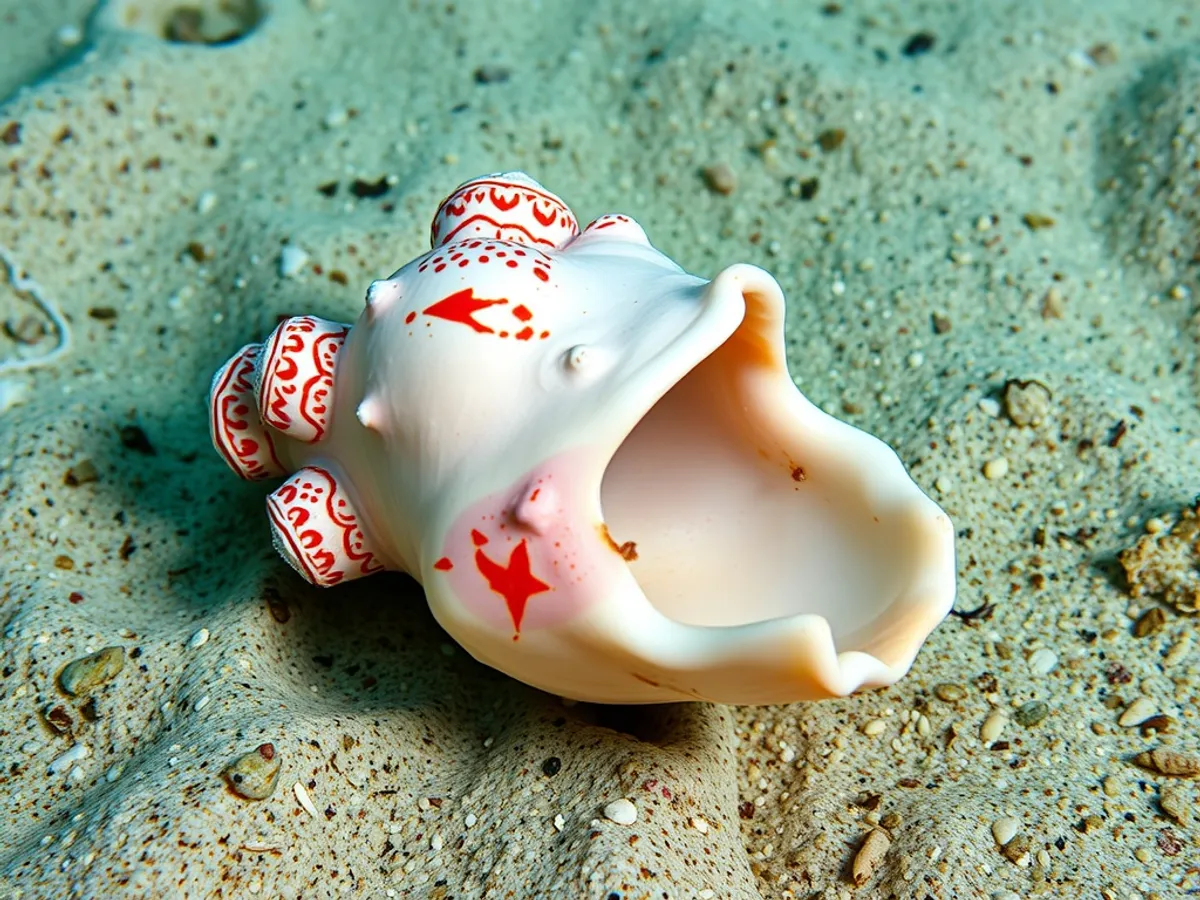
Queen conch
Lobatus gigas
About the Queen conch
The Queen conch is a large marine mollusk recognized for its beautiful, spiral-shaped pink shell and distinctive flared lip. Native to the warm, shallow waters of the Caribbean Sea and western Atlantic Ocean, this gastropod spends much of its life slowly grazing on algae and seagrass. Queen conchs play a vital ecological role in maintaining healthy seagrass beds and are an important food source for marine predators and humans alike. Due to overfishing and habitat degradation, their populations have declined in many areas, leading to increased conservation efforts.
Fascinating facts
Iconic Shell
The queen conch's shell is prized for its striking pink interior and is often collected for decorative and commercial purposes.
Seagrass Grazer
Queen conchs help maintain healthy seagrass beds by grazing on algae, which prevents overgrowth and promotes ecosystem balance.
Conservation Concern
Due to overharvesting for food and shells, queen conch populations have declined, leading to fishing restrictions and conservation programs.
Detailed description
The queen conch (Lobatus gigas) is a large marine gastropod mollusk, with adult shells typically ranging from 20 to 35 cm in length and weighing up to 2.3 kg. Its shell is robust, heavy, and features a high spire with a flared, thickened outer lip that is characteristically pink to orange on the interior. The animal’s soft body is protected by the shell and includes a muscular foot used for locomotion, equipped with a pointed operculum that acts as a digging tool and defensive structure. Queen conchs have a pair of long, stalked eyes that provide a wide field of vision, and a siphon for drawing in water to their gills. They are primarily herbivorous, grazing on epiphytic algae, detritus, and seagrass, and play a crucial role in nutrient cycling within seagrass ecosystems. Juveniles are cryptic and bury themselves in sediment, while adults are more mobile, often migrating seasonally to deeper waters for spawning. Their life span can exceed 20 years under natural conditions, although most harvested individuals are much younger. Queen conchs are dioecious (separate sexes), and their reproductive output is highly sensitive to population density. They are known for their slow growth and late maturity, making them particularly vulnerable to overexploitation. Their shells are prized for ornamental and commercial purposes, and the flesh is a traditional food source throughout the Caribbean.
Did you know?
Despite their slow movement, queen conchs can travel considerable distances by 'leaping' forward using their strong foot.
Research & sources
Wikipedia summary
Aliger gigas, originally known as Strombus gigas or more recently as Lobatus gigas, commonly known as the queen conch, is a species of large sea snail, a marine gastropod mollusc in the family of true conches, the Strombidae. This species is one of the largest molluscs native to the Caribbean Sea, and tropical northwestern Atlantic, reaching up to 35.2 centimetres (13.9 in) in shell length. A. gigas is closely related to the goliath conch, Titanostrombus goliath, a species endemic to Brazil, as well as the rooster conch, Aliger gallus.
Behaviour & social structure
Queen conchs are primarily solitary but may aggregate in large numbers during the breeding season. They are slow-moving, typically traveling less than 100 meters per day, and use their muscular foot to 'leap' forward in short bursts. Feeding occurs mostly during daylight hours, with individuals grazing on algae and detritus on seagrass blades and sandy substrates. Juveniles tend to remain buried during the day to avoid predation, emerging at night to feed. Adults are less vulnerable and spend more time exposed on the substrate. Queen conchs exhibit homing behavior, returning to preferred feeding grounds after displacement. During the reproductive season, adults migrate to deeper waters (10–30 meters) to form spawning aggregations, which are critical for successful fertilization. Social interactions are generally limited to mating and occasional competition for food or space.
Reproduction & life cycle
Queen conchs reach sexual maturity between 3 and 5 years of age, typically when their shell lip begins to flare and thicken. Spawning occurs seasonally, peaking from March to October, depending on local environmental conditions. Males and females engage in copulation, with the male using a long, extensible penis to transfer sperm to the female. Females lay egg masses containing up to 750,000 eggs, which are deposited in gelatinous strings on sandy substrates. Embryonic development lasts 3–5 days, after which planktonic veliger larvae hatch and drift with ocean currents for 2–4 weeks before settling to the benthos. There is no parental care; survival rates of larvae are low due to predation and environmental factors. Successful recruitment is highly dependent on larval dispersal and suitable nursery habitats.
Adaptations & survival
Queen conchs possess several adaptations for survival in their shallow marine habitats. Their thick, heavy shells provide protection against predators such as crabs, rays, and humans. The bright pink interior of the shell may serve as a warning or deterrent. The pointed operculum is used for digging into sand to escape predators and for locomotion, allowing the conch to 'leap' away from threats. Their siphon enables them to detect chemical cues in the water, aiding in predator avoidance and mate location. Juveniles exhibit cryptic coloration and burrowing behavior to reduce predation risk. Their slow metabolism and ability to subsist on low-nutrient diets are advantageous in nutrient-poor seagrass beds.
Cultural significance
The queen conch holds deep cultural and economic significance throughout the Caribbean. Its meat is a traditional delicacy, featured in dishes such as conch fritters and salads. The shell is used for jewelry, ornaments, and as a musical instrument (conch trumpet) in ceremonies and festivals. In some cultures, the conch symbolizes fertility, prosperity, and spiritual awakening. Archaeological evidence shows that indigenous peoples used conch shells for tools and ceremonial objects for thousands of years. Today, the queen conch remains an important symbol of Caribbean identity and heritage, but unsustainable exploitation threatens both the species and the livelihoods of those who depend on it.
Recent research
Recent research has focused on queen conch population genetics, larval dispersal, and the effectiveness of marine protected areas (MPAs) in supporting recovery. Genetic studies reveal significant population structure across the Caribbean, indicating limited larval connectivity and emphasizing the need for localized management. Experimental restocking and aquaculture initiatives are underway to enhance depleted populations, though challenges remain in larval rearing and post-release survival. Studies on reproductive biology have highlighted the importance of maintaining high adult densities for successful spawning. Ongoing monitoring using underwater visual censuses and acoustic telemetry is improving understanding of movement patterns and habitat use. The species is listed in Appendix II of CITES, and international trade is regulated to prevent further declines.
Sources
Videos
Habitat
Shallow seagrass beds and sandy substrates in warm coastal waters

Conservation
The Queen conch is currently classified as Queen conch is listed as 'Endangered' by the IUCN Red List on the IUCN Red List.
Threats & challenges
Queen conch populations face significant threats from overfishing, habitat degradation, and illegal trade. Their slow growth, late maturity, and density-dependent reproduction make them especially susceptible to population declines. Harvesting for meat and decorative shells has led to local extirpations in several Caribbean regions. Habitat loss due to coastal development, pollution, and seagrass bed destruction further exacerbates their decline. Enforcement of fishing regulations is often weak, and illegal, unreported, and unregulated (IUU) fishing persists. Climate change poses additional risks through ocean warming, acidification, and altered current patterns affecting larval dispersal. Conservation challenges include establishing effective marine protected areas, regulating harvests, and supporting community-based management.
Taxonomy
Scientific name
Lobatus gigas
- Kingdom
- Animalia
- Phylum
- Mollusca
- Class
- Gastropoda
- Order
- Littorinimorpha
- Family
- Strombidae
- Genus
- Lobatus
- Species
- gigas
Community notes
Share your observations about the Queen conch.
No community notes yet. Be the first!
Discover more wildlife
More fascinating animals from the encyclopedia.