
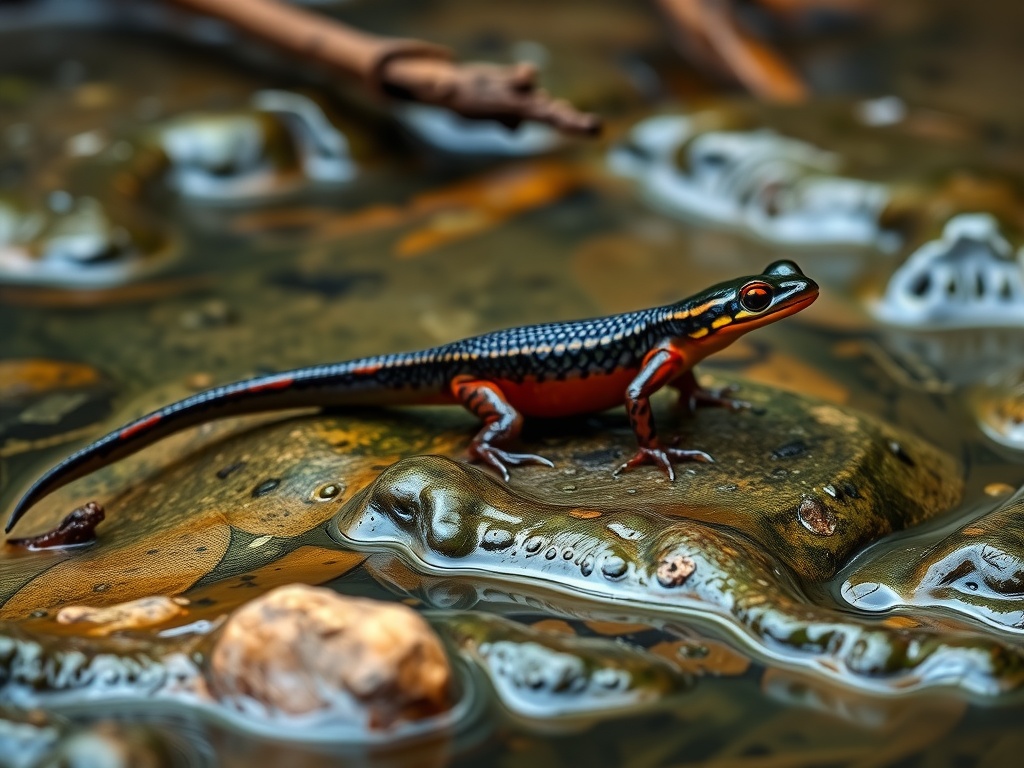
About the Red-bellied Newt
The Red-bellied Newt is a striking amphibian native to the coastal forests of northern California. Characterized by its dark brown to black dorsum and vivid brick-red belly, this newt uses its bright coloration as a warning to potential predators about its potent toxins. Adults are most frequently found in moist, shaded woodlands and near streams, especially during their spring breeding migration. Despite their toxicity, these newts play a vital role in their ecosystem by controlling insect populations and serving as prey for a few specialized predators.
Fascinating facts
Potent Toxins
Red-bellied Newts secrete tetrodotoxin, a potent neurotoxin that can deter most predators and is strong enough to be lethal to humans if ingested.
Restricted Range
This species is found only in a narrow strip of humid coastal forest in northern California, making its habitat range quite limited compared to other newts.
Predator Arms Race
Certain garter snakes have developed a resistance to the newt’s toxins, leading to a fascinating evolutionary arms race between predator and prey.
Detailed description
The Red-bellied Newt (Taricha rivularis) is a medium-sized salamander, typically reaching 7–8.5 cm (2.8–3.3 in) snout-to-vent length, with total lengths up to 18 cm (7 in). Its most distinctive feature is the vivid, brick-red to orange-red coloration of its ventral surface, sharply contrasting with a dark brown to nearly black dorsum. The skin is rough and granular, especially on the dorsum, which aids in water retention and toxin secretion. Eyes are relatively small and set laterally, with a horizontal pupil. Limbs are robust, and the tail is laterally compressed, facilitating swimming during the breeding season. Red-bellied Newts are primarily terrestrial outside of breeding periods, spending much of the year in moist, shaded forest floors under logs, rocks, or leaf litter. They are solitary except during the breeding season, when they migrate en masse to natal streams. Their skin contains tetrodotoxin, a potent neurotoxin, providing effective chemical defense against most predators. The species is long-lived for an amphibian, with individuals known to survive over 15 years in the wild. During the non-breeding season, they exhibit site fidelity, often returning to the same terrestrial refuges year after year.
Did you know?
Despite their toxicity, some garter snake populations have evolved resistance to the Red-bellied Newt’s poison and are among their few natural predators.
Research & sources
Wikipedia summary
The red-bellied newt is a newt that is native to coastal woodlands in northern California and is terrestrial for most of its life.
Behaviour & social structure
Red-bellied Newts are largely nocturnal, emerging at dusk to forage for invertebrates such as earthworms, snails, and small arthropods. They employ a slow, deliberate hunting strategy, using chemosensory cues to locate prey. When threatened, they exhibit the 'unken reflex,' arching their back and displaying their red belly as a warning of toxicity. Outside of the breeding season, individuals are solitary and territorial, rarely interacting with conspecifics. During the spring rains (typically March–May), adults migrate in large numbers to breeding streams, sometimes traveling over a kilometer. In aquatic environments, they become more active during the day, swimming and engaging in courtship behaviors. Feeding ceases during the breeding period, resuming once they return to terrestrial habitats. Juveniles and larvae are aquatic and exhibit cryptic coloration, hiding among stream debris to avoid predation.
Reproduction & life cycle
Breeding occurs annually from March to May, triggered by increased rainfall and stream flow. Males arrive at breeding streams first and establish territories in slow-moving pools. Courtship involves the male nudging and circling the female, followed by the deposition of a spermatophore, which the female picks up with her cloaca. Females lay 7–30 eggs per clutch, attaching them singly or in small groups to submerged vegetation, rocks, or debris. The eggs are encased in a gelatinous envelope, providing protection from desiccation and some predators. Incubation lasts 3–6 weeks, depending on water temperature. Larvae are fully aquatic, possessing external gills and a broad tail fin. Metamorphosis occurs after 3–6 months, at which point juveniles leave the water and adopt a terrestrial lifestyle. There is no parental care beyond egg deposition.
Adaptations & survival
The Red-bellied Newt's most notable adaptation is its production of tetrodotoxin, a potent neurotoxin that deters most vertebrate predators. The bright ventral coloration serves as aposematic (warning) signaling. Their granular skin reduces water loss and facilitates toxin secretion. The species exhibits strong homing ability, using olfactory and geomagnetic cues to return to natal streams for breeding. Their robust limbs and prehensile toes aid in climbing and navigating the rugged, moist forest floor. During dry periods, they seek out deep refuges to avoid desiccation, entering a state of reduced metabolic activity (aestivation) if necessary. The aquatic larvae have cryptic coloration and rapid growth rates to minimize predation risk.
Cultural significance
The Red-bellied Newt is not widely featured in folklore or traditional use, likely due to its potent toxicity. However, it is valued by naturalists and educators as an indicator species for healthy forest and stream ecosystems. Its striking coloration and unique behaviors make it a subject of interest in regional wildlife interpretation programs. In some localities, it has become a symbol of the unique biodiversity of northern California’s coastal forests.
Recent research
Recent research has focused on the molecular genetics of tetrodotoxin synthesis and resistance, both in Taricha rivularis and its predators, such as the Common Gartersnake (Thamnophis sirtalis), which has evolved partial resistance to the toxin. Population genetic studies have revealed significant genetic structuring among isolated populations, highlighting the importance of habitat connectivity. Ongoing ecological monitoring tracks the impacts of climate change and habitat fragmentation on breeding success and population viability. Studies on navigation and homing have provided insights into amphibian orientation mechanisms. There is also active research into the effects of emerging pathogens, such as chytrid fungus (Batrachochytrium dendrobatidis), on population health.
Videos
Habitat
Moist forests and clean, flowing streams
 Elevated Terrain
Mountain
High-altitude environments with varying climates and specialized wildlife adapted to rugged terrain and thin air.
 Global
Forest
Wooded areas with significant tree cover and diverse plant and animal communities.
 Global
Freshwater
Lakes, rivers, and wetlands with diverse aquatic ecosystems.
Conservation
The Red-bellied Newt is currently classified as Least Concern on the IUCN Red List.
Threats & challenges
The primary threats to Red-bellied Newts include habitat loss and fragmentation due to logging, urbanization, and road construction. Stream pollution from agricultural runoff and sedimentation can reduce egg and larval survival. Road mortality during breeding migrations is a significant localized threat. Introduced predators, such as non-native fish and crayfish, may prey on eggs and larvae. Climate change poses a long-term risk by altering precipitation patterns and stream flow, potentially disrupting breeding cycles. While populations remain locally abundant, the species is listed as Vulnerable by the IUCN due to its restricted range and ongoing habitat pressures. Conservation efforts focus on habitat protection, stream restoration, and mitigation of road mortality.
Taxonomy
Scientific name
Taricha rivularis
- Kingdom
- Animalia
- Phylum
- Chordata
- Class
- Amphibia
- Order
- Caudata
- Family
- Salamandridae
- Genus
- Taricha
- Species
- rivularis
Community notes
Share your observations about the Red-bellied Newt.
No community notes yet. Be the first!
Discover more wildlife
More fascinating animals from the encyclopedia.