
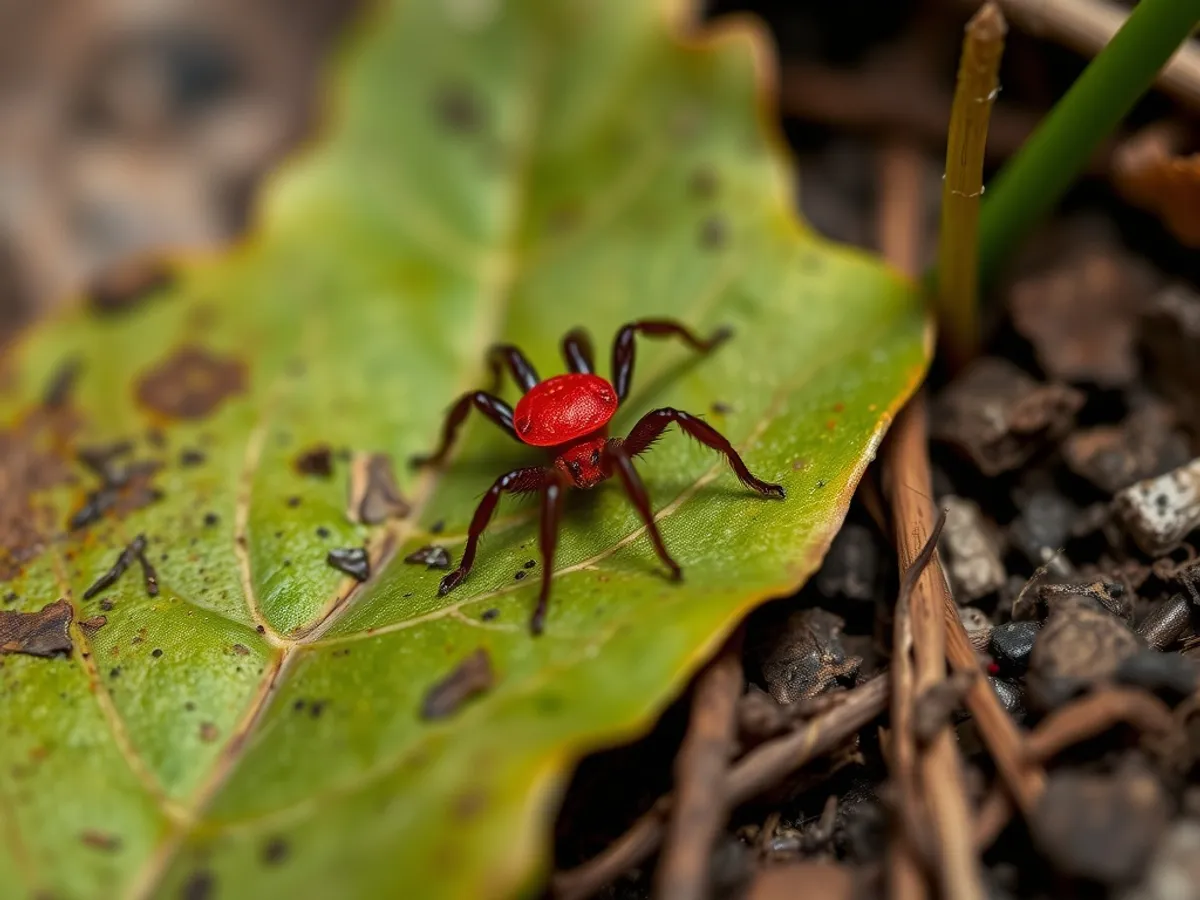
About the Red Velvet Mite
The Red Velvet Mite is a strikingly bright red arachnid known for its soft, velvety appearance. These small invertebrates are often seen crawling on the ground after rain, especially in forests and grasslands. As larvae, they are parasitic on insects, while the adults are free-living predators that help control small arthropod populations. Their vivid coloration serves as a warning to predators due to their distasteful and toxic secretions.
Fascinating facts
Not a Spider
Although they resemble spiders, Red Velvet Mites are actually part of the mite subgroup within Arachnida.
Post-Rain Appearances
Red Velvet Mites are most commonly seen above ground after rain showers, as the moist environment suits their active foraging.
Warning Coloration
Their bright red color warns would-be predators of their toxic secretions, a classic example of aposematism.
Detailed description
The Red Velvet Mite (Trombidium holosericeum) is a conspicuous arachnid belonging to the family Trombidiidae, easily recognized by its vivid scarlet coloration and dense covering of fine, velvety setae that give it a plush texture. Adults typically measure between 4 and 6 mm in length, though some individuals may reach up to 8 mm, making them among the largest terrestrial mites in Europe and Asia. Their bodies are oval and robust, with relatively short legs compared to other mite species, adapted for crawling through leaf litter and soil. The mite's exoskeleton is soft and lacks the hard sclerotization seen in many arachnids, which is compensated by its chemical defenses. Red Velvet Mites possess simple eyes (ocelli) that detect light and shadow, aiding navigation in their dimly lit habitats. Their mouthparts (chelicerae) are adapted for piercing and consuming the bodily fluids of small invertebrates. Larvae are ectoparasitic, attaching to insects such as grasshoppers, beetles, or spiders, while nymphs and adults are predatory, feeding on eggs, larvae, and soft-bodied arthropods. The species is solitary, with individuals only coming together for mating. Their life cycle is complex, involving several developmental stages: egg, larva, protonymph, deutonymph, tritonymph, and adult. Red Velvet Mites are most active during humid conditions following rainfall, which triggers their emergence from underground burrows. Their bright coloration is aposematic, warning potential predators of their unpalatable and mildly toxic secretions, which are produced by specialized glands in the cuticle.
Did you know?
Despite their tiny size, adult Red Velvet Mites can consume prey several times larger than themselves.
Research & sources
Behaviour & social structure
Red Velvet Mites are primarily solitary and exhibit crepuscular to diurnal activity, emerging from the soil or leaf litter after rainfall when humidity is high. This behavior minimizes desiccation risk and coincides with increased prey availability. Adults are active hunters, using their chelicerae to grasp and liquefy prey, which includes insect eggs, larvae, and other soft-bodied arthropods. They exhibit a slow, deliberate crawling motion, often pausing to probe the substrate with their forelegs, which are rich in sensory setae. Larvae display parasitic behavior, seeking out hosts by climbing vegetation or ambushing passing insects, to which they attach and feed on hemolymph. Social interactions are minimal outside of mating, and there is no evidence of cooperative behavior. When threatened, Red Velvet Mites may release defensive secretions containing aliphatic aldehydes and ketones, deterring predators such as ants and small vertebrates. They spend much of their life cycle in a dormant state underground, emerging only under optimal environmental conditions.
Reproduction & life cycle
Reproduction in Trombidium holosericeum is seasonal, typically occurring in late spring to early summer, coinciding with periods of high humidity. Males deposit spermatophores (sperm packets) on the substrate, often on small stalks of silk. Females locate these spermatophores using chemosensory cues and absorb the sperm through their genital opening. There is no direct copulation. Females lay clusters of several hundred eggs in moist soil or leaf litter, where they are protected from desiccation. The eggs hatch into six-legged larvae after an incubation period of 2–3 weeks, depending on temperature and humidity. Larvae actively seek hosts for parasitism, feeding for several days to weeks before dropping off to molt into the eight-legged protonymph stage. There is no parental care; all developmental stages are independent. The full life cycle may take one to two years, with long periods of dormancy (diapause) during unfavorable conditions.
Adaptations & survival
Red Velvet Mites exhibit several key adaptations for survival in terrestrial environments. Their dense, velvety setae not only provide camouflage among red-hued leaf litter but also help retain moisture and protect against desiccation. The bright red coloration is a classic example of aposematism, warning predators of their chemical defenses. Specialized glands in the cuticle secrete toxic compounds that deter predation. Their chelicerae are adapted for both parasitic and predatory feeding, allowing flexibility in diet across life stages. Behavioral adaptations include synchronized emergence after rainfall, maximizing reproductive and foraging success when conditions are optimal. Their ability to enter diapause enables them to survive periods of drought or cold. Larval parasitism increases dispersal potential, as hosts may carry larvae to new habitats.
Cultural significance
In some cultures, Red Velvet Mites have been associated with folklore and traditional medicine. In parts of South Asia, they are sometimes referred to as 'rain bugs' due to their sudden appearance after monsoon rains, and are believed to be harbingers of good luck or fertility. Historically, some traditional remedies have used crushed mites for purported medicinal properties, though there is no scientific basis for these practices. Their striking appearance has made them subjects of curiosity and fascination in natural history literature and popular science education.
Recent research
Recent research has focused on the chemical ecology of Red Velvet Mites, particularly the identification of their defensive secretions and their role in predator deterrence. Studies have also examined their potential as bioindicators of soil health, given their sensitivity to environmental changes and reliance on intact leaf litter ecosystems. Molecular phylogenetics has clarified relationships within the Trombidiidae, revealing cryptic diversity and possible species complexes. Ongoing research is investigating the impact of climate change on their phenology and population dynamics, as well as their role in regulating pest populations through predation on insect eggs and larvae.
Sources
Trombidium holosericeum (Linnaeus, 1758): Taxonomy, Biology, and Ecology
Zhi-Qiang Zhang, Encyclopedia of Soil Science, Springer (2022)
scientificChemical defense in red velvet mites (Trombidium holosericeum)
M. Bertaux, J. G. V. Smith (2021)
scientificVideos
Habitat
Moist forest floor and grassland leaf litter


Conservation
The Red Velvet Mite is currently classified as Least Concern on the IUCN Red List.
Threats & challenges
Currently, Trombidium holosericeum faces few significant threats and is classified as Least Concern. However, habitat degradation due to deforestation, intensive agriculture, and pesticide use can negatively impact local populations by reducing prey availability and suitable microhabitats. Soil compaction and pollution may also affect survival rates, particularly for eggs and dormant stages. Climate change, with its effects on rainfall patterns and humidity, could alter emergence timing and reproductive success. Despite these potential challenges, the species remains widespread and locally abundant in suitable habitats. There is little evidence of direct exploitation or targeted collection by humans.
Taxonomy
Scientific name
Trombidium holosericeum
- Kingdom
- Animalia
- Phylum
- Arthropoda
- Class
- Arachnida
- Order
- Trombidiformes
- Family
- Trombidiidae
- Genus
- Trombidium
- Species
- holosericeum
Community notes
Share your observations about the Red Velvet Mite.
No community notes yet. Be the first!
Discover more wildlife
More fascinating animals from the encyclopedia.