
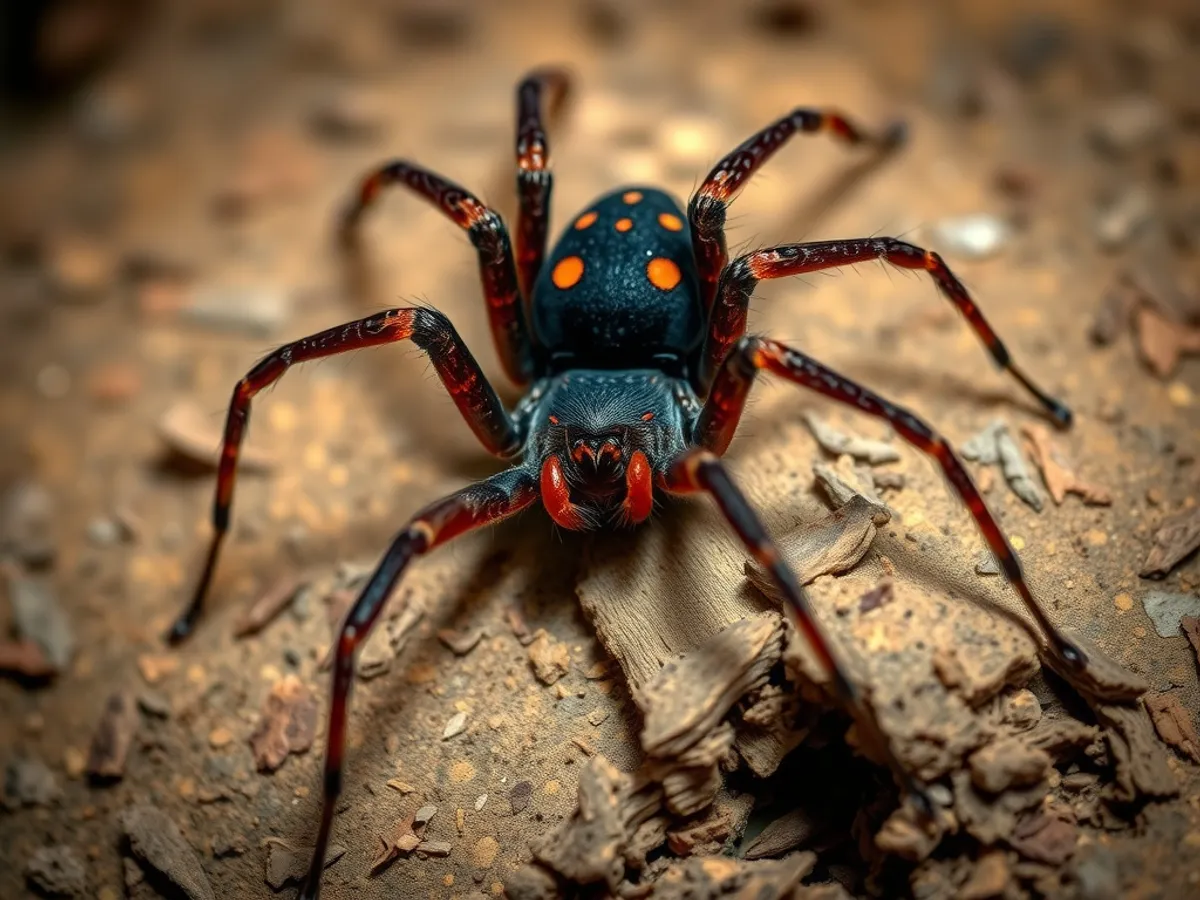
About the Redback Spider
Latrodectus hasselti is Australia's black widow, and its males do something almost unique: during mating, the male somersaults his abdomen directly onto the female's fangs, presenting himself to be eaten while continuing to transfer sperm. This is not accident or predation on an unwilling partner — it is an active, evolved behaviour. The payoff, demonstrated by Maydianne Andrade, is that a male who is consumed copulates for roughly twice as long, transfers more sperm, and the female is far less likely to mate again, so the sacrificed male fathers more offspring. Males are tiny, about 3 to 4 mm, against a female of 10 mm plus, and they rarely survive long enough for a second mating anyway. The female's bite is medically significant: alpha-latrotoxin triggers massive neurotransmitter release, causing latrodectism — intense local pain spreading over hours, sweating, nausea and hypertension. It is very rarely fatal; an antivenom introduced in 1956 is credited with there being no confirmed death from a redback in Australia for decades, though a 2016 review controversially questioned whether the antivenom outperforms placebo. Redbacks thrive in human habitat — under outdoor furniture, in letterboxes and, in Australian folklore, under the toilet seat of an outhouse.
Fascinating facts
Distinctive Appearance
Female Redback Spiders are easily identified by a prominent red or orange stripe along their black, bulbous abdomen.
Potent Venom
The Redback's venom contains neurotoxins that can cause intense pain and systemic symptoms in humans, but antivenom is highly effective.
Urban Adaptation
Redback Spiders commonly thrive in urban environments, often making webs in sheds, mailboxes, and even under outdoor furniture.
Detailed description
The Redback Spider (Latrodectus hasselti) is a small to medium-sized spider, with adult females measuring 8–13 mm in body length, while males are significantly smaller at just 3–4 mm. Females are easily identified by their glossy black, globular abdomens adorned with a prominent longitudinal red or orange stripe dorsally, and sometimes a red hourglass marking ventrally. Males are lighter in color, often brownish with white markings and less distinct red patches. The species exhibits pronounced sexual dimorphism, not only in size but also in coloration and lifespan; females can live up to three years, whereas males rarely survive beyond a few months. Redbacks construct irregular, tangled webs close to the ground, typically in sheltered, dry locations such as under rocks, logs, sheds, or outdoor furniture. The web features a dense retreat area where the female resides and sticky, vertical trap lines to ensnare prey. These spiders are primarily nocturnal, remaining concealed during the day and becoming active at night. Redbacks are solitary, except during mating or when spiderlings disperse. Their venom contains potent neurotoxins, notably alpha-latrotoxin, which immobilizes prey and can cause significant symptoms in humans. The species is highly adaptable, thriving in diverse habitats ranging from arid deserts to urban environments, and is known for its synanthropic tendencies, often living in close association with humans.
Did you know?
Female Redback Spiders sometimes practice sexual cannibalism, often consuming the male during or after mating.
Research & sources
Wikipedia summary
The redback spider, also known as the Australian black widow, is a species of highly venomous spider believed to originate in Australia, but which is now found in Southeast Asia and New Zealand. It has also been found in packing crates in the United States with colonies elsewhere outside Australia. It is a member of the cosmopolitan genus Latrodectus, the widow spiders. The adult female is easily recognised by her spherical black body with a prominent red stripe on the upper side of her abdomen and an hourglass-shaped red/orange streak on the underside. Females usually have a body length of about 10 millimetres (0.4 in), while the male is much smaller, being only 3–4 mm (0.12–0.16 in) long.
Behaviour & social structure
Redback Spiders are sit-and-wait predators, relying on their irregular webs to capture a variety of insects and small vertebrates, including beetles, ants, isopods, and occasionally small lizards or juvenile snakes. Prey ensnared in the sticky web is quickly immobilized by the spider's venomous bite and then wrapped in silk for later consumption. Females rarely leave their webs, while males are more mobile, especially during the mating season when they actively seek out females. Cannibalism is common, with females sometimes consuming males during or after copulation and also preying on their own offspring under resource-limited conditions. Redbacks exhibit limited social interaction, with juveniles dispersing soon after hatching to avoid competition and predation. Activity peaks at night, with spiders repairing webs and hunting, while remaining largely inactive during daylight hours.
Reproduction & life cycle
Reproduction in Redback Spiders is marked by complex and risky mating behaviors. Males locate females by following pheromone trails and often cohabit the female's web for several days before attempting to mate. Courtship involves the male plucking the web to signal his presence and reduce the risk of being mistaken for prey. Mating is unique in that males often perform a 'somersault' maneuver, positioning their abdomen near the female's mouthparts, which frequently results in sexual cannibalism. Despite this, cannibalized males may achieve higher paternity rates. Females can store sperm from multiple males and produce up to 10 egg sacs over their lifetime, each containing 40–300 eggs. Incubation lasts 2–4 weeks, depending on temperature, and spiderlings disperse soon after hatching via ballooning, a process in which they release silk threads to catch the wind and travel to new locations. Parental care is absent, with females providing only the initial protection of the egg sac.
Adaptations & survival
Redback Spiders possess several adaptations that enhance their survival. Their potent neurotoxic venom is highly effective against both invertebrate and vertebrate prey, allowing them to subdue animals much larger than themselves. The irregular, three-dimensional web structure is optimized for trapping ground-dwelling and climbing insects. Females' cryptic coloration and reclusive habits reduce predation risk, while their ability to thrive in disturbed and urban environments demonstrates ecological flexibility. The species' reproductive strategy, including sperm storage and multiple egg sacs, maximizes reproductive output. Ballooning behavior in spiderlings facilitates wide dispersal, aiding colonization of new habitats. Physiologically, Redbacks can tolerate a range of temperatures and arid conditions, contributing to their success in diverse Australian landscapes and beyond.
Cultural significance
The Redback Spider holds a prominent place in Australian culture and folklore, often symbolizing danger and resilience. It features in songs, literature, and even postage stamps. The spider's notoriety stems from its medically significant bites, which have been the subject of public health campaigns and scientific research since the early 20th century. The development of Redback antivenom in 1956 was a milestone in Australian medicine, virtually eliminating fatalities. In some Indigenous Australian traditions, spiders are associated with creation myths, though the Redback itself is more commonly referenced in contemporary contexts. Its distinctive appearance and reputation have made it an iconic Australian animal.
Recent research
Recent research has focused on the molecular composition of Redback venom, revealing unique peptides with potential biomedical applications, including novel painkillers and insecticides. Studies on mating behavior have provided insights into sexual selection, sperm competition, and the evolutionary advantages of sexual cannibalism. Genetic analyses indicate low genetic diversity in introduced populations, suggesting founder effects but also highlighting the species' capacity for rapid adaptation. Ongoing ecological research monitors the spread of Redbacks in non-native regions and their impact on local ecosystems. Additionally, the spider's ability to thrive in urban environments is being studied as a model for understanding synanthropic species.
Sources
Taxon details Latrodectus hasselti Thorell, 1870
World Spider Catalog, Natural History Museum Bern (2024)
scientificVenom composition and pain-inducing peptides of the Redback Spider
Herzig, V. et al. (2020)
scientificVideos
Habitat
Urban areas, forests, deserts, woodlands, and grasslands
 Arid Regions
Desert
Arid lands with minimal rainfall, extreme temperatures, and specialized wildlife adapted to harsh conditions.
 Various Continental Regions
Grassland
Open areas dominated by grasses rather than trees, supporting numerous herbivores and their predators.
 Global
Forest
Wooded areas with significant tree cover and diverse plant and animal communities.
Conservation
The Redback Spider is currently classified as Least Concern on the IUCN Red List.
Threats & challenges
Currently, Redback Spiders face few significant natural threats due to their adaptability and potent defenses. Predators include certain wasps (notably the spider wasp Cryptocheilus bicolor), birds, and larger spiders. Human activity has paradoxically benefited the species by providing abundant artificial shelters and prey in urban settings. However, pesticide use and habitat modification can locally reduce populations. The species is not considered threatened and is listed as Least Concern by the IUCN. Invasive populations, such as those in New Zealand and Southeast Asia, may face competition with native spiders, but Redbacks often outcompete them due to their aggressive predation and reproductive strategies.
Taxonomy
Scientific name
Latrodectus hasselti
- Kingdom
- Animalia
- Phylum
- Arthropoda
- Class
- Arachnida
- Order
- Araneae
- Family
- Theridiidae
- Genus
- Latrodectus
- Species
- hasselti
Community notes
Share your observations about the Redback Spider.
No community notes yet. Be the first!
Discover more wildlife
More fascinating animals from the encyclopedia.