
About the Rio Fuerte Beaded Lizard
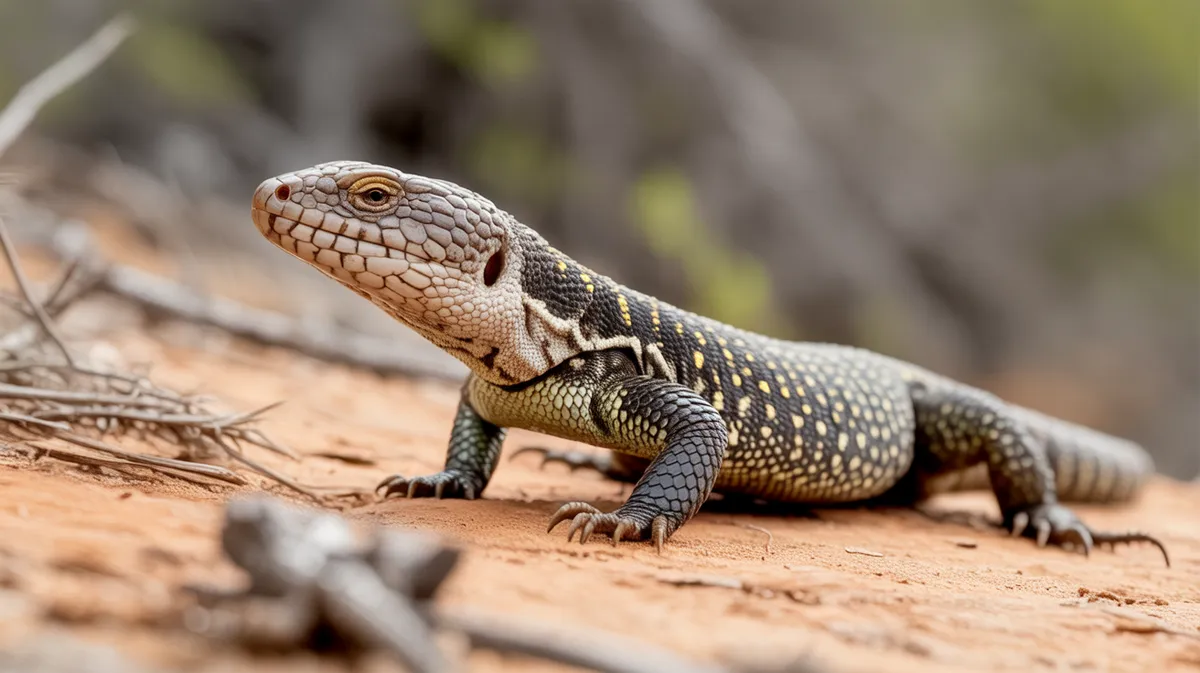
The Rio Fuerte Beaded Lizard is a large, venomous lizard native to northwestern Mexico. Characterized by its bead-like, bumpy skin and thick body, it sports a striking pattern of black with yellow or cream-colored bands and spots. This elusive reptile is primarily terrestrial and prefers arid or semi-arid environments, where it spends much of its time in underground burrows. The Rio Fuerte Beaded Lizard is slow-moving but can defend itself with a potent venom delivered through grooved teeth. It is closely related to the more widely known Gila monster but differs in range, coloration, and some behavioral aspects.
Fascinating facts
Venomous Bite
The Rio Fuerte Beaded Lizard delivers venom through grooves in its lower jaw, making its bite potentially dangerous to predators and humans.
Burrow Dweller
This lizard spends much of its life underground in burrows, emerging mainly in the early morning and late evening to avoid extreme heat.
Egg Eater
Its diet consists largely of bird and reptile eggs, as well as nestling mammals and reptiles, making it an important predator of nests.
Detailed description
The Rio Fuerte Beaded Lizard (Heloderma exasperatum) is a robust, heavy-bodied lizard reaching adult lengths of 60–90 cm (24–35 in) and weighing up to 2 kg (4.4 lbs). Its skin is covered in osteoderms—bony, bead-like scales that provide both armor and its distinctive texture. The coloration consists of a dark black or brown base, overlaid with irregular yellow or cream bands and spots, which serve as camouflage among leaf litter and rocky terrain. The head is broad and blunt, with powerful jaws and grooved teeth in the lower jaw that deliver venom via capillary action. This species is primarily terrestrial and spends a significant portion of its life in self-dug or abandoned mammal burrows, emerging mainly during the rainy season or cooler parts of the day. It is a solitary animal, with individuals maintaining exclusive home ranges except during the breeding season. The Rio Fuerte Beaded Lizard is a slow-moving ambush predator, relying on stealth and its potent venom rather than speed. Its diet is specialized, focusing on eggs (reptilian and avian), nestling birds, small mammals, and occasionally carrion. Adapted to arid and semi-arid environments, it can withstand long periods without food or water by storing fat in its tail and body. Its life history is characterized by slow growth, late sexual maturity (6–8 years), and remarkable longevity, often exceeding 30 years in captivity.
Did you know?
The Rio Fuerte Beaded Lizard can store fat in its tail, allowing it to survive long periods without food.
Research & sources
Behaviour & social structure
Heloderma exasperatum is primarily crepuscular, becoming active during dawn and dusk, though it may also be nocturnal during the hottest months. It spends up to 90% of its time underground, emerging to forage or bask. When foraging, it uses a highly developed sense of smell, flicking its forked tongue to detect prey, especially eggs buried underground. The lizard is a sit-and-wait predator, often raiding nests for eggs and young, and is capable of climbing low shrubs or trees in search of food. Social interactions are minimal, with adults displaying territorial behaviors and occasionally engaging in ritualized combat during the breeding season. Defensive behaviors include hissing, body inflation, and, if provoked, a venomous bite. Despite its fearsome reputation, it is generally docile and avoids confrontation.
Reproduction & life cycle
Breeding occurs in late spring to early summer, coinciding with the onset of the rainy season. Males engage in combat, wrestling for access to receptive females. Copulation is prolonged, often lasting over an hour. Females lay a single clutch of 2–13 leathery eggs in a burrow or concealed location, typically in June or July. Incubation is lengthy, lasting 7–8 months, with hatchlings emerging the following spring. There is no parental care post-oviposition; hatchlings are independent from birth and possess fully functional venom glands. Sexual maturity is reached at 6–8 years, reflecting the species’ slow life history strategy.
Adaptations & survival
The Rio Fuerte Beaded Lizard exhibits several adaptations for survival in harsh, arid environments. Its bead-like osteoderms provide protection against predators and reduce water loss. The ability to store fat in the tail and body enables it to survive long periods of food scarcity. Its venom, a complex mixture of proteins, serves both as a defense mechanism and as a means to subdue prey, particularly eggs and nestlings. The lizard’s low metabolic rate and reclusive behavior minimize water and energy expenditure. Its acute olfactory sense allows it to locate buried eggs, a critical food resource in its habitat. Additionally, its cryptic coloration and burrowing habits reduce predation risk.
Cultural significance
While less prominent in folklore than its relative, the Gila monster, the Rio Fuerte Beaded Lizard is sometimes featured in local myths as a dangerous or mystical animal. In some indigenous traditions, it is believed to possess supernatural powers or medicinal properties, though there is little evidence of widespread traditional use. Its striking appearance and rarity have made it a subject of fascination among herpetologists and wildlife enthusiasts. Conservation programs have begun to emphasize its ecological importance and the need for habitat protection.
Recent research
Recent research has focused on the composition and pharmacological properties of Heloderma exasperatum venom, which contains exendin-4, a peptide with potential applications in diabetes treatment. Genetic studies have clarified its relationship to other Heloderma species, confirming its status as a distinct species since its formal description in 2008. Ongoing field studies are investigating its population ecology, habitat use, and responses to environmental changes. Conservation efforts are increasingly collaborative, involving local communities in habitat restoration and anti-poaching initiatives. There is also growing interest in the species’ role as an indicator of ecosystem health in the dry forests of northwestern Mexico.
Sources
Systematics and Natural History of Mexican Beaded Lizards (Heloderma) with Description of a New Subspecies
Bezy, R. L., & Smith, H. M. (1972)
scientificHeloderma exasperatum: The IUCN Red List of Threatened Species 2019
IUCN SSC Amphibian and Reptile Specialist Group
conservationA revision of Heloderma (Squamata: Helodermatidae) with the description of a new species from western Mexico
Bezy, R.L., & Smith, H.M. (1972)
scientificHeloderma exasperatum: The IUCN Red List of Threatened Species 2019
IUCN SSC Amphibian and Reptile Specialist Group
conservationVideos
Habitat
Dry forests and thorn scrub of northwestern Mexico
 Arid Regions
Desert
Arid lands with minimal rainfall, extreme temperatures, and specialized wildlife adapted to harsh conditions.
 Elevated Terrain
Mountain
High-altitude environments with varying climates and specialized wildlife adapted to rugged terrain and thin air.
 Global
Forest
Wooded areas with significant tree cover and diverse plant and animal communities.
Conservation
The Rio Fuerte Beaded Lizard is currently classified as Near Threatened on the IUCN Red List.
Threats & challenges
The primary threats to Heloderma exasperatum include habitat destruction due to agricultural expansion, logging, and urbanization in northwestern Mexico. Illegal collection for the pet trade and local persecution, stemming from fear and misunderstanding of its venomous nature, also contribute to population declines. The species’ slow reproductive rate and low population densities make it particularly vulnerable to these pressures. Climate change, with its potential to alter precipitation patterns and reduce suitable habitat, poses an emerging threat. Current population trends are believed to be decreasing, and the species is classified as Near Threatened by the IUCN.
Taxonomy
Scientific name
Heloderma exasperatum
- Kingdom
- Animalia
- Phylum
- Chordata
- Class
- Reptilia
- Order
- Squamata
- Family
- Helodermatidae
- Genus
- Heloderma
- Species
- exasperatum
Community notes
Share your observations about the Rio Fuerte Beaded Lizard.
No community notes yet. Be the first!
Discover more wildlife
More fascinating animals from the encyclopedia.