
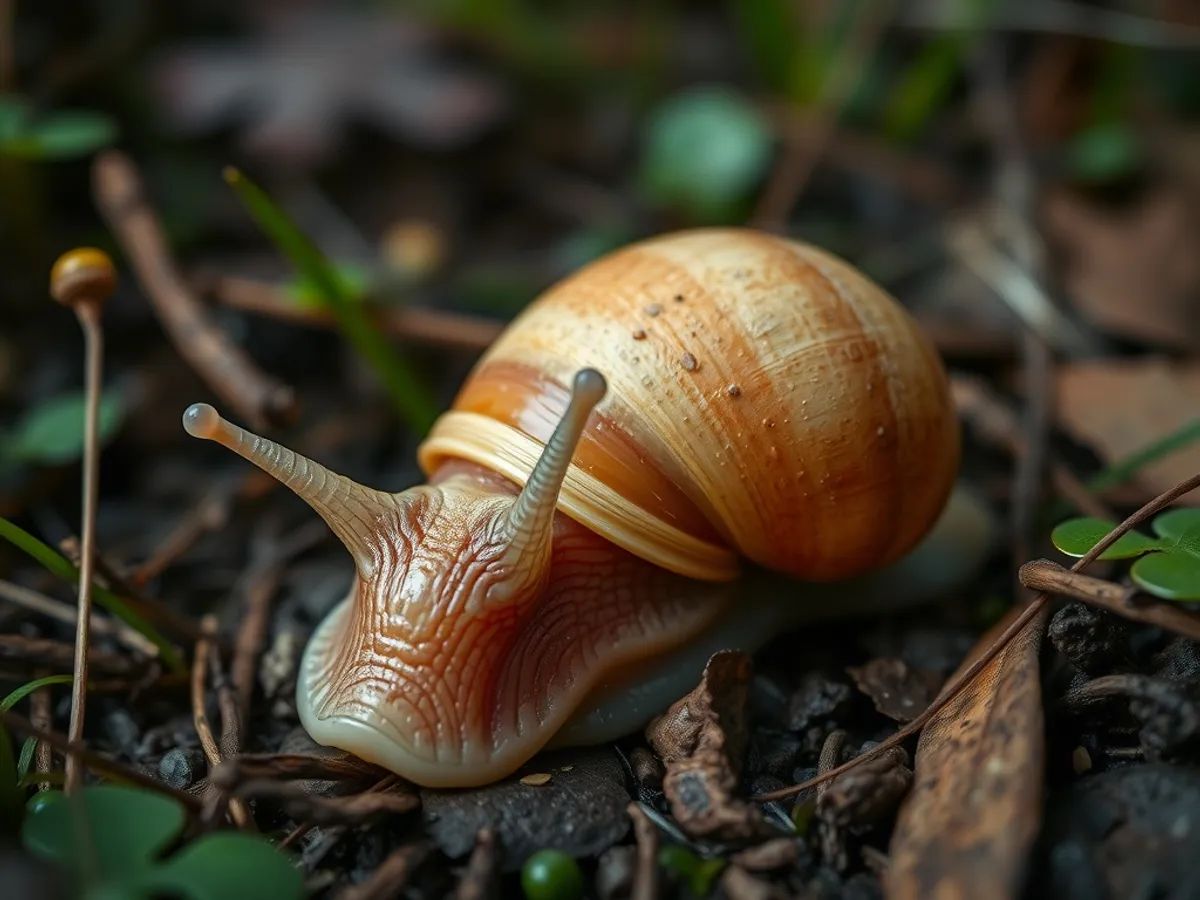
About the Rosy wolf snail
The rosy wolf snail is a large, predatory land snail native to the southeastern United States. Recognized for its elongated, pinkish-brown shell and agile movements, it preys primarily on other snails and slugs, making it an effective but controversial biological control agent. This species is notorious for its introduction to various islands, where it has contributed to the decline and extinction of many native snail species. Despite its beneficial use in some agricultural contexts, its spread has raised significant conservation concerns due to its impact on biodiversity.
Fascinating facts
Predatory Behavior
Unlike most snails, the rosy wolf snail is a voracious predator, feeding on other snails and slugs rather than plants.
Invasive Impact
Introduced to islands like Hawaii for pest control, it decimated native snail populations, leading to multiple extinctions.
Surprisingly Fast
This species is known for its relatively rapid movement, making it one of the fastest terrestrial snails.
Detailed description
The rosy wolf snail (Euglandina rosea) is a large terrestrial gastropod, typically measuring 60–100 mm in length, with a slender, elongated shell that is smooth, glossy, and varies in color from pale pink to brownish-rose. The shell is dextral (right-coiling) and comprises 6–7 whorls, with a pointed apex and a relatively narrow aperture. The soft body is similarly pinkish or grayish, with two pairs of tentacles—the upper pair bearing eyes. Euglandina rosea is renowned for its agility compared to other land snails, moving at speeds up to 8 mm/s, facilitated by a muscular, elongated foot. Its head is equipped with specialized chemoreceptors, allowing it to track prey by following mucus trails. This species is a voracious carnivore, primarily preying on other terrestrial gastropods, including both snails and slugs. It is solitary by nature, with individuals exhibiting territorial behavior and rarely interacting outside of mating. Reproduction is hermaphroditic, with reciprocal copulation and internal fertilization. Eggs are laid in moist soil, and juveniles hatch fully formed. The species is native to the southeastern United States but has been introduced to many Pacific and Indian Ocean islands, where it has become invasive. Its introduction has had severe ecological consequences, particularly for endemic snail fauna.
Did you know?
The rosy wolf snail has caused the extinction of dozens of native snail species in places where it was introduced as a biological control agent.
Research & sources
Wikipedia summary
Euglandina rosea, the rosy wolfsnail or cannibal snail, is a species of medium-sized to large predatory air-breathing land snail, a carnivorous terrestrial pulmonate gastropod mollusk in the family Spiraxidae.
Behaviour & social structure
Euglandina rosea exhibits highly specialized predatory behavior, actively hunting other land snails and slugs by following their mucus trails using chemoreceptors located on its lower tentacles. The snail employs a combination of tactile and chemical cues to locate prey, sometimes pursuing them for several hours. Upon contact, it uses its muscular foot to restrain the prey and its elongated, extensible buccal mass to consume the victim, often ingesting smaller snails whole or rasping larger prey with its radula. The species is primarily nocturnal or crepuscular, being most active during periods of high humidity or after rainfall. It is solitary, with little evidence of social interaction outside of mating. Territoriality is observed, as individuals may defend prime hunting grounds. The snail spends daylight hours concealed under leaf litter or logs to avoid desiccation.
Reproduction & life cycle
Rosy wolf snails are simultaneous hermaphrodites, possessing both male and female reproductive organs. Mating involves reciprocal copulation, typically occurring during the wet season when conditions favor egg survival. Courtship is brief, and copulation may last several hours. After mating, each individual can lay up to 25–40 oval, calcareous eggs in a shallow nest in moist soil or leaf litter. Incubation lasts 30–40 days, depending on temperature and humidity. There is no parental care post-oviposition; hatchlings are independent and begin hunting small gastropods immediately. Sexual maturity is reached within 6–12 months, and individuals may live up to 2–3 years in the wild.
Adaptations & survival
Euglandina rosea exhibits several adaptations for a predatory lifestyle. Its elongated, streamlined shell and body allow for greater mobility and access to narrow crevices where prey may hide. The lower tentacles are highly developed for chemoreception, enabling the snail to detect and follow the mucus trails of other gastropods with remarkable accuracy. The buccal mass and radula are adapted for grasping and consuming soft-bodied prey. Its relatively rapid movement for a land snail aids in both hunting and evasion of predators. The ability to aestivate during dry periods allows survival in fluctuating environments. Its hermaphroditic reproductive system increases the likelihood of successful mating encounters in low-density populations.
Cultural significance
The rosy wolf snail holds little traditional cultural significance but is notable in modern conservation history as a cautionary example of failed biological control. Its introduction and subsequent ecological impact are frequently cited in environmental science and policy discussions. The species has become symbolic of the unintended consequences of human-mediated species introductions.
Recent research
Recent research has focused on the ecological impacts of Euglandina rosea in non-native habitats, particularly its role in the extinction of Partulidae and Achatinellidae snails. Studies have also examined its chemosensory mechanisms, revealing sophisticated trail-following behavior mediated by specific olfactory cues. Ongoing research includes the development of barriers and management techniques to protect endangered native snails, as well as genetic studies to understand population structure and dispersal. The species is used as a model organism for studying gastropod predation and invasive species dynamics.
Videos
Habitat
Forests and woodlands, often in moist, shaded environments

Conservation
The Rosy wolf snail is currently classified as Least Concern on the IUCN Red List.
Threats & challenges
While Euglandina rosea is classified as Least Concern globally, its invasive populations pose significant threats to native gastropod biodiversity, especially on islands. Its introduction as a biological control agent for the giant African land snail (Lissachatina fulica) has led to unintended declines and extinctions of endemic snail species, particularly in Hawaii, French Polynesia, and other Pacific islands. The species itself faces few natural predators in introduced ranges, but habitat loss, pollution, and climate change may impact populations in its native range. Conservation challenges focus on mitigating its impact as an invasive species rather than protecting the snail itself.
Taxonomy
Scientific name
Euglandina rosea
- Kingdom
- Animalia
- Phylum
- Mollusca
- Class
- Gastropoda
- Order
- Stylommatophora
- Family
- Spiraxidae
- Genus
- Euglandina
- Species
- rosea
Community notes
Share your observations about the Rosy wolf snail.
No community notes yet. Be the first!
Discover more wildlife
More fascinating animals from the encyclopedia.